Published On:
March 2, 2026
Updated On:
March 2, 2026
Gurugram has officially overtaken Mumbai as India’s premier luxury real estate market in 2025, recording a staggering Rs 24,120 crore in high-end home sales. Driven by a desire for expansive living spaces, world-class amenities, and robust infrastructure, high-net-worth individuals and NRIs are fundamentally reshaping the nation's premium housing landscape.
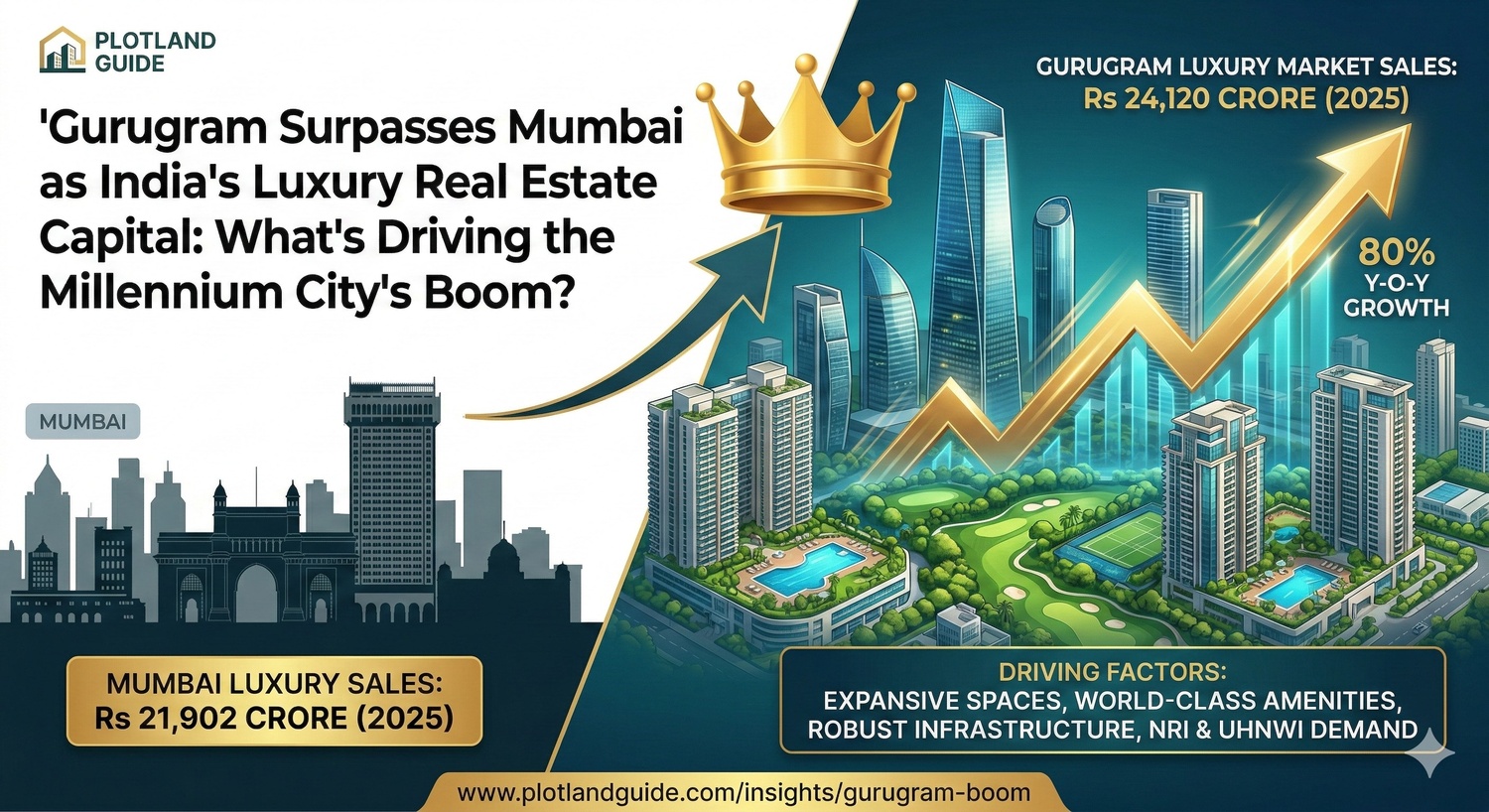
For decades, the narrative of Indian luxury real estate began and ended with Mumbai. The financial capital’s sea-facing promenades and exclusive southern pin codes were universally recognized as the ultimate status symbols for the country's elite. However, the real estate landscape has undergone a seismic structural shift. As of 2025, Gurugram has decisively eclipsed Mumbai to become the largest and fastest-growing luxury housing market in India.
The Millennium City is no longer just a corporate satellite hub; it is the absolute epicenter of wealth, lifestyle, and premium residential development. This transition reflects much more than just a change in geographical preference. It signifies an evolution in what affluent buyers value most, moving away from cramped prestige addresses toward expansive, amenity-rich, and community-driven living spaces.
The statistics from the 2025 calendar year highlight a market operating at unprecedented velocity. Gurugram recorded a monumental Rs 24,120 crore in transactions for homes priced at Rs 10 crore and above. This performance represents a staggering 80% jump from the previous year and completely outpaces Mumbai, which registered Rs 21,902 crore in the same ultra-premium category.
To understand the sheer scale of this acceleration, one only needs to look back a couple of years. In 2023, Gurugram saw a modest 155 homes sold in the Rs 10-crore-plus segment. Fast forward to 2025, and that number has skyrocketed to nearly 1,500 units—a nearly tenfold increase in volume in an incredibly short span. During the same 12-month period, Mumbai recorded 967 transactions in this elite bracket.
In terms of market share, ultra-luxury housing now accounts for roughly 24% of Gurugram’s entire residential market value. The average ticket size for a premium home in the city has settled around the Rs 16 crore mark, indicating a robust and sustained appetite for high-value assets. Total sales value for the region leaped from roughly Rs 4,000 crore in 2023 to over Rs 24,000 crore today. This extraordinary momentum has firmly cemented the city's position as the nation's primary hub for high-end residential growth, completely rewriting the hierarchy of India's property market.
The demographic driving this real estate boom is distinctly different from the traditional property investor of the past. The buyer profile is becoming noticeably younger, with highly discerning individuals in their early 30s actively entering the ultra-luxury space.
This momentum is heavily fueled by sustained wealth creation across the technology sector, start-up ecosystems, and financial services. The broader economic climate has played a massive role here. In recent times, robust capital formation—highlighted by over a hundred Indian corporate entities raising nearly $20 billion through mainboard IPOs—has generated an entirely new cohort of young founders, entrepreneurs, and senior corporate professionals. Flush with newfound liquidity, these individuals are funneling their wealth into premium real estate.
Simultaneously, there is a massive influx of interest from Non-Resident Indians (NRIs) and ultra-high-net-worth individuals (UHNIs). For the NRI demographic, Gurugram’s modern luxury developments offer a global lifestyle benchmark that aligns perfectly with the standards they are accustomed to overseas. They are not merely looking for a place to park their capital; they are seeking trophy assets that offer an uncompromising, world-class living experience.
The transition of the ultra-wealthy from Mumbai to the National Capital Region is largely driven by a practical evaluation of value, supply dynamics, and location advantages. Market analysts frequently point to the "space versus price" reality as the primary catalyst for this shift.
In upscale South Central corridors of Mumbai, such as Worli or Prabhadevi, staggering budgets often yield relatively compact living spaces due to the severe land constraints of the island city. Affordability, even for the ultra-rich, has become stretched. In stark contrast, the same financial investment in Gurugram unlocks sprawling, large-format estates. Buyers are trading constrained city apartments for massive residences situated within private golf courses, featuring Olympic-size pools, sprawling green landscapes, and low-density planning.
This dynamic has even sparked widespread discussions across digital forums and social media platforms, where young corporate executives debate the merits of modern gated townships versus traditional legacy neighborhoods. For many affluent families, an ultra-luxury high-rise in Gurugram offers practical lifestyle advantages that simply cannot be matched by independent bungalows in older, congested parts of the capital. Gated communities provide organized parking, enhanced multi-tier security, and immediate walking access to premium recreational facilities like tennis courts and clubhouses. More importantly, they offer curated social capital—a neighborhood of like-minded, successful residents. This community aspect is a major reason why buyers are increasingly choosing Rs 100-crore penthouses over standalone villas in traditional elite enclaves.
The phenomenal growth of Gurugram’s luxury real estate is not evenly distributed; it is heavily concentrated in rapidly emerging micro-markets that have benefited from massive infrastructure upgrades. The expansion is no longer confined to legacy addresses, as new growth corridors take the lead.
The Dwarka Expressway stands out as the undisputed leader of this structural expansion. Supported by large-scale premium project launches and transformative road connectivity, this micro-market witnessed a jaw-dropping surge in transaction value. Sales skyrocketed from a modest Rs 383 crore to an astonishing Rs 8,347 crore in a remarkably short timeframe.
Similarly, the Golf Course Extension Road has emerged as a major hotspot for affluent homebuyers. This corridor recorded an incredible rise in sales value, accompanied by sharp capital appreciation. Weighted average prices in this specific zone climbed significantly, moving from roughly Rs 24,800 per square foot to nearly Rs 38,000 per square foot.
While the traditional premium corridors like Golf Course Road continue to hold their prestige, they have seen slightly moderated sales activity simply due to a lack of fresh inventory. However, the overall infrastructure push—including seamless access to the international airport, the development of new expressways, and improved metro connectivity—has transformed previously peripheral zones into highly coveted premium enclaves.
What exactly does a Rs 16 crore to Rs 50 crore home look like in today’s market? The definition of luxury has evolved far beyond imported marble and expensive fixtures. Today’s buyers demand an integrated ecosystem that guarantees privacy, wellness, and effortless living.
In the current market, expansive residential units averaging around 5,000 square feet completely dominate demand. Data indicates that homes falling within the 4,000 to 6,000 square foot category account for more than half of the total transaction value in the city. Interestingly, properties exceeding 8,000 square feet contributed nearly 22% of the overall sales value. This highlights a clear willingness among buyers to pay a massive premium for scale and exclusivity.
Modern ultra-luxury projects in the city are designed as master-planned ecosystems. They feature wellness zones with spas and yoga decks, smart home automation, sustainable architectural designs, and concierge services that rival five-star hospitality brands. Recent benchmark-setting transactions perfectly illustrate the ceiling of this market. In one notable deal, a highly prominent global insurance executive purchased a sprawling 7,400-square-foot introductory apartment for an astonishing Rs 85 crore. This specific transaction established a new high-water mark for the region, pushing the per-square-foot rate to nearly Rs 1.10 lakh—a figure that directly rivals the most expensive neighborhoods in Mumbai.
Furthermore, several Mumbai-based real estate developers, recognizing the shifting tides, are now actively acquiring land parcels in Gurugram. Drawn by the availability of expansive land—a luxury practically nonexistent in Mumbai—these developers are eager to tap into a market where premium projects frequently sell out within days of their initial launch.
With such explosive growth, a critical question naturally arises: Can the Millennium City sustain this unprecedented demand, or is the market edging toward a potential bubble?
Industry observers and real estate strategists remain cautiously optimistic, noting that the market is entering a phase of maturation. The ultra-luxury tier—specifically properties priced at Rs 50 crore and above—is currently transitioning into a normalization phase. Sales are experiencing a slight cool-off period following the initial frenzy. However, demand in this highly exclusive segment is expected to remain incredibly resilient as long as supply is tightly controlled. Ultra-high-net-worth buyers treat these properties as limited-edition trophy assets rather than speculative inventory. Because these homes are often held for the long term by families and investors who value the cohesive lifestyle, sudden market crashes in this specific tier are highly unlikely.
Conversely, the broader Rs 10-crore to Rs 20-crore segment may face some headwinds. The market has seen a substantial influx of new supply over the past two years. While this inventory has been successfully absorbed so far, continuous high-volume launches could potentially dilute the scarcity premium that initially drove up prices. If the supply pipeline is not carefully managed, there could be a moderation in sales velocity and limited capital growth in this specific bracket. Investors who previously engaged in speculative buying are now treading with more caution, leaving the market largely driven by genuine end-users and long-term UHNI buyers.
Nevertheless, the overarching sentiment remains highly positive. As long as developers continue to prioritize prime locations, superior construction quality, and amenity-rich environments, the absorption rates are expected to hold steady.
Gurugram’s ascent to the top of India’s luxury real estate ladder is a testament to the city's remarkable transformation. It has successfully capitalized on the changing preferences of the modern wealthy demographic, offering a compelling blend of expansive living, world-class infrastructure, and vibrant community life.
By surpassing Mumbai in high-value property transactions, the city has proven that the definition of a premium address in India has officially been rewritten. The focus has decisively shifted from legacy pin codes to master-planned luxury ecosystems that cater to a global standard of living. As wealth creation in India continues on an upward trajectory, fueled by technological innovation and entrepreneurial success, Gurugram stands perfectly positioned to remain the undisputed king of the nation's ultra-luxury residential market for the foreseeable future.
