Published On:
August 29, 2026
Updated On:
August 29, 2026
The newly proposed Rs 140-crore underpass on the Gurugram-Sohna Highway is set to directly link Sectors 66-67 with Sectors 68-69, bringing major traffic relief to the Southern Peripheral Road and benefiting over 17 fast-growing sectors. By offering a direct cross-highway route, this infrastructure upgrade aims to bypass existing bottlenecks and significantly enhance the daily commute and real estate landscape in New Gurugram.
The National Capital Region is constantly evolving, and Gurugram remains at the absolute epicenter of this rapid urban expansion. For years, the city has been expanding southward and westward, transforming once-empty stretches into bustling commercial hubs and premium residential corridors. However, this explosive growth has brought along a familiar urban challenge: severe traffic congestion and the fragmentation of neighborhoods divided by massive arterial highways.
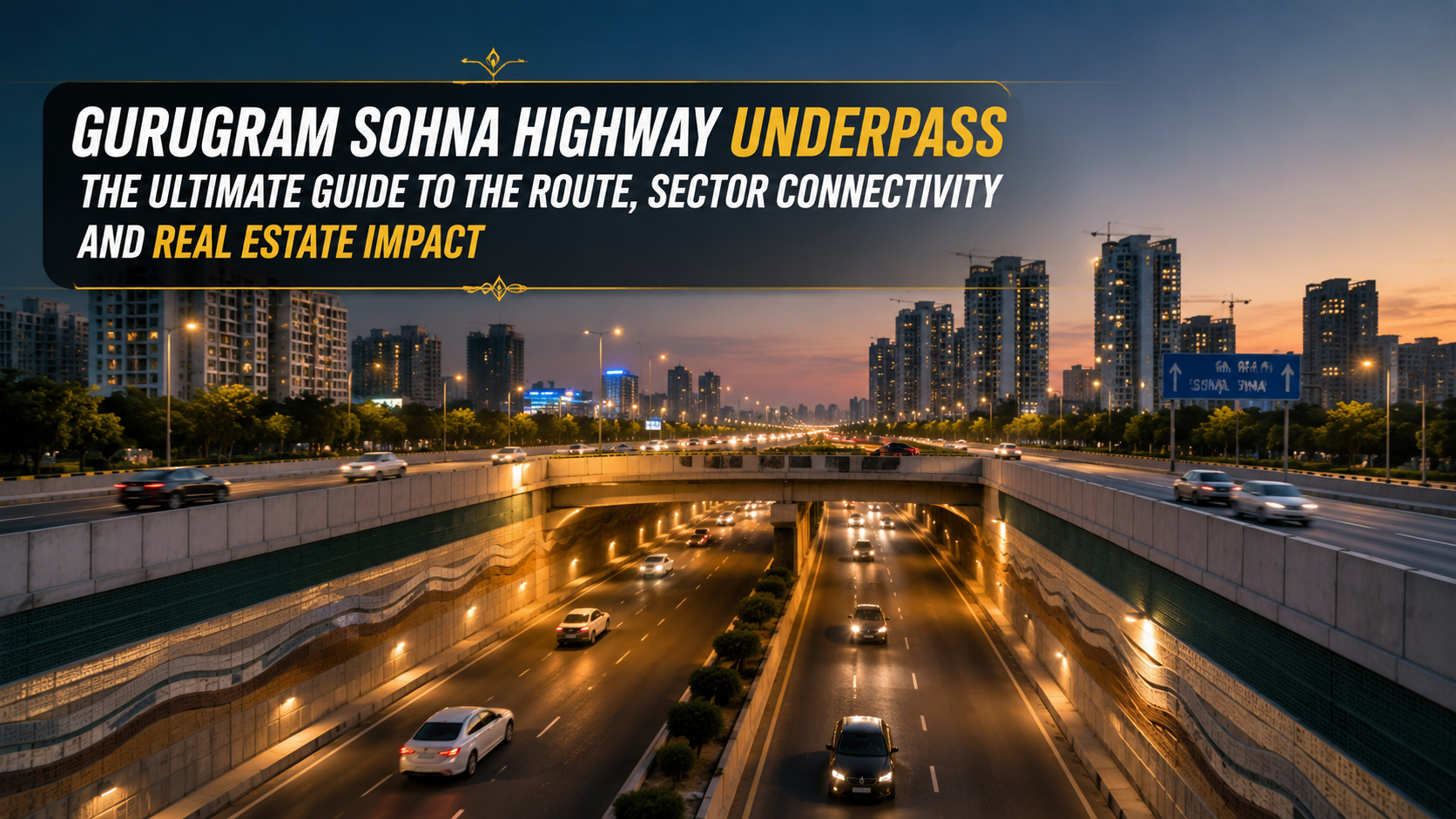
To bridge these gaps, local civic authorities are continuously conceptualizing new infrastructural solutions. The latest mega-project creating a massive buzz among daily commuters and real estate investors alike is the newly proposed underpass on the Gurugram-Sohna Highway, officially known as NH-248A. Designed to seamlessly connect the master roads of Sectors 66 and 67 with Sectors 68 and 69, this underpass is not just a concrete structure; it is a vital urban stitch meant to weave together fragmented parts of the city.
For anyone navigating the notorious peak-hour traffic of Gurugram, or for those tracking property investments in the region, understanding the exact route, the sectors involved, and the underlying challenges of this project is crucial.
At its heart, the proposed underpass aims to solve a highly localized but incredibly frustrating problem. Currently, the Gurugram-Sohna Highway acts as a massive physical barrier separating the fast-developing sectors on its eastern and western flanks. If a resident of Sector 66 wants to drive across to Sector 68, they cannot simply cross the highway. Instead, they are forced to merge into the heavy, fast-moving traffic of NH-248A, drive towards a major junction, take a U-turn or navigate a congested roundabout, and then enter their destination sector.
The new underpass will eliminate this exhausting detour. It is designed to pass directly beneath the Gurugram-Sohna Highway, perfectly aligning the master road on the Sector 66-67 side with the master road on the Sector 68-69 side. This creates a straightforward, cross-highway local transit option.
Spearheaded by the Gurugram Metropolitan Development Authority, the project is currently in its advanced proposal stages. Financial estimates for the construction are tentatively pegged between Rs 140 crore and Rs 145 crore. The final capital outlay will ultimately depend on detailed engineering assessments, structural investigations, and the complex process of shifting underground utilities like water pipelines and optical fiber networks.
The civic body is modeling this new infrastructure on the highly successful Vatika Chowk underpass. The goal is to construct a robust, high-capacity subterranean route that can handle the heavy influx of local commuter traffic, school buses, and commercial delivery vehicles, completely isolating them from the high-speed intercity traffic zooming above on the Sohna Highway.
To fully appreciate the necessity of this underpass, one must look at the current traffic dynamics of the region. Right now, the burden of east-west local movement falls almost entirely on the Southern Peripheral Road and the Golf Course Extension Road. Commuters heavily rely on these massive corridors and the existing Vatika Chowk underpass for movements that are geographically quite short but logistically complicated.
During morning and evening peak hours, the Vatika Chowk underpass and the Badshahpur intersections witness massive traffic snarls. Thousands of vehicles from nearby residential condominiums funnel into these choke points simply because they have no direct way to cross the Sohna Highway.
Once the new Sector 66-69 underpass becomes operational, it will fundamentally alter these traffic patterns. By providing a dedicated corridor for local sector-to-sector transit, the underpass will siphon off a massive volume of vehicles from the SPR. The daily commuter traveling between the Sector 58-67 belt and the Sector 68-80 belt will no longer need to clog the main highway intersections. Furthermore, travelers heading towards Sohna or the Delhi-Mumbai Expressway will experience a smoother, uninterrupted drive on the surface, as local cross-traffic will be entirely routed underground.
Every time a major road or transit link is announced in Gurugram, the real estate market reacts. This proposed underpass is particularly significant because it impacts one of the most dense and rapidly appreciating residential belts in the city.
While the immediate connection points are Sectors 66, 67, 68, and 69, the ripple effects of this connectivity upgrade will be felt across a much wider radius. Civic reports suggest that residential societies, commercial plazas, and colonies across at least 17 adjoining sectors stand to benefit immensely. Prominent sectors such as 70, 70A, 75, and 76 will see a drastic improvement in their accessibility.
For real estate investors and prospective homebuyers, this belt has always been highly attractive due to its proximity to the Golf Course Extension Road and the Aravalli foothills. The region boasts a dense concentration of luxury apartments, premium gated communities, and bustling retail hubs. However, the lack of seamless internal connectivity has often been a sticking point for end-users comparing properties in this micro-market.
The promise of the new underpass adds a massive premium to the livability index of these sectors. A family residing in Sector 68 will soon find that accessing top-tier schools, hospitals, and high-street retail zones located in Sector 66 and beyond is just a swift, five-minute drive through the underpass, rather than a frustrating thirty-minute ordeal in bumper-to-bumper traffic.
While seasoned investors know better than to expect an overnight spike in property prices purely based on a proposal, the long-term capital appreciation prospects are undeniable. For anyone shortlisting properties in New Gurugram, the future trajectory of this cross-highway link is a critical factor to keep firmly on the investment checklist.
While the grand vision of the underpass is compelling, it is crucial to understand that a bridge or an underpass is only as useful as the roads leading up to it. In this specific case, the underpass proposal is actually part of a larger, two-pronged infrastructure puzzle.
On the western side of the highway, there is an ongoing road project aimed at filling a critical missing link between Sectors 68 and 69. This separate initiative, valued at approximately Rs 26.83 crore, involves the construction of a missing road section and adjoining service lanes. Once this one-year construction contract is completed, the approach roads on the western flank will be ready to funnel traffic seamlessly into the future underpass.
However, the situation on the eastern side—specifically the master road dividing Sectors 66 and 67—is far more complicated and represents a classic urban planning hurdle. The main arterial road in this zone has reportedly remained incomplete for nearly 15 years. The delay is not due to a lack of funds, but rather severe right-of-way issues.
The proposed alignment of the Sector 66-67 road runs directly into a series of deeply entrenched physical and historical obstacles. Right in the middle of the planned path sits a century-old historical stepwell, alongside a cluster of established residential houses and an active government school. Acquiring this land, preserving or bypassing the heritage structure, and relocating the school and residents has proven to be an administrative nightmare.
This ground reality is vital for setting realistic expectations. The underpass cannot function at full capacity until the master road on the Sector 66-67 side is fully cleared, paved, and integrated. Therefore, while the underpass approval is a massive step forward, the actual on-ground timeline will heavily depend on resolving these decade-old land alignment issues.
Infrastructure projects in a densely populated region like Gurugram involve a complex web of multiple government agencies, and this underpass is no exception. Because the Gurugram-Sohna Highway is officially categorized as National Highway 248A, the land directly beneath it falls under the jurisdiction of the National Highways Authority of India.
While the local metropolitan development authority is spearheading the design, funding, and execution of the underpass, they cannot lay a single brick without explicit permission from the national highway body. The civic authority must submit highly detailed structural blueprints to ensure that the tunneling work does not compromise the structural integrity of the active highway above.
Once the local authorities grant internal financial approvals, the next immediate phase will involve securing this crucial right-of-way clearance. Furthermore, the project timeline—which is optimistically projected at 18 months post-approval—will heavily depend on the speed of utility shifting. Relocating high-tension electrical cables, massive storm water drains, and critical telecommunication lines without disrupting existing city services is a meticulous process that often dictates the pace of heavy construction.
It is helpful to view the Gurugram-Sohna Highway underpass not as an isolated project, but as a critical piece of a much larger, city-wide infrastructure overhaul. The local development authorities are aggressively pushing a multi-tiered strategy to decongest the entire southern and eastern peripheral grid of the city.
Just a few kilometers away, massive upgrades are being planned for the Vatika Chowk cloverleaf and the Southern Peripheral Road itself. Designs for elevated stretches and multi-level trumpet flyovers are in the works to allow uninterrupted traffic movement from Faridabad Road, Golf Course Road, and the Dwarka Expressway. Similarly, plans are actively being drafted for new underpasses near the Millennium City Centre metro station and upgrading the vital corridor stretching from Iffco Chowk to the SPR.
The new Sector 66-69 underpass acts as a local pressure release valve within this massive macro-network. While the elevated expressways and cloverleafs will handle the heavy, inter-state and inter-city transit, this underpass will ensure that the internal, neighborhood-level traffic remains fluid and separate.
The announcement of the new Gurugram-Sohna Highway underpass is undoubtedly one of the most promising infrastructural developments for New Gurugram in recent years. It tackles a very real, everyday problem faced by thousands of commuters who lose precious hours navigating disjointed sectors. By finally bridging the gap between Sectors 66-67 and Sectors 68-69, the project promises to democratize access, reduce fuel consumption, lower localized pollution at traffic junctions, and vastly improve the overall quality of life for residents in over 17 adjoining sectors.
However, tempered optimism is required. The grand vision is tethered to the very real challenges of land acquisition, heritage preservation, and multi-agency coordination. The incomplete master road on the Sector 66-67 side remains the largest hurdle to the project's ultimate success.
For the daily commuter, the underpass represents the dream of a five-minute neighborhood transit replacing a thirty-minute highway detour. For the real estate investor, it is a glaring signal that the micro-markets along this stretch of the Sohna Highway are poised for a massive connectivity upgrade. As the authorities navigate the red tape, secure the necessary approvals, and finally begin the heavy digging, the entire region waits with bated breath for the day the east and west sides of the Gurugram-Sohna Highway are finally connected.
