Published On:
September 27, 2026
Updated On:
September 27, 2026
A recent intervention by the Gurugram district registrar mandates that residents of Economically Weaker Section (EWS) units in a Sector 110 housing society must be granted full access to common parks and pathways, sparking a broader debate over maintenance contributions, RWA bylaws, and the realities of inclusive urban planning in luxury real estate.
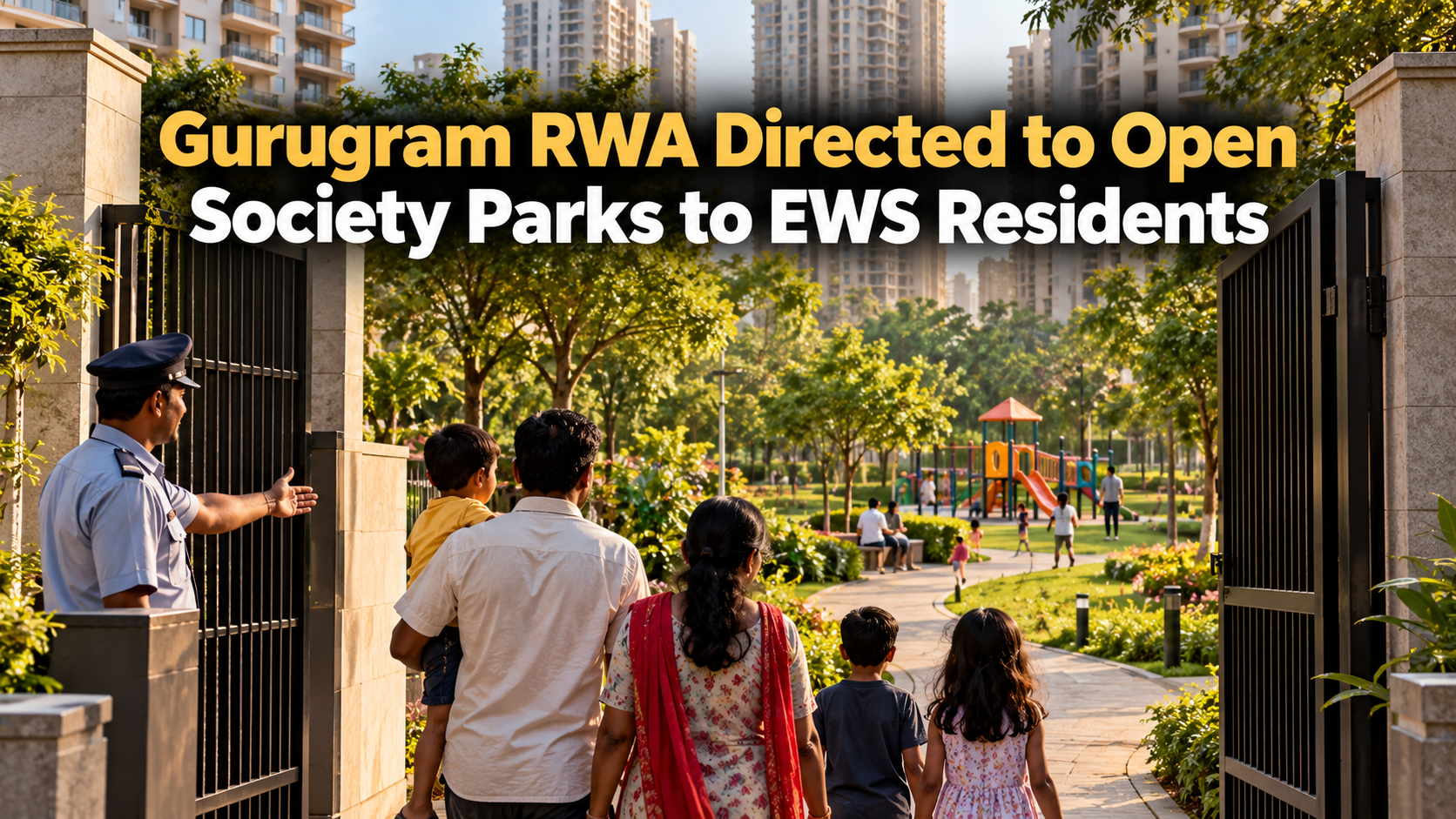
The skyline of Gurugram represents the pinnacle of modern Indian real estate, defined by sprawling luxury condominiums, state-of-the-art clubhouses, and meticulously manicured green spaces. However, within the secure perimeters of these gated communities, a complex socio-economic dynamic is constantly at play. The integration of Economically Weaker Section (EWS) housing within premium residential projects has long been a mandate of urban planning policies aimed at fostering inclusive living. Yet, the practical execution of this policy often leads to friction, raising difficult questions about the financial maintenance of shared amenities and the fundamental rights of marginalized residents.
A recent incident in a prominent housing complex in Sector 110 has brought this long-standing issue to the forefront. The local administration was forced to step in after allegations of discriminatory practices surfaced, resulting in a landmark directive that could set a precedent for how resident welfare associations across the National Capital Region handle the integration of subsidized housing units.
Understanding the nuances of this conflict requires looking beyond a single dispute. It demands a closer examination of housing regulations, the financial burden of facility management, and the ongoing struggle to harmonize distinct economic realities within a shared residential boundary.
The controversy centers around a well-known residential society in Sector 110, Gurugram, which comprises a mix of 599 standard luxury apartments and 141 units specifically designated for the economically weaker sections. The architecture of such societies is designed to accommodate the government's inclusive zoning requirements, ensuring that affordable housing is built alongside premium developments rather than being pushed to the extreme peripheries of the city.
The structural harmony on paper, however, did not translate to operational harmony on the ground. The conflict escalated late last month when a seventy-year-old resident of the EWS block, alongside his wife, attempted to access the society’s central park for their evening routine. They were allegedly intercepted by the estate's security personnel and members of the local resident welfare association, who explicitly barred them from entering the recreational green space.
The grievances extended beyond the park. The senior citizen reported that the specific parking zones originally demarcated for the subsidized housing block had been systematically encroached upon, with a temporary shed constructed over the area, effectively stripping the marginalized residents of their designated vehicle space. Furthermore, there was a blanket restriction placed on their use of internal roads and common pathways, physically restricting their movement to a confined corner of the expansive property.
Feeling marginalized and subjected to unfair treatment in their twilight years, the couple decided to escalate the matter. They approached the local authorities through a Samadhan Shivir, a dedicated public grievance redressal mechanism designed to offer swift administrative resolutions to citizens.
The grievance caught the immediate attention of the Gurugram deputy commissioner, who recognized the gravity of the allegations. The matter was swiftly forwarded to the district registrar of firms and societies, the governing authority that oversees the functioning and legal compliance of resident welfare associations in the region.
Following a review of the complaints and multiple visits by the aggrieved couple to the registrar's office, the administration took a firm stance against the exclusionary practices. By the middle of September, an official directive was issued to the housing complex's managing committee. The mandate was unequivocal: the association, its office-bearers, and the private security staff were strictly instructed to cease any restrictions placed on the subsidized housing residents regarding the use of common internal infrastructure.
The ruling emphasized a humanitarian and fundamental rights perspective. The district registrar noted that access to open green spaces and parks is essential for peaceful recreation, access to fresh air, and general health maintenance, particularly for senior citizens. More importantly, the administration issued a stern warning against any form of discriminatory policing, intimidation, or misbehavior by the estate management toward the minority block.
This swift administrative action highlights a growing intolerance among civil authorities for the physical segregation of residents within a single licensed residential colony. It reinforces the principle that while financial contributions to society coffers may differ, basic human dignity and access to essential environmental amenities cannot be compromised.
While the administrative order paints a picture of necessary social justice, the perspective of the resident welfare association reveals the intricate financial and legal complexities of managing a large-scale real estate asset. The association leadership strongly contested the allegations of arbitrary discrimination, framing their actions strictly within the boundaries of government-approved bylaws and the basic economics of facility management.
The core of the association's defense lies in the stark disparity in maintenance contributions. The management highlighted that the owners of the standard premium apartments are currently paying upwards of eleven thousand rupees every single month toward the upkeep of the society. These funds are pooled to maintain the manicured lawns, pay for round-the-clock specialized security, manage the internal road infrastructure, and power the common area lighting.
In contrast, the residents of the subsidized units pay a nominal, minimum maintenance charge. From the perspective of the regular flat owners, the premium amenities are essentially private assets funded entirely by their heavy monthly financial burdens. The association argues that because the marginalized block does not contribute to the capital or operational expenditure required to develop and maintain these specific common areas, they inherently do not possess a legal or moral stake in utilizing them.
Furthermore, the structural governance of the complex was brought into question. The association leadership pointed out that the established bylaws, which have been ratified by the relevant government bodies, explicitly prevent owners of subsidized units from becoming voting members of the RWA. They argue that the district registrar's sweeping directive to open all internal spaces oversteps the jurisdictional mandate of the office, effectively overriding the legally binding documents that govern the private property.
Determined to protect the financial interests of the primary contributors, the association is already preparing to mount a robust legal challenge against the registrar's order, planning to appeal to higher appellate authorities in Chandigarh.
To truly grasp why this conflict in Gurugram is not an isolated incident, one must look at the broader framework of real estate development in Haryana. The Town and Country Planning department mandates that developers of group housing colonies must reserve a specific percentage of their total built-up area or total units for economically weaker sections. This policy was designed with the noble intention of preventing the creation of urban slums and ensuring that service personnel, domestic workers, and lower-income families have access to safe, regulated housing within the city fabric.
Developers comply with these regulations to secure their building licenses. The subsidized units are constructed and typically handed over at highly controlled, below-market rates. However, the regulatory framework often falls agonizingly short when it comes to the post-possession phase.
While the laws mandate the physical construction of mixed-income housing, they remain largely ambiguous about the integration of these communities. There is no rigid, universally applied legislative framework detailing exactly how the operational costs of shared amenities should be divided, or whether a developer is obligated to build entirely separate recreational facilities for the subsidized blocks.
This policy gap leaves the heavy lifting of social integration to the developers and, eventually, to the resident welfare associations. When a builder hands over the reins of a society to an RWA, the association inherits a structurally fractured community. The premium buyers, who invested heavily based on glossy brochures promising exclusive lifestyles and private parks, suddenly find themselves expected to subsidize the recreational facilities of a neighboring demographic.
For estate managers and facility management companies operating in the National Capital Region, navigating these dual-structured societies is a daily tightrope walk. The physical layout of many modern condominiums subtly encourages segregation. Often, the subsidized towers are relegated to the extreme corners of the plot, featuring separate entry and exit gates. This architectural distancing is highly preferred by developers as it allows them to market the primary towers as exclusive and insulated.
However, when shared infrastructure like central parks, main arterial driveways, or primary utility nodes are involved, friction is inevitable. Facility managers are caught between the aggressive demands of the primary RWA members, who sign their paychecks, and the legal rights of the subsidized residents, who are protected by basic civil laws and municipal regulations.
When an RWA decides to strictly enforce exclusionary rules, it often falls upon the on-ground security guards to act as enforcers, leading to the kind of discriminatory policing that the district registrar recently condemned. The security staff is forced to manually identify and restrict a specific class of residents, creating a hostile living environment that completely defeats the purpose of inclusive urban planning.
The impending legal battle in Chandigarh over the Sector 110 dispute will be closely watched by developers, investors, and resident associations across Haryana. If the appellate authorities uphold the district registrar's order, it will send a definitive message that exclusionary bylaws drafted by private associations cannot supersede the fundamental rights of residents to access common green spaces and essential internal infrastructure.
Such a ruling could force a massive operational shift in how luxury real estate is managed. Resident associations may be forced to re-evaluate their maintenance models, potentially seeking ways to create tiered access systems that rely on electronic authentication rather than physical intimidation. Alternatively, it might push current and future developers to completely redesign their master plans, ensuring that subsidized housing blocks are provided with their own dedicated, proportional green spaces and basic amenities right from the inception stage, thereby eliminating the need for shared access and the ensuing financial disputes.
On the other hand, if the RWA successfully argues that their government-approved bylaws protect their right to restrict access based on financial contribution, it could validate the physical segregation within gated communities. This would allow premium societies to legally wall off their parks and luxury amenities, effectively creating a city-within-a-city where movement is dictated strictly by one's ability to pay the monthly maintenance invoice.
The Real Estate Regulatory Authority (RERA) also plays a crucial role in this evolving landscape. While RERA strictly defines common areas and mandates transparent handover processes, the localized interpretation of who gets to use a park remains a gray area that desperately requires clarification through legislative amendments rather than case-by-case administrative firefighting.
The situation unfolding in Gurugram serves as a vital case study in the growing pains of rapid, mandated urban integration. It highlights a critical flaw in the lifecycle of real estate development: the assumption that diverse economic groups can seamlessly share private infrastructure without a clear, legally binding framework for cost-sharing and access.
As the National Capital Region continues to expand vertically, the density of these mixed-income micro-cities will only increase. To prevent every housing complex from turning into a battleground over park access and pathway usage, policymakers must step in to bridge the gap between the idealistic goals of affordable housing allocation and the harsh financial realities of luxury facility management.
Until standard operating procedures are clearly defined at the state level, the responsibility falls on the shoulders of developers to design smarter, self-sufficient layouts, and on resident associations to balance their financial pragmatism with a degree of community empathy. The outcome of this specific dispute will likely echo through the corridors of urban planning for years to come, shaping the social fabric of gated communities and redefining what it truly means to share a neighborhood in the modern Indian city.
