Published On:
January 29, 2026
Updated On:
January 30, 2026
A significant trend is sweeping Gurugram's real estate market in 2026: buyers are increasingly favoring independent floors over high-rise apartments. Driven by a desire for privacy, faster possession timelines (12-18 months), and upgraded amenities like private elevators and gated security, low-rise living is becoming the new gold standard in the city.
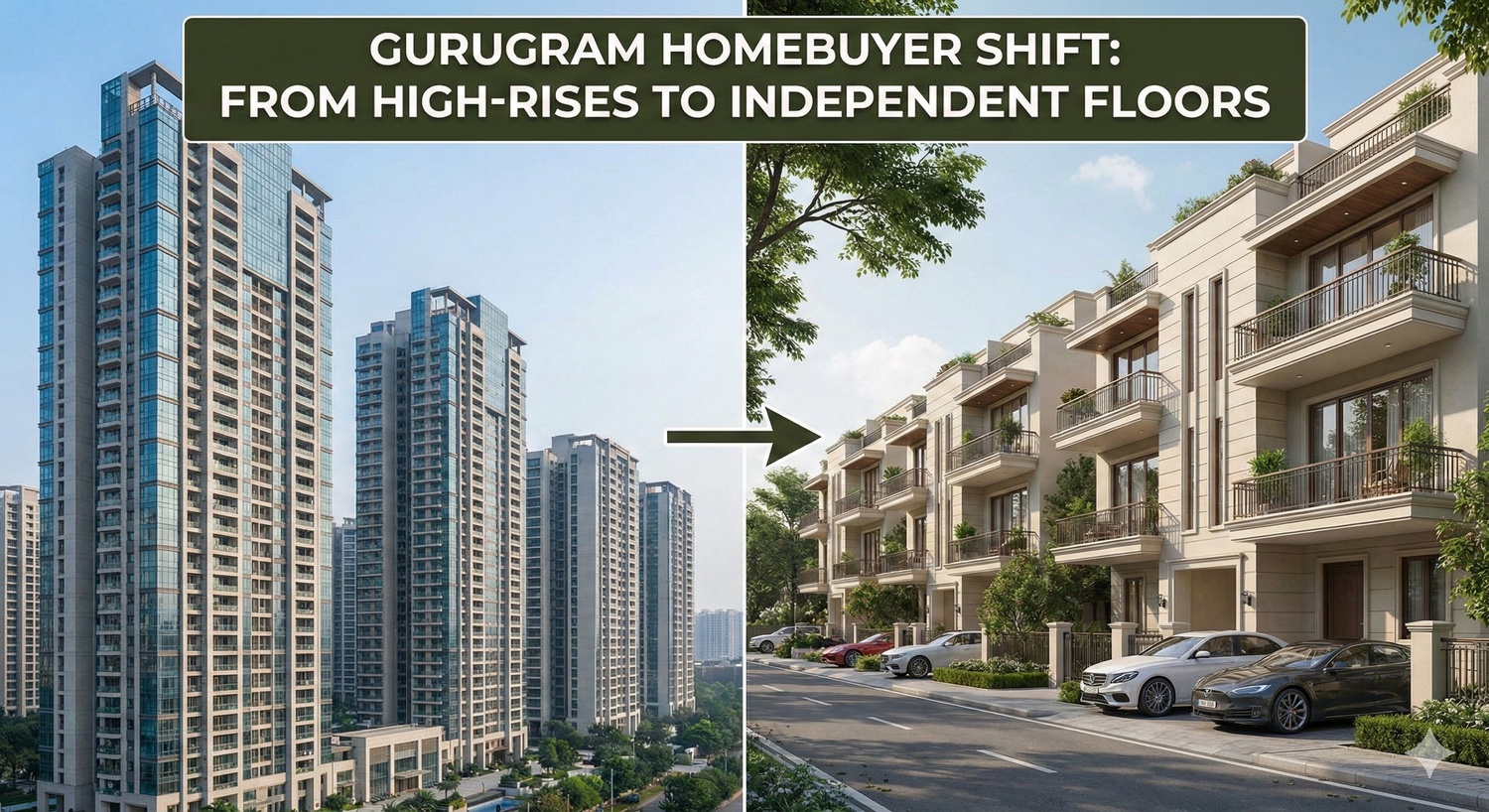
For nearly two decades, the image of Gurgaon (Gurugram) has been synonymous with glass-facade skyscrapers piercing the sky. The Millennium City built its reputation on vertical ambition, with high-rise condominiums becoming the default aspiration for the upwardly mobile middle class. However, as we move through the mid-2020s, a quiet but powerful revolution is taking place at the ground level. The real estate narrative is shifting from "higher is better" to "privacy is paramount."
A growing wave of homebuyers and savvy investors are turning away from the 30th-floor apartment in favor of independent floors. This isn't just a nostalgic return to the "kothi" culture of the past; it is a modern, strategic pivot driven by post-pandemic lifestyle changes, investment mathematics, and a desire for low-density living. This comprehensive guide explores why independent floors have become the new gold standard in Gurgaon’s property market and what this means for your portfolio.
To understand the rise of independent floors, one must first look at the growing fatigue associated with high-rise living. For years, the high-rise apartment was the ultimate status symbol, promising a "resort-like" life with swimming pools, clubhouses, and panoramic views. While these amenities remain attractive, the lived reality for many has been different.
The defining characteristic of a high-rise society is density. A single project can house thousands of families. This density translates into practical friction points: waiting for elevators during rush hour, crowded swimming pools, jammed parking basements, and a general lack of personal space in common areas. The post-pandemic world has made buyers hyper-aware of "personal bubbles." The allure of a shared lobby has been replaced by the desire for a private entrance. Independent floors, typically built on plot sizes of 200 to 500 square yards with a Stilt + 4 structure, inherently offer a low-density environment. Instead of sharing a building with 400 families, you are sharing it with three or four.
One of the most compelling arguments driving buyers toward independent floors is the connection to the land. When you buy an apartment on the 15th floor of a high-rise, your ownership of the underlying land is negligible—a tiny fraction of the total project area. You essentially own the air space between your walls.
In contrast, purchasing an independent floor comes with a significant "Undivided Share of Land" (UDS). While you don't own the plot exclusively (unless you buy all four floors), your proportionate share of the land is substantial. In the long run, buildings depreciate, but land appreciates. This high land component acts as a solid hedge against inflation and ensures that the asset retains intrinsic value even as the structure ages. For the traditional Indian investor who believes "land is gold," the independent floor bridges the gap between an apartment and a villa.
In the world of real estate investment, time is money. This is where independent floors currently hold a massive advantage over high-rise projects.
Constructing a high-rise township is a gargantuan engineering and logistical feat. From excavation to the final Occupancy Certificate (OC), a typical high-rise project in Gurgaon takes anywhere from 48 to 72 months (4 to 6 years) to complete. For an end-user paying both rent and EMI, this waiting period is a financial bleed. For an investor, it means capital is locked in for half a decade before any rental yield kicks in.
Independent floors flip this script. A low-rise building can be constructed and finished in 12 to 18 months. This "turnaround velocity" is incredibly attractive.
Historically, "builder floors" had a mixed reputation. They were often associated with small-time local contractors, inconsistent construction quality, and a lack of amenities. You bought a floor for space, but you gave up on the safety and lifestyle of a gated society.
That paradigm has been shattered. The market has witnessed the entry of Grade-A developers into the plotted and low-rise development space. Companies that previously only built skyscrapers are now launching "luxury independent floors" that offer the best of both worlds.
The modern independent floor project in Gurgaon is often part of a larger, gated township. This "hybrid" model addresses the biggest historical drawback of builder floors: security and amenities.
No analysis of the Gurgaon floor market is complete without mentioning the policy tailwinds, specifically the Deen Dayal Jan Awas Yojna (DDJAY). This Haryana government scheme was designed to encourage high-density plotted colonies and affordable housing in low and medium-potential towns.
While aimed at affordability, DDJAY sparked a frenzy of plotted developments in New Gurgaon, Sohna, and along the Dwarka Expressway. It allowed developers to build floors on smaller plots (up to 150-180 sq yards) with separate registration for each floor. This democratization of the "floor" market meant that owning an independent floor was no longer the exclusive preserve of the ultra-wealthy buying 500-yard plots in DLF Phase 1 or 2. It opened the market to the upper-middle class, creating a surge in supply and demand for "boutique" living spaces.
The migration from high-rises to floors is not uniform across the city. It is concentrated in specific micro-markets where infrastructure supports low-density expansion.
This corridor has emerged as the premium hub for luxury independent floors. With land prices skyrocketing, developers have utilized low-rise formats to offer ultra-luxury specifications—Italian marble, VRV air conditioning, and smart home automation—at a price point that rivals premium apartments.
As the expressway nears full operational status, the sectors lining it (Sector 37D, Sector 88-113) have seen a boom in DDJAY plots and private builder floor townships. The connectivity to Delhi and the airport makes this a prime zone for frequent flyers who value the quick possession of floors.
For budget-conscious buyers priced out of the city center, New Gurgaon and Sohna offer larger floor sizes for the same price as a compact apartment in the city. The "work from anywhere" culture has made these slightly peripheral locations viable, as buyers prioritize the extra bedroom or home office space available in a floor layout over a central location.
Beyond the purchase price, the lifecycle cost of living plays a role in this shift.
High-rise societies come with high Common Area Maintenance (CAM) charges. You pay for the upkeep of massive gardens, elevators, fountains, and acres of common space, whether you use them or not. These charges can escalate annually, becoming a significant monthly outgoing.
Independent floors typically have much lower maintenance costs. While gated floor townships do levy CAM charges, they are generally lower than high-rise luxury condos because the "common" infrastructure is less energy-intensive (no high-speed elevators for 40 floors, less central HVAC).
Furthermore, independent floors offer "Control." In a high-rise, renovating your bathroom or changing your balcony tiles can require permissions from the RWA and the facility management team. In an independent floor, you have far greater autonomy over your internal space. You own the floor; you decide the decor.
While the narrative is overwhelmingly positive, the shift to independent floors is not without its caveats. Buyers must be aware of the trade-offs.
The movement of buyers from high-rises to independent floors in Gurgaon is not a temporary blip; it is a structural change in consumer preference. It represents a maturation of the market. The initial excitement of "living in the clouds" has settled into a pragmatic desire for "living with space."
For the investor, the independent floor offers a faster rotation of capital and a higher land-value component. For the family, it offers the privacy of a house with the security of a complex. As Gurgaon continues to expand, the skyline will undoubtedly keep rising, but for a growing number of discerning buyers, the ultimate luxury is no longer height—it is a piece of earth to call their own.
Whether you are looking to invest or to nest, the independent floor segment currently offers the most dynamic intersection of value, lifestyle, and growth in the National Capital Region. The question is no longer "How high can you go?" but rather "How much space can you own?"
