Published On:
February 27, 2026
Updated On:
February 27, 2026
The Haryana government's massive drive to acquire over 25,000 acres in Gurugram via the transparent e-Bhoomi portal marks the return of state-led urban development after two decades. This phased initiative aims to establish new residential and commercial sectors, offering a well-planned, infrastructure-rich alternative to the city's premium private real estate market.
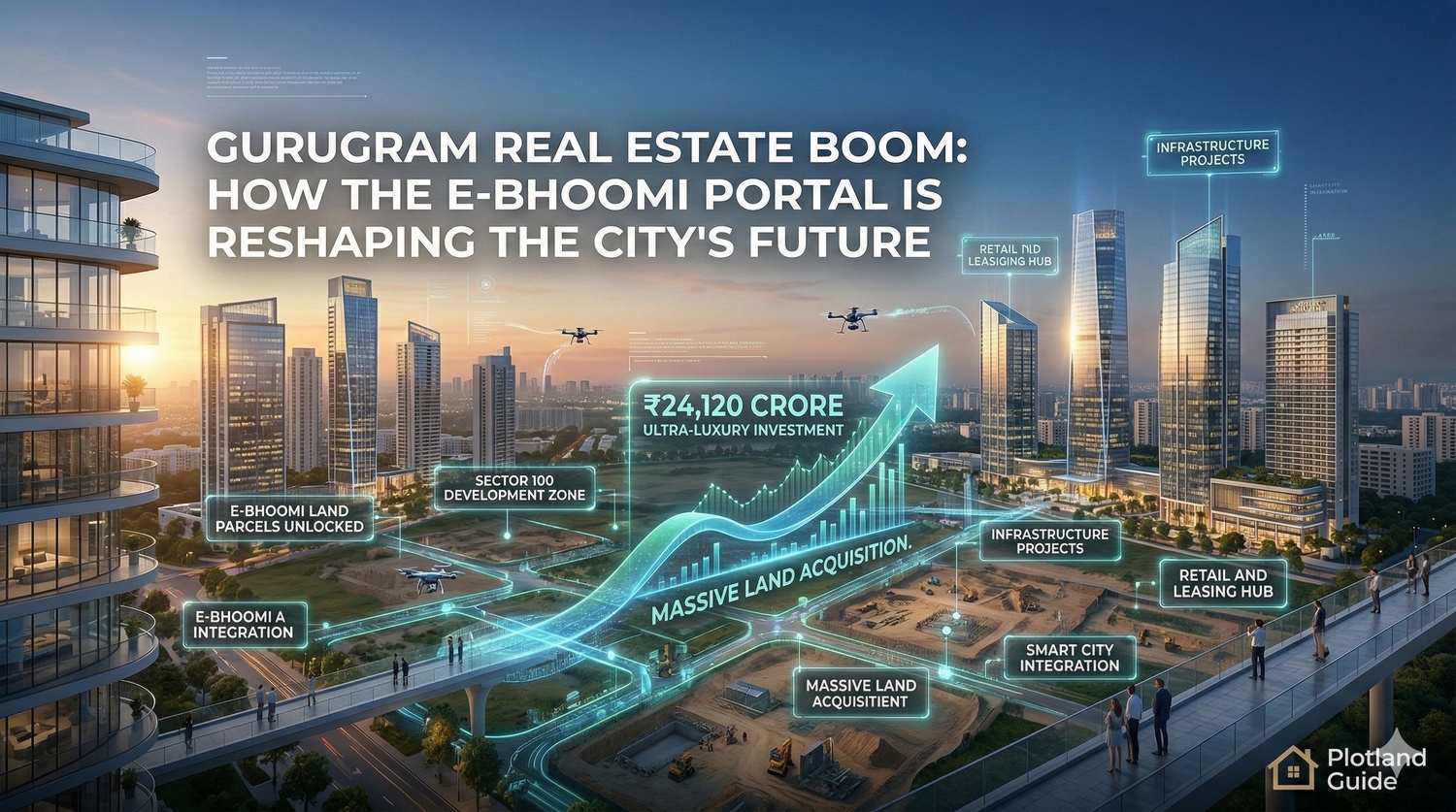
For years, purchasing a home or a plot in Gurugram has been the ultimate aspiration for countless families and investors. The city’s skyline is a testament to rapid corporate growth, global investments, and luxury living. However, the dream of owning property here has grown increasingly steep, driven largely by private developer monopolies and a noticeable scarcity of new state-planned sectors. That familiar narrative is now undergoing a massive, structural transformation. The state government has set the wheels in motion for one of the most ambitious urban expansion projects in recent history, leveraging the innovative e-Bhoomi portal to accelerate land procurement and sector development.
This is not just another minor policy tweak to existing regulations. It is a sweeping, comprehensive strategy designed to acquire over 25,000 acres in Gurugram alone, acting as the cornerstone of a staggering 1.67 lakh-acre statewide master plan. By prioritizing transparency and voluntary participation, the administration is bypassing the historically fraught processes of forced land acquisition. The goal is absolutely clear: to systematically develop new residential and commercial hubs, stabilize spiraling property rates, and bring meticulously planned, state-backed infrastructure to the forefront of the National Capital Region's real estate market.
The Return of State-Led Development After Two DecadesTo truly understand the gravity of this development, one must look back at Gurugram’s real estate trajectory over the past generation. For the past twenty years, the primary urban development authority has largely taken a backseat in carving out new sectors within the Millennium City. While the early foundational sectors, primarily from Sector 1 to 57, were meticulously planned and executed by the state, the subsequent expansion was handed over almost entirely to private enterprises and independent builders.
This administrative tilt toward a private-developer-led model led to the rapid rise of ultra-luxury condominiums, premium townships, and expansive golf-course communities. While this undoubtedly elevated the city's global profile and attracted multinational corporations, it simultaneously pushed property prices far beyond the reach of the average middle-class buyer. Affordable plotted developments, once a staple of the city's growth, became a rarity.
Now, the state is re-entering the arena with a massive course correction. Recent administrative moves, including the merging of the state housing board with the urban development authority, signal a consolidated, aggressive push to streamline housing delivery. By stepping back into the role of a primary developer, the government aims to inject a massive supply of serviced plots and planned group housing back into the market. This critical intervention is expected to provide competitive, reasonably priced alternatives to private projects, completely altering the supply-demand dynamics in the region and cooling down overheated micro-markets.
Demystifying the e-Bhoomi Portal AdvantageAt the heart of this massive urban expansion is the e-Bhoomi portal, a digital platform that has fundamentally changed how land is procured for public projects in Haryana. Historically, compulsory land acquisition under older laws was a highly contentious issue, often leading to decades of litigation, widespread farmer protests, and stalled infrastructure projects that frustrated both developers and buyers. The e-Bhoomi system replaces this friction with a transparent, consent-based, and highly efficient mechanism.
Through this digital portal, landowners and registered land aggregators can voluntarily offer their parcels of land directly to the government. The system is entirely digitized, allowing farmers to independently list their properties, quote their expected prices, and negotiate directly without opaque bureaucratic hurdles. To ensure the system remains robust and free of manipulation, aggregators participating in the process must meet strict criteria. They must be registered income taxpayers, hold verified state family identification documents, and offer a minimum threshold of land—usually around ten acres—to ensure the viability of large-scale sector planning.
Once the land details are uploaded to the platform, a streamlined review process immediately kicks in. If the quoted rates align with the prevailing collector rates, administrative approvals are swiftly granted to expedite the purchase. If they exceed the baseline, specialized high-powered committees evaluate the proposals to ensure fair, market-aligned compensation. This voluntary framework guarantees that not a single inch of land is procured without the free will of the owners, effectively eliminating the risk of forced displacement while ensuring that rural landowners receive lucrative payouts.
The 25,000-Acre Blueprint and Phased Rollout in GurugramThe sheer scale of the Gurugram land acquisition plan is unprecedented in modern urban planning. The authority has mapped out a highly structured, three-phase approach to acquire land across multiple high-growth corridors. This phased strategy ensures that the system is not overwhelmed and that urban planning can proceed systematically without causing market chaos.
The first phase is the most extensive and immediate, targeting heavily demanded areas where real estate activity is already peaking. During the initial window stretching through March and April, the focus is on procuring approximately 17,300 acres across 51 vital sectors. This massive sweep includes prime locations along the Dwarka Expressway and New Gurugram, spanning Sectors 36, 36A, 37D, and an expansive belt from Sector 102 all the way to Sector 113. Developed and rapidly emerging areas like Sectors 88A, 89A, 92, 95, and 99 are also central to this initial thrust. Landowners in these designated zones are currently uploading their details, setting the stage for negotiations that will shape the immediate future of the city's real estate.
As the summer approaches, the second phase will kick off in May and run through June. This phase deliberately shifts the geographical focus toward the southern and eastern peripheries of the city, specifically targeting around 5,000 acres in the Sohna, Pataudi, and Gwal Pahari belts. These regions have already seen significant organic growth due to recently completed highway projects, and state-backed sector development here will formally integrate them into the primary urban grid.
Finally, the third phase, scheduled for July and August, will concentrate on the Farukhnagar region. By targeting over 1,200 acres in this historic town on the outskirts of Gurugram, the administration is ensuring that urban expansion is decentralized. This move strategically pulls development away from the already congested central zones and spreads economic opportunities across the broader district.
Spotlight on Emerging Micro-MarketsFor anyone keeping a close watch on Gurugram real estate, the specific sectors chosen for this procurement drive offer massive clues about the city's future focal points and investment hotspots.
The stretch from Sector 102 to 108, lying parallel to the newly operational Dwarka Expressway, is already a magnet for premium residential demand. Properties in these sectors currently benefit from seamless, signal-free connectivity to the international airport and the national capital. By aggressively acquiring more land in this specific corridor, the government is setting the stage to introduce structured plotted developments and robust civic amenities that will directly complement the existing high-rise landscape, creating a more balanced neighborhood profile.
Similarly, the inclusion of Sohna and Pataudi highlights a strategic shift towards the deep suburbs. Sohna, increasingly referred to as South Gurugram, has transformed rapidly thanks to the elevated corridor linking it directly to the city's core commercial hubs. The availability of larger land parcels here makes it ideal for expansive, green-themed sectors and affordable housing projects. Pataudi, traditionally an agricultural and heritage town, is now being woven into the modern urban fabric for the first time. For retail investors and aspiring homebuyers, these peripheral markets represent the ground floor of the next big real estate boom, offering lucrative entry points at a fraction of the cost of central Gurugram.
A Massive Boost to Infrastructure and Urban LivingProcuring land is only the foundational step; the ultimate goal is comprehensive, sustainable urban expansion. Gurugram's rapid population growth has placed immense strain on its existing infrastructure. Traffic congestion, water logging during monsoons, and overburdened civic amenities are frequent pain points for long-time residents. The e-Bhoomi land acquisition push is essentially a reset button for the city's overarching civic planning.
With vast new tracts of land falling under state control, urban planners finally have the blank canvas required to design modern, future-proof sectors. The incoming developments will feature significantly wider arterial and internal sector roads, aimed at easing traffic bottlenecks from day one. State-of-the-art drainage and underground sewage systems are being planned from the ground up, entirely avoiding the complex retrofitting challenges currently faced in older parts of the city.
Furthermore, this raw land expansion allows for the proper, mandatory allocation of public utilities. The new sectors will have legally reserved zones for large public parks, community recreation centers, public schools, multi-specialty hospitals, and police stations. By injecting well-planned residential zones into peripheral areas, the administration aims to drastically improve overall livability standards and reduce the severe population density burden on the legacy sectors.
The Ripple Effect Across the StateWhile Gurugram is undoubtedly the crown jewel of this massive initiative, the impact of the e-Bhoomi portal extends far beyond the city's immediate borders. The state government recognizes that balanced regional development is absolutely crucial for long-term economic stability. As a result, the land procurement drive is simultaneously activating real estate markets in several other key districts, ensuring uniform growth.
Neighboring Faridabad is slated to see massive acquisitions, with thousands of acres targeted across Palwal, Prithla, and surrounding regions. This move will revitalize the industrial and residential landscape of the state's oldest manufacturing hub. Similarly, fast-growing urban centers like Karnal, Panchkula, and Sonipat are prominently featured in the broader urban expansion strategy. This synchronized, statewide development ensures that the housing supply increases uniformly across regions, creating multiple economic growth engines rather than concentrating all population pressures in a single metropolitan area.
Navigating the Market: What This Means for Buyers and InvestorsFor the common homebuyer and the retail property investor, this policy shift is a significant beacon of hope. The confirmed prospect of newly launched, state-developed sectors means the imminent return of reasonably priced residential plots. Government-auctioned land typically sets a baseline benchmark that can force private developers to rationalize their aggressive pricing strategies, making the overall property market much more accessible to the general public.
Middle-class families looking to buy land and build their own custom homes, rather than purchasing expensive high-rise apartments with steep maintenance fees, will soon have viable, legally secure options. Furthermore, purchasing property in a state-developed sector guarantees a baseline standard of civic infrastructure and absolute legal clarity that is sometimes dangerously missing in unapproved or aggressively marketed private colonies.
However, patience and strict due diligence remain essential. Transforming raw agricultural land into a fully functional, livable residential sector is a multi-year endeavor involving complex zoning laws, environmental clearances, and heavy civil engineering. Buyers eyeing opportunities in these upcoming areas should remain highly vigilant. It is crucial to closely monitor official government notifications regarding sector launches and open land auctions. When evaluating private projects that are suddenly springing up adjacent to these new state sectors, verifying official RERA approvals and thoroughly researching the builder's past delivery track record is absolutely non-negotiable.
A New Era for the Millennium CityThe activation of the e-Bhoomi portal and the subsequent, aggressive drive to acquire 25,000 acres is a definitive watershed moment for Gurugram. It signifies a mature, well-calibrated approach to urban growth, successfully balancing the financial rights of rural landowners with the pressing, undeniable need for planned civic infrastructure.
By taking back the reins of sector development after a two-decade hiatus, the state is making a bold, highly visible commitment to the city's long-term future. If executed with the promised digital transparency and administrative speed, this initiative will not only solve the immediate housing supply crunch but also lay down the physical and economic foundation for Gurugram's next ambitious phase of global prominence. For anyone invested in the future trajectory of Indian real estate, the ongoing transformation of this city is a real-time masterclass in modern urban management, promising a more structured, accessible, and deeply dynamic housing market in the crucial years to come.
