Published On:
January 29, 2026
Updated On:
January 30, 2026
The Haryana government has cleared a major hurdle for the Gurugram Metro by approving a direct land purchase policy, allowing the state to negotiate directly with landowners. This move aims to fast-track the critical 28.5 km Millennium City Centre to Cyber City corridor by bypassing lengthy acquisition delays.
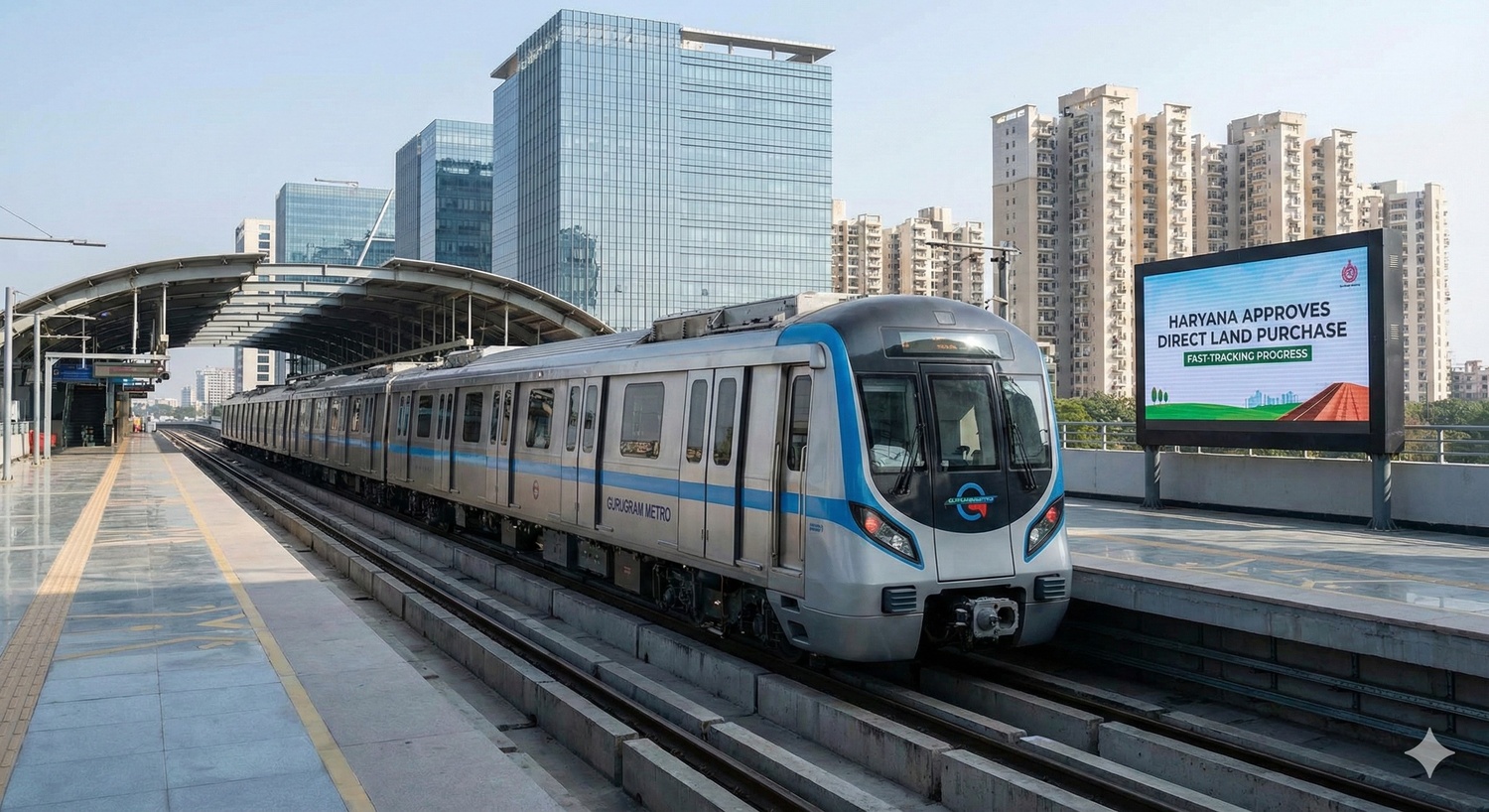
The wait for a comprehensive metro network in Gurugram has often felt like an endless saga of high-profile announcements followed by confusing silence. For a city that generates a massive chunk of Haryana's revenue and houses global Fortune 500 companies, its public transport infrastructure has remained woefully inadequate, forcing millions onto congested roads. However, a significant policy shift by the Haryana government in January 2026 signals that the gears are finally turning—and fast.
In a decisive move to unclog the bottlenecks stalling the project, the state government has formally cleared the route for direct land purchase. This decision is not just administrative jargon; it is the "accelerator pedal" the Gurugram Metro Rail Limited (GMRL) has been desperate for. By allowing authorities to buy land directly from owners through negotiation rather than waiting for the cumbersome mandatory acquisition process, the state aims to slash the timeline delays that have historically plagued infrastructure projects across India.
This comprehensive update explores what this policy change means, why the Sector 48 depot is the linchpin of the entire network, and how this expansion will redefine the real estate and commuter landscape of the Millennium City.
Infrastructure projects in India typically die a slow death during the "land acquisition" phase. The traditional process, governed by the Land Acquisition, Rehabilitation and Resettlement Act, is intentionally rigorous. It involves social impact assessments, public hearings, potential objections, and often, years of litigation by unhappy landowners who feel shortchanged.
Recognizing that the Gurugram Metro cannot afford these delays if it wants to meet its deadlines, the Haryana Cabinet has authorized GMRL to bypass this red tape for specific critical parcels. The new policy empowers a "High-Powered Land Purchase Committee" to sit across the table with landowners and negotiate a mutually agreed price.
While the metro lines and shiny stations garner all the public attention, the unsung hero of any rail network is the depot. Without a depot for maintenance, stabling, safety checks, and cleaning trains, a metro line simply cannot operate. For the Gurugram Metro expansion, the Sector 48 depot is that critical missing piece.
The GMRL has identified approximately 20 acres of land in Sector 48 for this facility. This location is strategic. Situated near the intersection of Sohna Road and the Southern Peripheral Road (SPR), it is perfectly positioned to serve the new loop line that will connect Millenium City Centre to Cyber City via Old Gurugram.
However, acquiring this land was proving difficult due to the high value of real estate in this developed sector. The direct purchase policy is specifically aimed at resolving this deadlock. By offering landowners a seat at the negotiation table, the government hopes to secure this plot swiftly. Without this depot, even if the tracks were laid, the trains would have no home to return to at night, rendering the system non-functional.
To understand the immense impact of this project, one must look at the route map. The expansion is effectively a "ring" that connects the two diverse and currently disconnected halves of Gurugram: the glossy glass towers of "New Gurugram" and the dense, bustling neighborhoods of "Old Gurugram."
The 28.5-kilometer corridor will start from the existing Millennium City Centre (formerly Huda City Centre) and loop through:
Additionally, a vital spur line will connect Palam Vihar to Dwarka Sector 21, integrating the Gurugram network with the Delhi Airport Express Line (Blue Line). This is a massive connectivity upgrade, potentially allowing a resident in Palam Vihar to reach IGI Airport in under 30 minutes.
Real estate markets react to infrastructure news long before the ribbon is cut. The clarity on land acquisition is the signal investors and homebuyers have been waiting for.
Areas like Palam Vihar, Sector 4, and Sector 23 have largely missed out on the meteoric price appreciation seen on Golf Course Road or the Extension Road. With the metro finally coming to their doorstep, these sectors are poised for a significant re-rating. We can expect a surge in demand for builder floors and redevelopment projects in these established colonies as connectivity improves.
The Southern Peripheral Road (SPR) has struggled with occupancy levels despite high-quality residential supply. The location of the depot and stations at Sector 48 and Subhash Chowk validates this corridor as a prime living destination. The connectivity to Cyber City will make SPR a viable rental hub for corporate employees who currently find it "too far" from their workplace.
The metro route passes through key commercial belts like Udyog Vihar Phase 6 and Sector 10. Direct metro access is a top priority for corporate occupiers today. This project will likely spur a new wave of office leasing in these micro-markets, which offer lower rentals than Cyber City but will soon offer similar connectivity benefits.
With the land hurdles being cleared, the timeline for the project becomes the next focal point. The foundation stone for the project was laid by Prime Minister Narendra Modi in February 2024, and the clock is ticking.
The GMRL has already initiated geo-technical surveys and appointed design consultants. With the direct land purchase policy in place, the target to commission the project by 2030 looks increasingly achievable. For the residents of Gurugram, who spend hours stuck in traffic at Hero Honda Chowk or Signature Tower, this project is not just infrastructure; it is the promise of a reclaimed life.
The Haryana government's decision to opt for direct land purchase is a mature, pragmatic step. It acknowledges that in a high-stakes economic zone like Gurugram, time is money. By prioritizing speed and negotiation over bureaucratic rigidity, they have cleared the biggest roadblock to the city's future.
As the authorities sit down with landowners in Sector 48 in the coming weeks, they aren't just negotiating the price of soil; they are negotiating the future mobility of millions. The "Millennium City" tag has often felt ironic due to its crumbling infrastructure, but with the metro finally getting the green light on the ground, Gurugram might finally get the transit backbone it deserves.
