Published On:
January 26, 2026
Updated On:
February 7, 2026
The Gurugram-Faridabad-Noida RRTS is set to slash travel time to under 30 minutes, triggering a massive real estate boom in Faridabad by closing the price gap with its neighbors and transforming the city from an industrial zone into a prime residential and commercial hub.
For decades, the National Capital Region (NCR) has operated on a visible hierarchy. Gurugram and Noida claimed the top spots, driven by high-end corporate growth, luxury real estate, and superior infrastructure. Faridabad, despite its strategic location, was often viewed through a singular lens—an industrial satellite town grappling with connectivity hurdles.
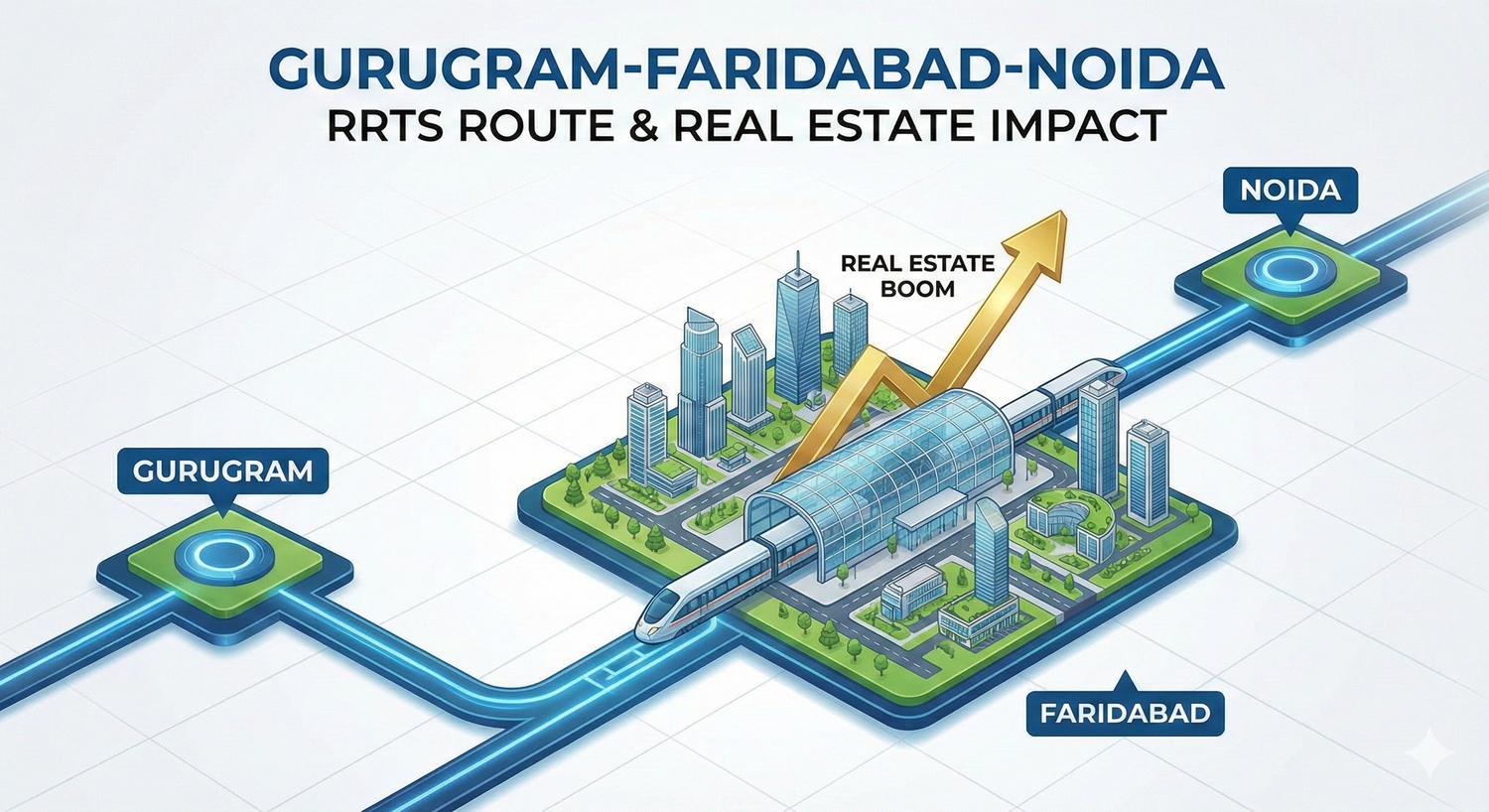
However, the script is flipping. The approval of the Gurugram-Faridabad-Noida Regional Rapid Transit System (RRTS) is not just an infrastructure upgrade; it is a structural realignment of the NCR’s economic and residential map. This 61-kilometer high-speed corridor is set to dissolve the physical barriers between the region’s three most vital economic nodes, positioning Faridabad as the biggest beneficiary of this "Golden Trinity" of connectivity.
The most significant hurdle for Faridabad has historically been the daily commute. Traveling to the corporate hubs of Cyber City in Gurugram or the IT sectors of Noida often involves navigating gridlocked routes like the Gurugram-Faridabad Road or the Kalindi Kunj stretch. Commutes that should take minutes often turn into hour-long ordeals.
The upcoming Namo Bharat train is the definitive transit fix. With a design speed significantly higher than a standard metro, the RRTS promises to slash travel times dramatically. Estimates suggest that the journey from Faridabad to Gurugram—currently a 60 to 90-minute struggle during peak hours—could drop to under 30 minutes.
The finalized Detailed Project Report (DPR) indicates a strategic alignment starting from Gurugram (likely connecting at key hubs like IFFCO Chowk or Millennium City Centre), cutting through the Aravallis to Faridabad (with major stops expected near Bata Chowk and the Nh-2 belt), and extending via the FNG expressway route into Noida (Sector 142/168) and terminating at Surajpur in Greater Noida. This creates a seamless east-west corridor that bypasses the congestion of Delhi entirely.
Real estate dynamics in the region are shifting toward Transit-Oriented Development (TOD). This urban planning concept focuses on creating high-density residential and commercial hubs within walking distance of mass transit stations.
In Faridabad, the impact is already visible in the blueprint stages. The areas surrounding the proposed RRTS stations are expected to evolve into self-sustaining micro-markets featuring high-rise residential towers, shopping complexes, and office spaces. This shift implies that residents will no longer just sleep in Faridabad and work elsewhere; the civic amenities and commercial ecosystem will come to them.
The sectors in Greater Faridabad, often referred to as Neharpar (Sectors 75 to 89), stand to gain the most. Once considered distant, these areas are now emerging as primary residential destinations. Unlike the saturated and land-locked pockets of Delhi or older Gurugram, Greater Faridabad offers large land parcels. This availability allows developers to construct modern, gated communities with world-class amenities—sprawling clubhouses, green landscapes, and sports facilities—that are increasingly rare or unaffordable in neighboring cities.
With the RRTS acting as a catalyst, these sectors are transitioning from "upcoming" investments to "prime" real estate. The connectivity to the new Jewar Airport via the interchange at Surajpur further sweetens the deal for long-term investors.
For the savvy investor and the middle-class homebuyer, the current market presents a distinct window of opportunity. There remains a significant price arbitrage between Faridabad and its neighbors. Today, one can acquire a premium 3-bedroom apartment in Greater Faridabad for the price of a compact studio or 1-bedroom unit in prominent Gurugram sectors.
Market analysts predict that this price gap will shrink rapidly once construction mobilizes (targeted for late 2026) and pillars become visible. Early movers who enter the market now—before the "infrastructure premium" is fully priced in—could see substantial appreciation by the time the corridor becomes operational around 2030-31.
The transformation extends beyond residential real estate. The RRTS will effectively unify the labor markets of Gurugram, Faridabad, and Noida. With travel times minimized, corporations in Gurugram can easily hire talent living in Faridabad without the friction of commute burnout. Conversely, Faridabad is likely to see a surge in satellite offices and co-working spaces. Companies looking to optimize operational costs while staying connected to the NCR grid will find Faridabad’s lower rentals and improved connectivity an irresistible combination.
The Smarter Faridabad initiative, combined with this massive transit injection, signals that the city is ready to shed its "quiet industrial" tag. As the tracks are laid and the stations rise, Faridabad is on course to become a modern urban hotspot that offers the perfect balance: the lifestyle and amenities of a metropolis with the connectivity that makes living there practical.
For the NCR real estate market, the RRTS is the great equalizer, and for Faridabad, it is the dawn of a new era.
