Published On:
March 18, 2026
Updated On:
March 18, 2026
The newly approved Gurugram-Faridabad metro will share the 64-km Namo Bharat RRTS track, introducing 18 new local stations to seamlessly connect Haryana’s biggest economic hubs with Noida while driving massive real estate appreciation along the corridor.
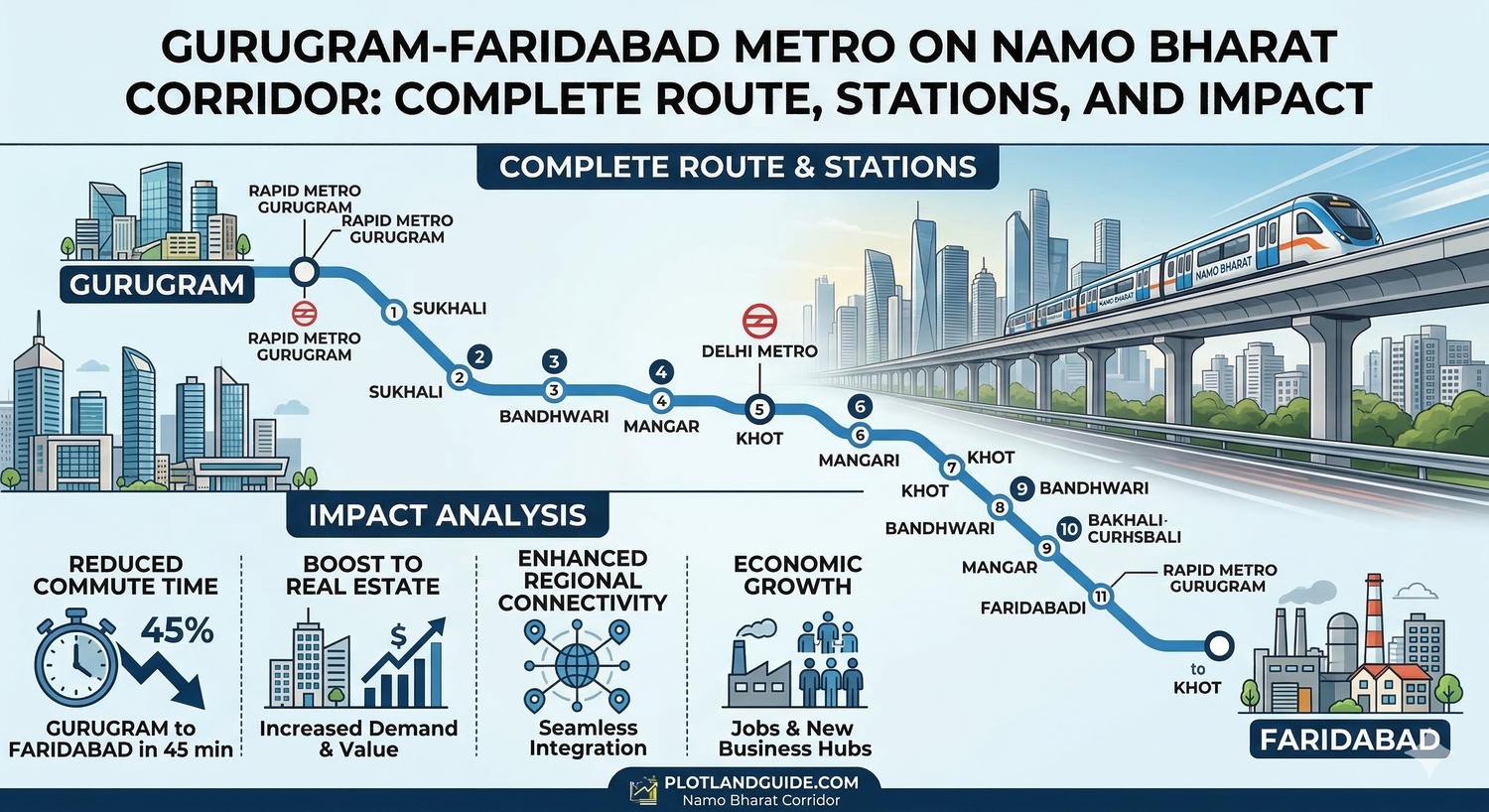
For anyone who commutes daily across the National Capital Region, the stretch between Gurugram and Faridabad has historically been a test of patience. Despite being two of Haryana’s most critical economic engines, the transit connectivity between these twin industrial and corporate hubs has heavily relied on congested roadways. However, a monumental shift in regional mobility is officially underway. The government has approved the final alignment for a groundbreaking transit project: running local metro trains on the same track as the high-speed Namo Bharat Regional Rapid Transit System (RRTS).
This 64-kilometer corridor, extending all the way into Noida and Greater Noida, is not just an infrastructure upgrade; it is a complete reimagining of urban transport in the NCR. By integrating local metro accessibility with interstate rapid rail speeds, this project promises to slash travel times, decongest major highways, and unlock unprecedented real estate value across emerging micro-markets.
The most innovative aspect of this upcoming corridor is the shared-track operational model. Traditionally, city metros and regional rapid rails require completely separate viaducts, land acquisitions, and overhead infrastructure. This project shatters that convention. The Gurugram-Faridabad metro will utilize the existing 64-kilometer Namo Bharat alignment, of which approximately 52 kilometers lie within Haryana's borders.
Under this system, the Namo Bharat trains, capable of hitting speeds between 160 to 180 kilometers per hour, will handle the long-haul, cross-city transit with fewer stops. Simultaneously, a dedicated fleet of local metro trains will run on the exact same tracks, serving a denser network of stations to cater to intra-city commuters. This dual-purpose infrastructure ensures maximum capital efficiency while providing commuters with the ultimate flexibility. You can take the metro for a short trip to the next sector or hop onto the Namo Bharat for a lightning-fast journey to Noida.
The alignment of this transit corridor has been meticulously planned to capture maximum footfall while avoiding the densest traffic bottlenecks. The journey begins in the heart of Gurugram at IFFCO Chowk. From this bustling junction, the elevated viaduct moves southward, slicing through the dense road networks of Sector 29 and aligning with Dr. BR Ambedkar Marg.
As it approaches the Southern Peripheral Road near Golf Course Extension Road, the track takes a sharp eastward turn toward Ghata Chowk. From this point, the alignment locks onto the scenic yet heavily trafficked Gurugram-Faridabad Road, also known as the Gwal Pahari route. This specific stretch is the critical bridge between the two cities.
Upon entering Faridabad, the corridor sweeps through the Sainik Colony and Badkhal Enclave regions, wrapping around the New Industrial Township (NIT) circular road. It navigates the heart of Faridabad by crossing National Highway-44 at Bata Chowk, running alongside the sector-dividing roads of Sectors 12 through 15. In its final leg within Haryana, the viaduct crosses the monumental Delhi-Mumbai Expressway and the Agra Canal, heading east toward the Yamuna River to finally enter Noida and Greater Noida.
To facilitate deep intra-city penetration, the Detailed Project Report outlines a total of 18 dedicated metro stations along the Haryana stretch. Gurugram will host eight of these strategically located stops, designed to capture both corporate office-goers and residential commuters.
The anchor of this segment is the IFFCO Chowk station, which will serve as a colossal multi-modal interchange hub. Here, passengers can seamlessly switch between the new metro line, the Namo Bharat network, and the proposed Delhi-Gurugram-Alwar RRTS corridor. Moving forward, a station at Sector 29 will cater to the district's vibrant commercial and hospitality sector.
The route then links up with the Millennium City Centre, offering a direct, frictionless interchange with the highly utilized Yellow Line of the Delhi Metro. Further down the line, stations are planned for Sector 52, the densely populated Wazirabad area, and Sector 57.
Another massive transit convergence will occur at the Sector 61 station. Positioned as a major interchange point, this hub will eventually connect three different transit lines, making it a critical node for residents living along the Golf Course Extension Road. Finally, the Gurugram leg concludes at Gwal Pahari, a rapidly developing premium residential micro-market that sits right on the border of Faridabad.
Faridabad is poised to be the biggest beneficiary of this infrastructure push, shedding its reliance on the Violet Line as its sole metro lifeline. The Faridabad stretch covers approximately 16 kilometers and includes ten dedicated metro stations, carefully mapped to serve both the legacy industrial zones and the newer residential townships.
The transit line makes its first Faridabad stop at Sainik Colony, moving rapidly toward the Badkhal Enclave. As it navigates the bustling NIT area, it provides essential connectivity to one of the city's oldest and busiest commercial districts.
The crown jewel of the Faridabad segment is the Bata Chowk station. Elevated to ensure zero disruption to the heavy traffic on NH-44 below, this station will provide a direct interchange with the existing Delhi Metro Violet Line. This means a commuter from South Delhi can easily switch at Bata Chowk and reach Gurugram's Golf Course Extension Road in a fraction of the current travel time.
Beyond Bata Chowk, the line services the premium residential belts of Sectors 12, 13, 14, and 15. The alignment then moves toward the expanding eastern corridors, touching Accord Hospital Road and Mata Anandmayee Marg, ensuring that the newer, developing sectors of Greater Faridabad are completely integrated into the NCR transit grid before crossing over into Uttar Pradesh.
While the Gurugram-Faridabad linkage is the centerpiece, the corridor’s true regional power lies in its eastern extension. After crossing the Yamuna River, the Namo Bharat and metro alignment pushes deep into Noida.
The primary entry point into Uttar Pradesh will be around the Sector 142 and Sector 168 belt, directly interfacing with the Faridabad-Noida-Ghaziabad (FNG) Expressway route. This station will provide an immediate interchange with the Noida Metro Aqua Line, instantaneously connecting the workforce in Greater Noida West and central Noida to the corporate parks of Gurugram.
The corridor eventually terminates at the Surajpur Junction in Greater Noida. Surajpur is being developed as a mega-interchange facility, linking this new line with the upcoming Ghaziabad-Jewar Airport RRTS. Ultimately, this creates a high-speed, uninterrupted transit loop connecting the Indira Gandhi International Airport in Delhi directly with the upcoming Noida International Airport, with Gurugram and Faridabad serving as the central transit arteries.
Deploying trains that travel at 180 kilometers per hour through densely populated urban sectors presents unique environmental and engineering challenges. The sheer acoustic footprint of aerodynamic trains passing through areas like Golf Course Extension Road or the NIT circular road is substantial.
Recognizing this, the Haryana Mass Rapid Transport Corporation has mandated the installation of advanced noise suppression systems along the entire viaduct. Heavy-duty acoustic barriers will be erected on both sides of the elevated tracks, specifically focusing on residential clusters, hospitals, and educational institutions. This ensures that the high-frequency transit operations do not degrade the local quality of life.
Furthermore, the entire corridor is being built with a massive focus on sustainability. The operational power for these stations and the high-speed trains will heavily rely on clean energy. Extensive solar panel arrays are planned for the station roofs and depot facilities, significantly reducing the carbon footprint of the network and ensuring long-term operational cost efficiency.
Mass transit infrastructure is the most potent catalyst for real estate appreciation, and this corridor is set to rewrite property valuations across three distinct cities. For years, the Gurugram-Faridabad road was seen merely as a driving route. Now, with dedicated metro stations, areas like Gwal Pahari are transforming into premium Transit-Oriented Development zones.
Homebuyers and investors are already shifting their focus toward the sectors flanking this route. In Gurugram, Sectors 57 through 61 are expected to see a surge in demand for premium residential apartments and Grade-A commercial spaces, driven by the sheer convenience of the triple-interchange hub at Sector 61. Corporate tenants highly value locations that offer their workforce seamless, multi-directional commute options.
In Faridabad, the impact will be even more pronounced. The city is rapidly transitioning from a purely industrial base to a balanced residential market. Micro-markets around Bata Chowk, Sector 14, and the eastern bypass will experience a significant upward price correction. The ability to live in Faridabad—where per-square-foot prices are still relatively competitive—and commute to a corporate office in Gurugram's Cyber City or Noida's Sector 142 in under forty-five minutes is an incredibly attractive proposition for the modern workforce.
Similarly, the Noida Expressway sectors will witness an influx of commercial real estate investments. As the physical barrier of the Yamuna River is effectively bridged by high-speed rail, the property markets of Noida and Faridabad will begin to equalize, drawing massive institutional investment into commercial parks, retail malls, and luxury housing projects situated near the transit nodes.
The integration of local metro services onto the Namo Bharat RRTS track is a masterclass in urban planning. It acknowledges a fundamental reality of the modern National Capital Region: economic boundaries between these cities no longer exist. People live in one district, work in another, and socialize in a third.
By pushing this 64-kilometer corridor from the drawing board to final alignment approval, the government is future-proofing the region's transport infrastructure. When operational, this network will remove hundreds of thousands of private vehicles from the roads, drastically cut carbon emissions, and give commuters their most valuable asset back: time. From the corporate towers of Millennium City Centre to the bustling industries of Faridabad and the expanding skylines of Noida, this corridor stands ready to unite the NCR like never before.
