Published On:
February 27, 2026
Updated On:
February 27, 2026
Dethroning Mumbai, Gurugram emerged as India's undisputed leader in ultra-luxury real estate in 2025, recording a massive ₹24,120 crore in sales for homes priced over ₹10 crore. This historic milestone is fueled by a booming wealth creation cycle, rapid infrastructure expansion, and a strong buyer preference for sprawling, premium living spaces.
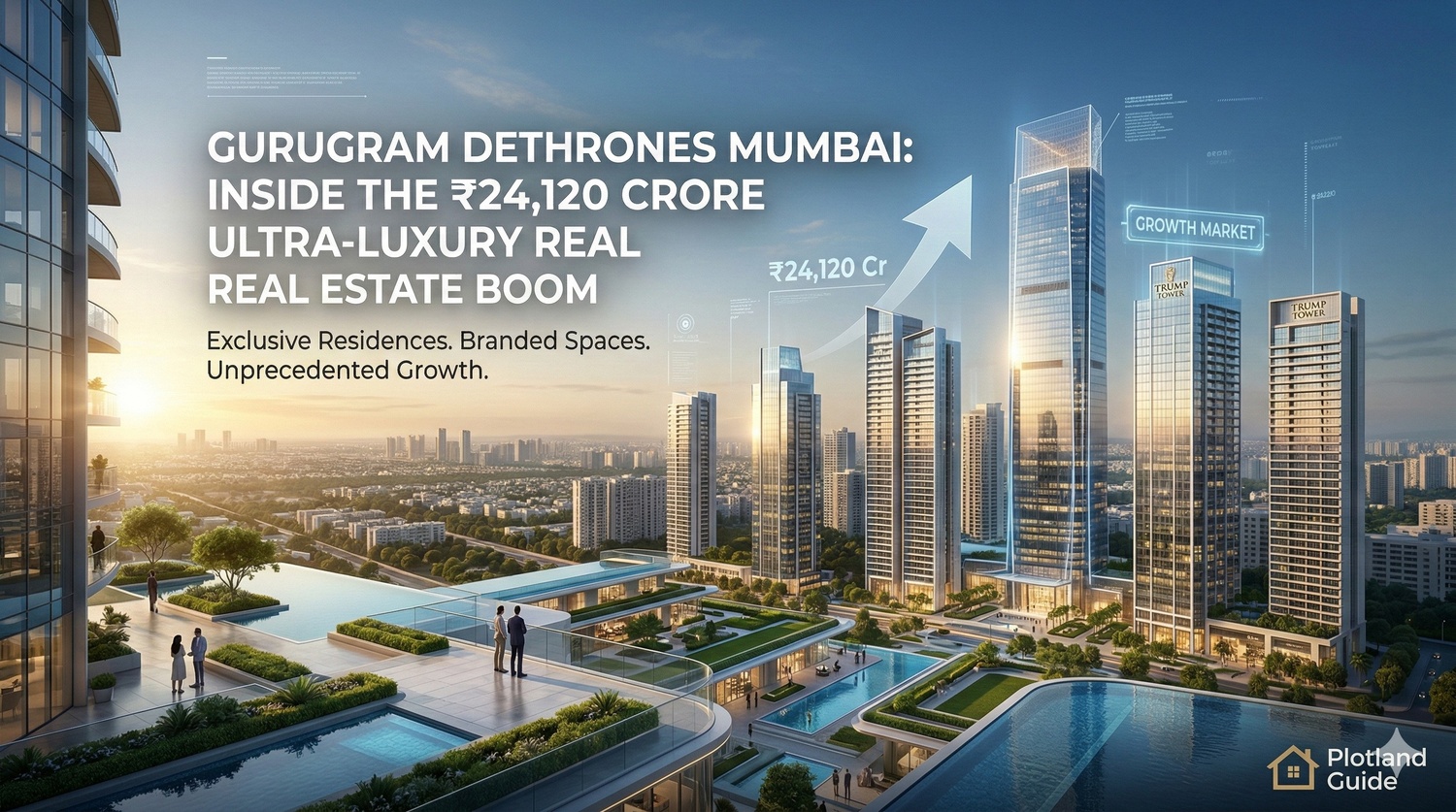
The historical narrative of the Indian property market has always placed Mumbai at the absolute pinnacle of luxury. For decades, the financial capital commanded the highest premiums, attracted the most affluent buyers, and recorded the largest volume of high-end transactions. However, a seismic shift has redefined the landscape in 2025. Gurugram has not just caught up; it has decisively overtaken Mumbai to become the country’s largest market for homes priced at ₹10 crore and above.
Recording a staggering ₹24,120 crore in ultra-luxury transactions during the 2025 calendar year, the Millennium City has cemented its status as the most dynamic premium residential hub in the country. By comparison, Mumbai registered ₹21,902 crore in high-end home deals during the same period. This milestone is not merely a temporary fluctuation but the culmination of rapid infrastructure development, evolving buyer preferences, and an unprecedented wave of wealth creation spreading across the National Capital Region. The sheer scale of this transformation highlights a broader restructuring of urban wealth, moving away from space-constrained coastal metros toward sprawling, master-planned developments that offer world-class lifestyles.
The magnitude of Gurugram's real estate boom becomes evident when tracking the trajectory of the past two years. The ultra-premium housing market has experienced a nearly tenfold expansion in a remarkably short span. In 2023, the city saw a modest 155 units sold in the ₹10 crore-plus bracket, amounting to a total transaction value of ₹4,004 crore. By 2024, the momentum began to build rapidly, with transaction values climbing to ₹13,384 crore across 519 units.
Fast forward to 2025, and those numbers have skyrocketed to a record-breaking 1,494 homes sold. This represents the highest volume of ultra-luxury properties ever transacted within a single 12-month period in the city, capturing a dominant 24% share of Gurugram’s total residential market value. While Mumbai’s market grew modestly from ₹20,415 crore in 2024 to ₹21,902 crore in 2025, it simply could not match the explosive 80% year-on-year acceleration seen in Gurugram.
A deeper look into the pricing segments reveals just how much the market has matured. Within the ₹10 crore-plus category, the ₹10 to ₹20 crore bracket formed the backbone of the expansion, accounting for over 80% of the market share by volume. Yet, the appetite for ultra-exclusive properties is growing at the very top end as well. The ₹20 to ₹40 crore segment expanded sharply, and there is a steady, rising demand for sprawling estates priced at ₹40 crore and above. The average ticket size for an ultra-luxury home in Gurugram now sits comfortably around ₹16 crore, indicating that high-net-worth buyers are deeply committed to the city's long-term value proposition.
Several powerful macroeconomic and demographic forces are driving this real estate supercycle. The most prominent factor is sustained domestic wealth creation. The Indian corporate landscape has recently witnessed a massive infusion of liquidity, with over a hundred companies raising nearly $20 billion through main board IPOs. This capital formation has birthed a new cohort of startup founders, tech entrepreneurs, and senior corporate executives who are actively channeling their newly acquired wealth into tangible, high-yielding lifestyle assets.
These modern buyers are noticeably younger, often in their early thirties, and carry a global perspective. They are no longer satisfied with mere property ownership; they are pursuing a comprehensive, upgraded lifestyle that mirrors international standards. Joining them is a robust wave of Non-Resident Indians who seek residential developments that align with the premium living benchmarks they are accustomed to overseas. Consequently, developers are responding by launching branded projects that feature world-class amenities, integrated green spaces, nature-centric themes, and unparalleled privacy.
Another critical factor is the transparent regulatory environment brought about by RERA, which has significantly restored buyer confidence in primary sales. Homebuyers are showing a strong preference for purchasing directly from reputable developers, driving massive capital into newly launched, high-quality residential assets.
The definition of luxury has fundamentally changed over the past few years. There is a distinct shift away from compact, high-priced urban apartments toward expansive living spaces. Buyers in the ultra-luxury segment are increasingly prioritizing scale, layout, and exclusivity.
In Mumbai, a budget of ₹10 crore often secures a premium but relatively compact apartment due to the severe scarcity of land and exorbitant per-square-foot costs. In contrast, the same investment in Gurugram unlocks palatial living. In 2025, the average size of a premium home sold in Gurugram hovered around 5,000 square feet. The bulk of the market demand—accounting for over a thousand of the units sold and 54% of the total transaction share—was concentrated in the 4,000 to 6,000 square foot category.
Even more telling is the appetite for massive estates. Residences exceeding 8,000 square feet contributed approximately 22% of the overall transaction value in the city. Homebuyers are willing to pay a premium for extra bedrooms, dedicated home offices, private entertainment lounges, and sprawling outdoor decks. They are actively seeking branded, amenity-rich gated communities that offer an oasis of security, complete with massive clubhouses, concierge services, and seamless integration with nature.
The geography of luxury within Gurugram is simultaneously undergoing a radical restructuring. Historically, high-end real estate was synonymous with legacy addresses like Golf Course Road. While this traditional premium corridor remains highly coveted and commands some of the highest ticket sizes in the city, its overall sales volume actually moderated in 2025, declining by roughly 28%. This drop was not due to a lack of demand, but rather a severe constraint on fresh inventory. The scarcity of available land in established sectors has pushed both developers and buyers to look outward, leading to the explosive rise of new luxury hubs.
The undisputed breakout star of 2025 is the Dwarka Expressway. Once viewed as an emerging peripheral market, it has rapidly transformed into the city's primary engine for luxury real estate expansion. Supported by the completion of large-scale infrastructure and seamless connectivity to Delhi and the international airport, this corridor witnessed an astonishing 2,079% jump in transaction value. Sales skyrocketed from a mere ₹383 crore in 2024 to an incredible ₹8,347 crore in 2025. The volume of ultra-luxury units sold here surged from just a few dozen to over 600 in a single year, accompanied by a healthy appreciation in weighted average prices.
Following closely is the Golf Course Extension Road, which has firmly established itself as a premier destination for high-end living. This micro-market posted a 379% year-on-year rise in luxury housing sales, leaping from ₹693 crore to ₹3,319 crore. The area experienced significant price appreciation as well, with weighted average prices jumping from under ₹25,000 per square foot to nearly ₹38,000 per square foot. The rapid sell-outs of large-scale, ultra-premium project launches in this vicinity have proven that buyers are more than willing to invest heavily in emerging corridors, provided the product and infrastructure meet their exacting standards.
This decentralization of luxury is a structural expansion, supported by proactive infrastructure upgrades. The development of the Gurugram-Sohna Connector, the Delhi-Mumbai Expressway, ongoing metro network expansions connecting sectors like Cyber City and Palam Vihar, and ambitious plans like the 1,000-acre Global City project are collectively elevating the region's appeal. These transport links are drastically reducing commute times and seamlessly integrating previously distant sectors into the core urban fabric.
While Gurugram leads the charge, the ripple effects of this high-end housing boom are visible across other major Indian cities, painting a broader picture of shifting real estate dynamics. The entire National Capital Region is experiencing a massive uplift. After Gurugram and Mumbai, the neighboring regions of Noida and Greater Noida emerged as formidable players in the ultra-luxury segment.
Benefiting from similar infrastructural tailwinds, including the upcoming international airport at Jewar and expanding metro networks, Noida and Greater Noida recorded a combined ultra-luxury sales value of ₹9,358 crore in 2025. These markets are increasingly attracting elite buyers looking for expansive properties and strong capital appreciation. Further south, Hyderabad recorded strong transactions worth ₹8,140 crore in the ₹10 crore-plus category, driven by its booming IT sector and commercial real estate growth. Bengaluru followed with ₹2,319 crore in high-end home sales. However, despite the positive momentum across these metropolitan areas, none matched the sheer scale, pace of growth, or transaction volume of Gurugram.
Given this unprecedented acceleration, a critical question naturally arises regarding the sustainability of this growth. Are we looking at a durable structural shift in the real estate market, or are there signs of a potential bubble? Market data and buyer behavior suggest the former. Unlike previous real estate cycles that were driven heavily by speculative investment, the current boom is rooted in genuine end-user demand and robust capital inflows.
The dominance of primary sales indicates that buyers are actively seeking out newly developed assets tailored to modern lifestyle requirements, rather than trading older properties for short-term gains. Real estate developers are also operating with stronger balance sheets and executing projects with a higher degree of financial discipline. While a growing pipeline of high-end supply will inevitably test the depth of the market in the coming years, the sustained wealth creation across the country provides a solid foundation.
Even with persistent geopolitical headwinds and broader global economic uncertainties, buyer sentiment in the premium housing segment remains overwhelmingly optimistic. However, this optimism is paired with a more calculated approach. Buyers have become markedly more discerning. They are prioritizing superior construction quality, reputed developer brands with proven track records of timely delivery, and prime locations over mere square footage. Projects that fail to meet these stringent criteria may struggle, but those that deliver on the promise of an elevated lifestyle are seeing their inventories absorbed within days of launching.
The transformation of Gurugram from a corporate outpost to India's premier luxury housing destination is a masterclass in urban economic evolution. The city successfully combined strategic infrastructure development with high-quality real estate supply to capture the immense wealth being generated in the modern economy. For professionals, entrepreneurs, and global investors, it offers a cosmopolitan environment that comfortably rivals major international hubs.
Looking ahead, the market is expected to remain robust, though year-on-year growth rates may naturally moderate as the statistical base expands. The focus for developers will likely shift toward delivering on the ambitious promises of these high-value projects and ensuring that civic infrastructure continues to keep pace with rapid private development.
For now, the financial metrics speak volumes. The historic milestone of crossing the ₹24,000 crore mark in the ₹10 crore-plus segment is a clear declaration of market dominance. Gurugram has not just entered the top tier of Indian real estate; it has entirely redefined it, proving that when world-class infrastructure meets visionary development, the demand for luxury living knows no bounds.
