Published On:
January 29, 2026
Updated On:
January 30, 2026
Varanasi is rapidly transforming from a spiritual capital into a high-growth property hub. With the Varanasi Development Authority's (VDA) new 2031 Master Plan, six new "Greater Noida-style" townships are being developed across 1,200 acres. Backed by ₹6,000 crore in land acquisition and major infrastructure projects like the urban ropeway and Ring Road, "Greater Varanasi" is offering early investors returns of 15-20% annually.
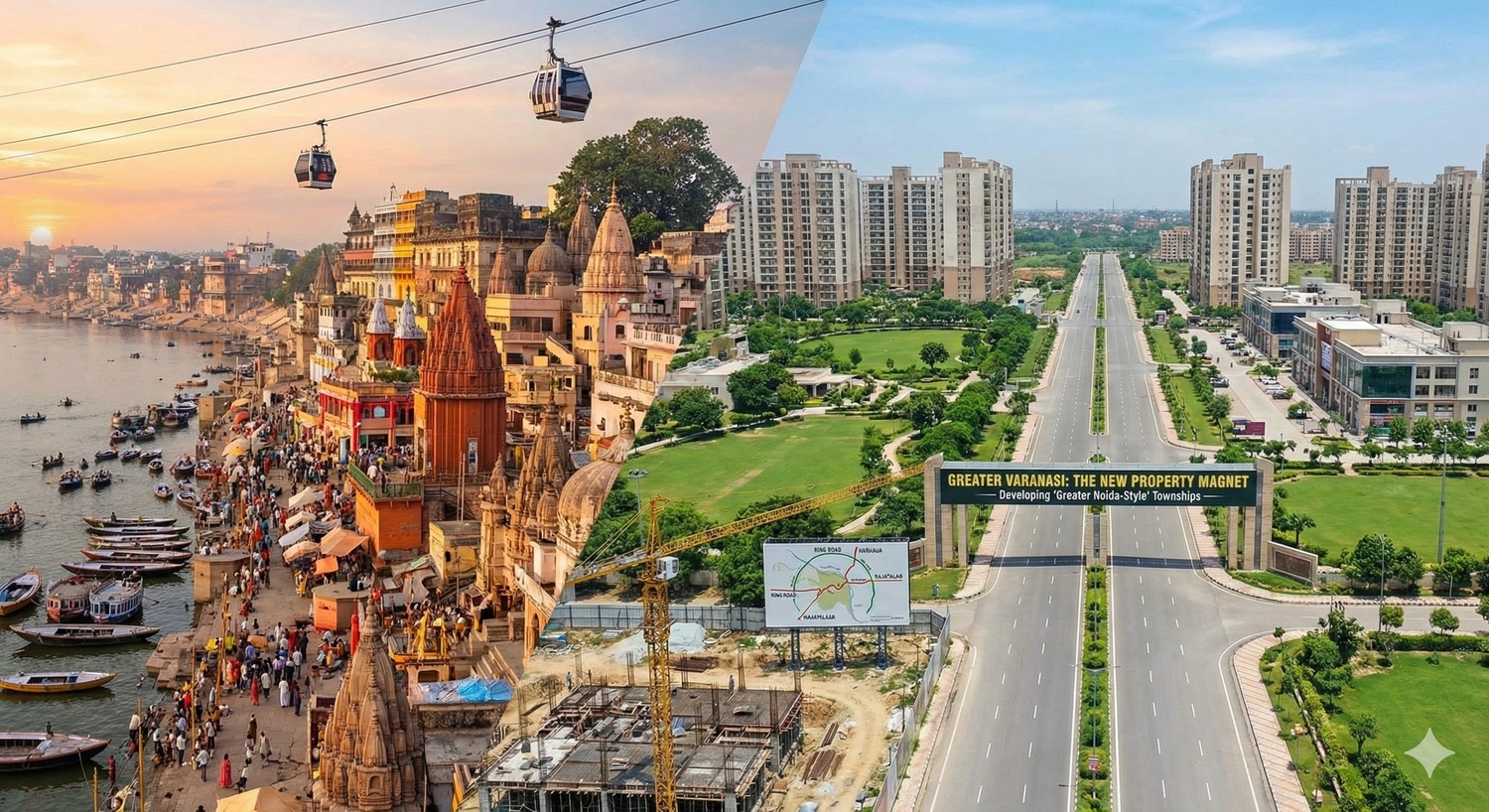
For centuries, Varanasi has been defined by its winding galis (lanes), ancient ghats, and a chaotic charm that draws millions of pilgrims annually. But as we move through 2026, the city is standing on the precipice of a radical transformation. The Varanasi Development Authority (VDA), backed by the state government, has initiated the "Greater Varanasi" project—a master plan that seeks to replicate the success of Greater Noida’s structured urban planning in the heart of Purvanchal.
This isn't just about widening a few roads; it is a fundamental shift in how the city lives, commutes, and invests. With dedicated townships, a "Vedic City" concept, and a focus on decongesting the heritage core, Greater Varanasi is fast becoming the new magnet for real estate investors who missed the bus in NCR.
The comparison to Greater Noida is not accidental; it is strategic. For decades, Varanasi expanded organically, leading to unauthorized colonies and choked infrastructure. The Greater Varanasi initiative aims to curb this by introducing Integrated Townships.
Just as Greater Noida was built on a grid of wide avenues and distinct sectors for residential, industrial, and institutional use, Greater Varanasi is being developed along the city’s Ring Road. The plan involves acquiring approximately 1,200 acres of land across dozens of villages to build self-sustaining urban centers. These aren't just housing societies; they are "cities within a city" designed to have their own schools, hospitals, malls, and green zones, ensuring that residents don't need to travel to the crowded city center for daily needs.
The VDA’s vision is categorized into specific thematic townships, which sets this project apart from standard development. The land acquisition is currently focused on the stretch between Harhua and Rajatalab, creating a new semi-circular urban belt.
Perhaps the most unique aspect of this master plan is the proposed "Vedic City." Located near Sarnath, this township is designed to reflect the spiritual and cultural ethos of Kashi. It will likely feature architecture inspired by heritage designs but backed by modern amenities. This area is targeted at spiritual seekers, NRIs, and retirees who want the "Banaras vibe" without the "Banaras traffic."
Moving towards the Raja Talab area, the plans include a "World City" and a "Sports City." With the international cricket stadium coming up in Ganjari, the surrounding infrastructure is being upgraded to support sports tourism, hotels, and commercial complexes. This creates a direct rental market for hospitality and service industries.
To balance the ecology, the authority is also focusing on the riverfronts. The Varuna river corridor is seeing renewed interest, with plans to develop residential zones that offer river views similar to the Gomti Riverfront in Lucknow, but with better residential integration.
No real estate market survives on hype alone; it needs asphalt. The spine of Greater Varanasi is the Ring Road (Phase 1 and 2).
If you are looking for the "Sector 18" or "Golf Course Road" of Varanasi’s future, look at the Harhua-Rajatalab corridor.
Investing in Varanasi comes with a safety net that few other cities have: Religious Tourism. The Kashi Vishwanath Corridor has permanently altered the city's economy. Millions of tourists mean a perennial demand for accommodation.
Investors in Greater Varanasi are not just looking at capital appreciation; they are looking at Rental Yields. Buying a plot or a flat in these new townships allows investors to run homestays, guest houses, or long-term rentals for the workforce supporting the tourism industry. Unlike a typical IT city where demand fluctuates with the job market, the demand in a spiritual capital is relatively recession-proof.
While the picture is rosy, the "Greater Noida" comparison also brings a word of caution. Large-scale land acquisition often faces delays due to farmer compensation issues or litigation.
Greater Varanasi is more than a real estate boom; it is a necessity. The ancient city cannot support the modern population load anymore. By creating a structured, planned satellite city, the administration is future-proofing Kashi.
For the investor, this represents a window of opportunity. The prices in Harhua and along the Ring Road are currently where Noida Extension was a decade ago. As the bulldozers level the ground for the Vedic City and the asphalt settles on the service lanes of the Ring Road, the "Property Magnet" of Purvanchal is just turning on.
