Published On:
September 12, 2026
Updated On:
September 12, 2026
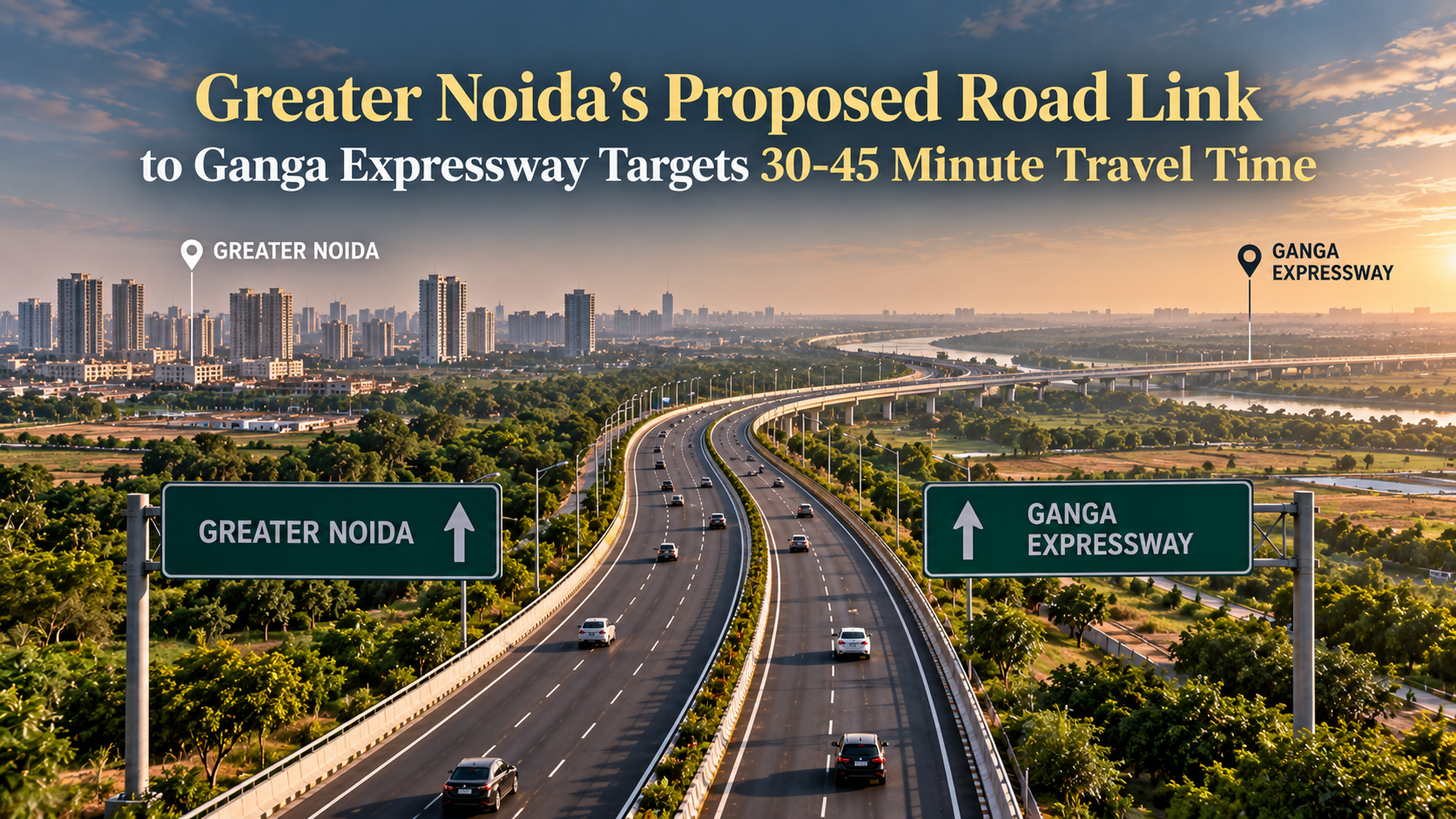
Greater Noida is set to revolutionise its connectivity with a proposed 105-metre-wide road linking the city directly to the Ganga Expressway via the Hapur bypass, cutting travel time to just 30-45 minutes. Coupled with a new six-lane elevated freight corridor to the Jewar Airport, this infrastructure upgrade will separate commercial and passenger traffic, boosting both real estate and logistical efficiency in the region.
The real estate and infrastructure landscape of the National Capital Region is preparing for another monumental leap forward. For years, Greater Noida has been widely recognised as one of Northern India’s most systematically planned industrial and residential hubs. However, as the region prepares for the operational launch of the much-awaited Noida International Airport in Jewar, local authorities are acutely aware that the existing road networks need a massive upgrade to handle the inevitable surge in vehicular traffic.
In a highly strategic move to future-proof the city’s transit ecosystem, the Greater Noida Industrial Development Authority has proposed an ambitious infrastructure blueprint. At the heart of this comprehensive plan is a brand-new, ultra-wide road link designed to seamlessly connect Greater Noida directly with the mammoth Ganga Expressway. By drastically reducing the commute time between these two major logistical arteries to a mere thirty to forty-five minutes, the state government is laying down the foundation for an economic and real estate boom.
This infrastructure overhaul goes far beyond just building another highway. It involves a fundamental amendment to the Greater Noida Master Plan 2041, aiming to completely segregate heavy freight movement from daily passenger traffic. Let us dive deep into the intricacies of this massive proposal, the routes involved, and what it means for residents, investors, and businesses across the region.
As the population density and industrial output of Greater Noida continue to multiply, the pressure on its arterial roads has intensified. The authorities have realised that routing interstate traffic and heavy commercial trucks through the city's internal road network is no longer sustainable. To counter this, the cornerstone of the new infrastructure proposal is the construction of a massive 105-metre-wide arterial road.
This exceptionally wide road is engineered to serve as a dedicated high-capacity corridor. The primary objective is to connect Greater Noida directly to the Hapur bypass. By extending the current connectivity footprint by approximately fifteen kilometres, this newly proposed route will act as a vital bridge, smoothly funnelling traffic from the Greater Noida region straight onto the Ganga Expressway.
The Ganga Expressway itself is one of the most ambitious road projects in Uttar Pradesh, designed to connect the eastern and western parts of the state. Currently, commuters and logistics operators travelling from the twin cities of Noida and Greater Noida have to navigate a maze of congested state highways and local town roads to access the expressway. The proposed 105-metre-wide road will bypass these traditional choke points entirely. Once constructed and operational, the authorities estimate that the driving distance to the Ganga Expressway will be covered in just thirty to forty-five minutes.
This dramatic reduction in travel time is a game-changer. For the everyday commuter, it means weekend getaways or business trips to central and eastern Uttar Pradesh will become significantly faster and less stressful. For the industrial sector, it translates to massive savings in fuel costs and a drastic reduction in the turnaround time for the transportation of manufactured goods.
While faster access to the Ganga Expressway is a massive highlight, the true brilliance of this new infrastructure proposal lies in its broader traffic management strategy. The overarching goal of the amendments proposed in the Greater Noida Master Plan 2041 is the formal separation of commercial freight movement from daily passenger transit.
As it stands today, heavy trucks carrying raw materials and finished goods share the same roads as school buses, office commuters, and local residents. This dangerous and inefficient mix leads to chronic traffic jams, an increased rate of road accidents, and rapid deterioration of civic infrastructure. With the Noida International Airport at Jewar inching closer to completion, the volume of cargo movement in the region is expected to skyrocket. Without intervention, the local road network would face complete gridlock.
To prevent this, the authorities are not just building the 105-metre-wide road for general traffic; they are also planning a highly specialised route exclusively for commercial use. By segregating the road networks based on vehicle type and purpose, the civic body aims to preserve the longevity of residential roads while giving industries the fast-track infrastructure they require to operate efficiently.
Complementing the road to the Hapur bypass is another massive engineering marvel: a proposed six-lane elevated road running parallel to the Western Dedicated Freight Corridor. This elevated stretch is being designed with a very specific, single-minded purpose. It will serve as an exclusive conduit for freight vehicles travelling between the upcoming logistics hubs in Greater Noida and the air cargo terminal of the Noida International Airport.
By elevating the freight traffic, the authorities are effectively pulling thousands of heavy trucks off the ground-level city roads every single day. Goods originating from local factories or arriving via the railway freight corridors can be loaded onto trucks that will instantly get onto this elevated six-lane highway. From there, they will enjoy a non-stop, signal-free run directly into the cargo bays of the Jewar airport without ever interacting with civilian vehicles.
This level of seamless, last-mile connectivity is unprecedented in the region. It ensures that the massive influx of cargo traffic generated by the airport does not spill over into the residential and commercial sectors of Greater Noida. Passenger vehicles will have the ground-level roads and the newly proposed arterial links to themselves, ensuring a smooth, safe, and pleasant driving experience for the city's residents.
To fully grasp the massive economic impact of these new road links, one must understand the large-scale logistical infrastructure currently taking shape within Greater Noida. The city is aggressively developing two major anchor projects: the Multi Modal Logistics Hub and the Multi Modal Transport Hub.
These massive facilities are designed to be the central nervous system for trade and transit in Northern India. The logistics hub will act as a massive inland port, handling the storage, sorting, and dispatch of millions of tonnes of cargo. Meanwhile, the transport hub will integrate railway networks, interstate bus terminals, and local mass transit systems into a single, cohesive mega-station.
The newly proposed 105-metre-wide road to the Ganga Expressway and the six-lane elevated freight corridor to the airport are the vital arteries connecting these hubs to the outside world. The logistics hub relies on rapid dispatch capabilities to be financially viable. If a truck takes hours just to exit the city limits, the entire purpose of a multimodal facility is defeated. The new road network guarantees that once a container leaves the logistics hub, it can reach the Jewar air cargo terminal in minutes via the elevated corridor, or hit the Ganga Expressway towards eastern markets in under three-quarters of an hour.
Infrastructure is the ultimate precursor to real estate appreciation, and the proposed road links are already sending positive ripples through the property markets of Greater Noida and the adjacent Yamuna Expressway region. Historically, areas that sit at the intersection of major expressways and logistical hubs witness explosive growth in both capital values and rental yields.
For the residential real estate sector, the benefits are clear. The promise of a traffic-free, streamlined commute makes Greater Noida an incredibly attractive destination for prospective homebuyers. Professionals working in Delhi or Noida are increasingly looking towards Greater Noida for spacious, affordable housing. The knowledge that the city is proactively separating heavy truck traffic from residential roads adds a massive premium to the local lifestyle quotient. Sectors located near the proposed 105-metre-wide road will likely see a surge in demand from end-users who value rapid interstate connectivity.
On the commercial and industrial front, the impact will be even more profound. Corporations, e-commerce giants, and third-party logistics companies are always on the hunt for warehousing spaces that offer unimpeded access to highways and airports. The combination of the Multi Modal Logistics Hub and the dedicated six-lane elevated freight road makes Greater Noida arguably the most attractive warehousing destination in the country today. We can expect a massive influx of corporate investment targeting the industrial sectors of the city, leading to widespread job creation and a corresponding boom in the demand for commercial office spaces and retail outlets.
Furthermore, the lands located along the proposed 15-kilometre extension towards the Hapur bypass are destined for rapid urbanisation. As the road takes shape, the surrounding rural and semi-urban pockets will inevitably be absorbed into the formal development grid. This opens up vast new land banks for private developers to launch integrated townships, commercial plazas, and specialised industrial parks, further expanding the economic footprint of the National Capital Region.
The proposals discussed at the high-level meetings chaired by the state’s industrial development ministry reflect a mature, forward-thinking approach to urban planning. The authorities are not reacting to a crisis; they are anticipating future growth and building the capacity to handle it well in advance.
The integration of these new routes into the Greater Noida Master Plan 2041 ensures that the land required for these massive corridors will be legally reserved and protected from unchecked private development. While the acquisition of land and the subsequent construction phases will require substantial capital and time, the administrative machinery appears fully committed to fast-tracking these critical projects.
As the Noida International Airport gears up for its grand opening, the surrounding infrastructure must rise to the occasion. The proposed 105-metre-wide road linking to the Ganga Expressway and the six-lane elevated freight corridor represent the final, crucial puzzle pieces in Greater Noida’s transit strategy.
When these roads are finally paved and opened to the public, they will do much more than just reduce travel times. They will fundamentally redefine the way people and goods move across Uttar Pradesh. By decisively separating the heavy, loud reality of industrial freight from the daily rhythm of passenger commutes, Greater Noida is setting a new national benchmark for smart, sustainable urban expansion. For investors, businesses, and residents alike, the message is clear: the future of seamless connectivity is arriving, and it is being built right here.
