Published On:
February 20, 2026
Updated On:
February 20, 2026
The newly revised Greater Noida West Metro project prioritizes a four-station corridor from Sector 61 to Sector 4, effectively linking the densely populated Gaur City area to the larger transit grid. This crucial infrastructure upgrade promises to eliminate severe traffic bottlenecks, boost local real estate values, and drastically reduce daily commute times for lakhs of residents.
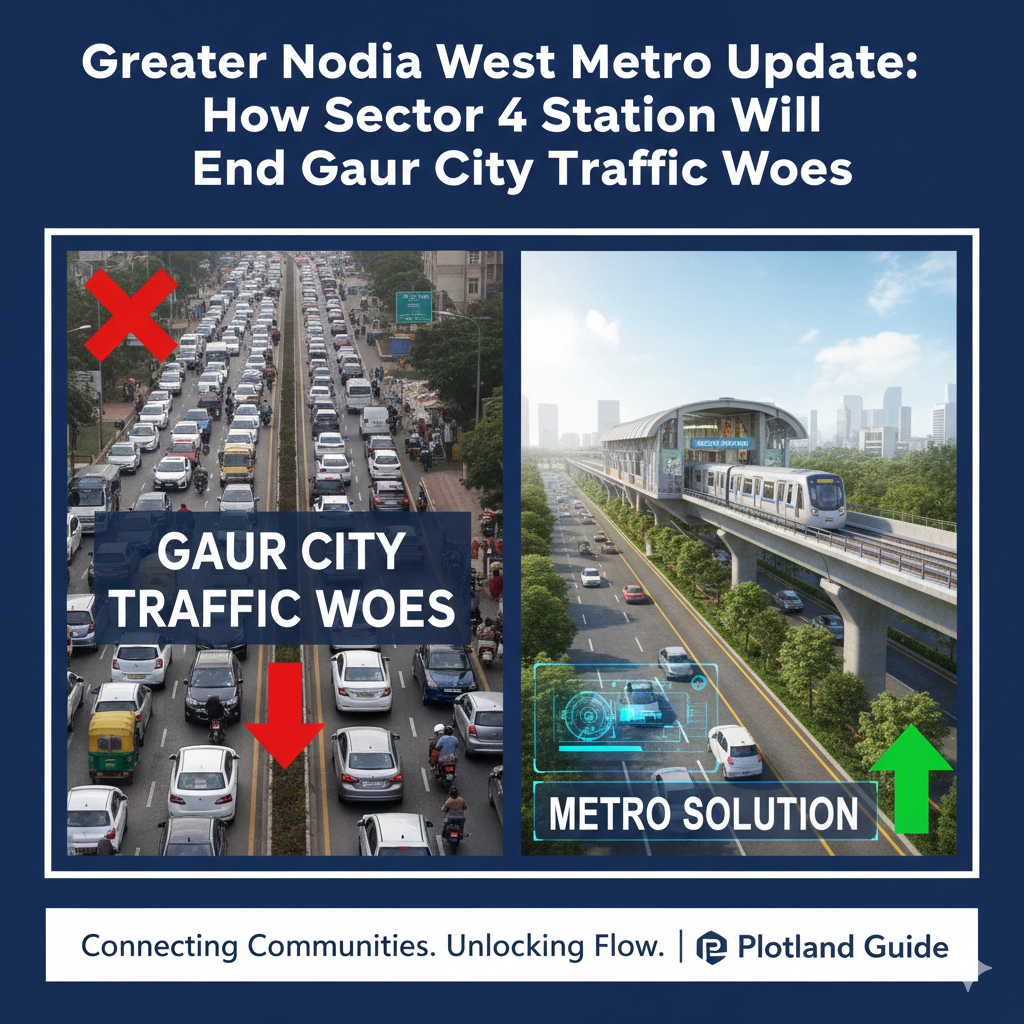
The daily commute to and from Greater Noida West has long been a daunting challenge for its residents, but the light at the end of the tunnel is finally visible, and it arrives in the form of a modern electric train. Over the past few years, the skyline of Noida Extension has transformed dramatically, populated by towering residential complexes and sprawling townships. Yet, the public transport infrastructure struggled to keep pace with this exponential growth. Today, that narrative is undergoing a massive shift. The state government and transit authorities have pivoted their focus toward accelerating the Greater Noida West Metro project, placing the spotlight firmly on the crucial stretch that culminates at Sector 4. This is no ordinary infrastructure update; it is a monumental leap toward connecting the sky-scraping apartment complexes of the Gaur City area directly to the broader Delhi-NCR transit grid.
For the over five lakh residents calling this region home, the announcement comes as a long-awaited deliverance from the soul-crushing traffic jams that plague the Gaur City circle every single day. Following multiple revisions and strategic alignments to ensure seamless integration with other upcoming transit networks, the Detailed Project Report for the first phase of the metro project has cleared its major bureaucratic hurdles. The dream of a smooth, predictable, and comfortable commute is rapidly taking shape on the ground.
The strategy for rolling out the Greater Noida West Metro, widely known as the Aqua Line Extension, has been cleverly redesigned to maximize immediate impact while ensuring future scalability. Initially envisioned as an extensive eleven-station corridor stretching all the way to Knowledge Park V, the authorities have pragmatically revised the blueprint for Phase 1. The new, fast-tracked plan focuses on a highly strategic elevated track that kicks off from Sector 61 in Noida and currently wraps up at Greater Noida Sector 4, right at the bustling Gaur Chowk.
This revised Phase 1 corridor will feature four critical stations: Sector 61, Sector 70, Sector 123, and the terminal point for this phase at Greater Noida Sector 4. The decision to truncate the initial phase was born out of a need to seamlessly integrate with the proposed Ghaziabad-Jewar Rapid Rail Transit System, a high-speed rail network destined to connect the region to the upcoming Noida International Airport. By focusing efforts and resources on this truncated but vital stretch, the transit corporation ensures that the most populated and congested zones receive immediate relief. Sector 61 is set to be developed on the lines of a major junction, serving as a vital interchange point where commuters can effortlessly switch between the local Aqua Line and the extensive Blue Line of the Delhi Metro.
Anyone who has navigated Greater Noida West during peak office hours understands the sheer magnitude of the traffic problem. The Char Murti intersection, commonly referred to as Gaur Chowk, serves as the primary gateway for thousands of families living in the dense clusters of Gaur City and the surrounding high-rises. In the absence of a robust mass transit system, the vast majority of these residents have been forced to rely heavily on private cars, two-wheelers, cabs, and shared auto-rickshaws to commute to commercial hubs in Noida, Delhi, and Gurgaon. The sheer volume of vehicles trying to funnel through limited arterial roads inevitably results in massive gridlocks.
The introduction of the Sector 4 metro station is poised to be the ultimate game-changer for this specific bottleneck. By establishing a high-capacity boarding point just a short walk or a brief ride from the gates of major housing societies, the project aims to take thousands of private vehicles off the roads every single morning. The route has been meticulously designed to snake through the most densely populated residential blocks, ensuring maximum accessibility. When fully operational, the station will serve as a massive pressure valve, releasing the pent-up traffic congestion and bringing order to the currently chaotic vehicular movement around the Gaur City roundabout.
The vision for this transit corridor extends far beyond merely laying down tracks; the objective is to build a top-tier urban mobility experience that encourages a permanent behavioral shift away from private vehicle usage. Every station on this newly proposed stretch, including the pivotal Sector 4 hub, will be entirely elevated. This architectural decision is vital because it ensures that the ongoing construction and future operations do not interfere with or further congest the existing road traffic below.
Commuters can expect an array of modern amenities that match the sophisticated vibe of the existing operational lines. The stations will be equipped with Automatic Fare Collection gates, advanced security screening systems, and comprehensive heavy-duty CCTV coverage to ensure maximum passenger safety. The platforms will feature sleek, modern aesthetics designed for smooth crowd management during peak rush hours. Furthermore, the authorities are deeply aware that the journey does not end at the station exit. To solve the crucial first-and-last-mile connectivity puzzle, comprehensive plans are being laid out to integrate dedicated e-rickshaw stands and low-floor electric feeder bus services right beneath the Sector 4 station. This ensures that a resident stepping off the train at night can quickly and safely reach their apartment complex without any logistical guesswork.
As we progress through 2026, the rhetoric surrounding the Greater Noida West Metro has finally translated into tangible action. After navigating a complex web of route revisions and funding discussions—particularly concerning the overlapping alignment with the rapid rail corridor—the central and state authorities have successfully untangled the administrative knots.
On the ground, the preliminary work that sets the foundation for heavy construction is well underway. Comprehensive soil testing and detailed topographic mapping for the stretch leading up to Sector 4 are nearly complete. These geotechnical surveys are critical for determining the structural requirements of the elevated pillars. Concurrently, the transit corporation is in the advanced stages of sorting through civil construction tenders. With the financial blueprints finalized and the equity sharing between the state, center, and local development authorities formally agreed upon, the deployment of heavy machinery and the commencement of barricading along the central verges of the Noida-Greater Noida Link Road are expected very soon.
For the families residing near Sector 4, the operationalization of this metro line will usher in a severe upgrade to their daily routines. The most immediate and tangible benefit is the massive reclamation of personal time. A grueling road journey that currently eats up forty-five minutes to an hour of stop-and-go frustration could be slashed to a highly predictable fifteen-minute train ride. This newfound punctuality is invaluable for working professionals who can now bypass the unpredictable nature of road traffic entirely.
Safety and comfort represent another massive upgrade. Navigating the wild, unstructured traffic of the extension area, especially during heavy monsoon downpours or dense winter fogs, is a highly stressful endeavor. The metro system operates completely insulated from these surface-level disruptions, offering a climate-controlled, well-lit, and heavily monitored environment. This is particularly beneficial for female commuters traveling after dark, offering a level of security that private cabs or shared autos simply cannot match.
Furthermore, the environmental implications of this shift are profound. The Delhi-NCR region continually battles severe air quality issues, driven in large part by vehicular emissions. By transitioning a significant portion of the commuting populace from fossil-fuel-burning cars to an electric mass transit system, the Sector 4 metro station will play a direct role in giving the local air quality a desperate and much-needed break.
It is an established economic principle that urban infrastructure drives real estate valuation, and the Greater Noida West market is already reacting aggressively to the solidified metro plans. Sector 4 and its immediate neighboring areas are currently experiencing a palpable metro surge. Residential flats that had seen stagnant valuations for a few years have witnessed a sudden and sharp appreciation in capital value. Market analysts note that property prices in societies situated within a close radius of the upcoming Sector 4 station have jumped by a significant 15 to 20 percent, purely because the metro is now recognized as an imminent reality rather than a speculative promise.
The rental market is simultaneously bracing for a massive transformation. Landlords are anticipating a flood of interest from young corporate professionals and nuclear families who desire the relatively spacious and affordable housing options of Greater Noida West, but absolutely require a fast, reliable link to their workplaces in the commercial centers of Noida and South Delhi.
This residential boom is closely trailed by a fierce commercial awakening. Real estate developers are racing against the clock to wrap up the construction of high-end shopping malls, multiplexes, and modern office towers in the vicinity of the planned station. They are betting big on the guaranteed, high-volume footfall that a major transit hub invariably brings. The area around Sector 4 is rapidly transforming from a mere residential dormitory into a self-sustaining micro-market brimming with retail, entertainment, and employment opportunities.
While the Sector 4 station represents a localized victory for Gaur City residents, it is a vital piece of a much larger puzzle aimed at weaving the entire National Capital Region into a tightly knit economic zone. The revised Aqua Line extension works in tandem with other massive infrastructure projects rapidly taking shape across the city. Together, these expansions are slowly eradicating the isolated pockets of the residential sectors.
In the near future, a commuter living in Gaur City will be able to board a train at Sector 4, switch seamlessly to the Blue Line at Sector 61, and travel all the way into the heart of central Delhi without ever stepping onto a congested road. Alternatively, they will be able to connect to the rapid rail network to access the upcoming international aviation hub at Jewar in record time. This holistic approach to urban planning ensures that Greater Noida West is not left as a sprawling suburb, but is instead elevated to the status of a premier, hyper-connected urban center.
The realization of the Sector 4 metro station is poised to permanently alter the socio-economic landscape of Greater Noida West. It signifies the end of an era defined by exhausting commutes and traffic gridlocks, ushering in a future characterized by speed, safety, and sustainable urban living. As the blueprints finally morph into concrete pillars and steel tracks over the coming years, the residents of Gaur City and its surrounding high-rises can confidently look forward to reclaiming their time and enjoying the true benefits of living in a modern, world-class city. The transformation of this bustling neighborhood has officially begun, and the momentum is unstoppable.
