Published On:
July 26, 2026
Updated On:
July 26, 2026
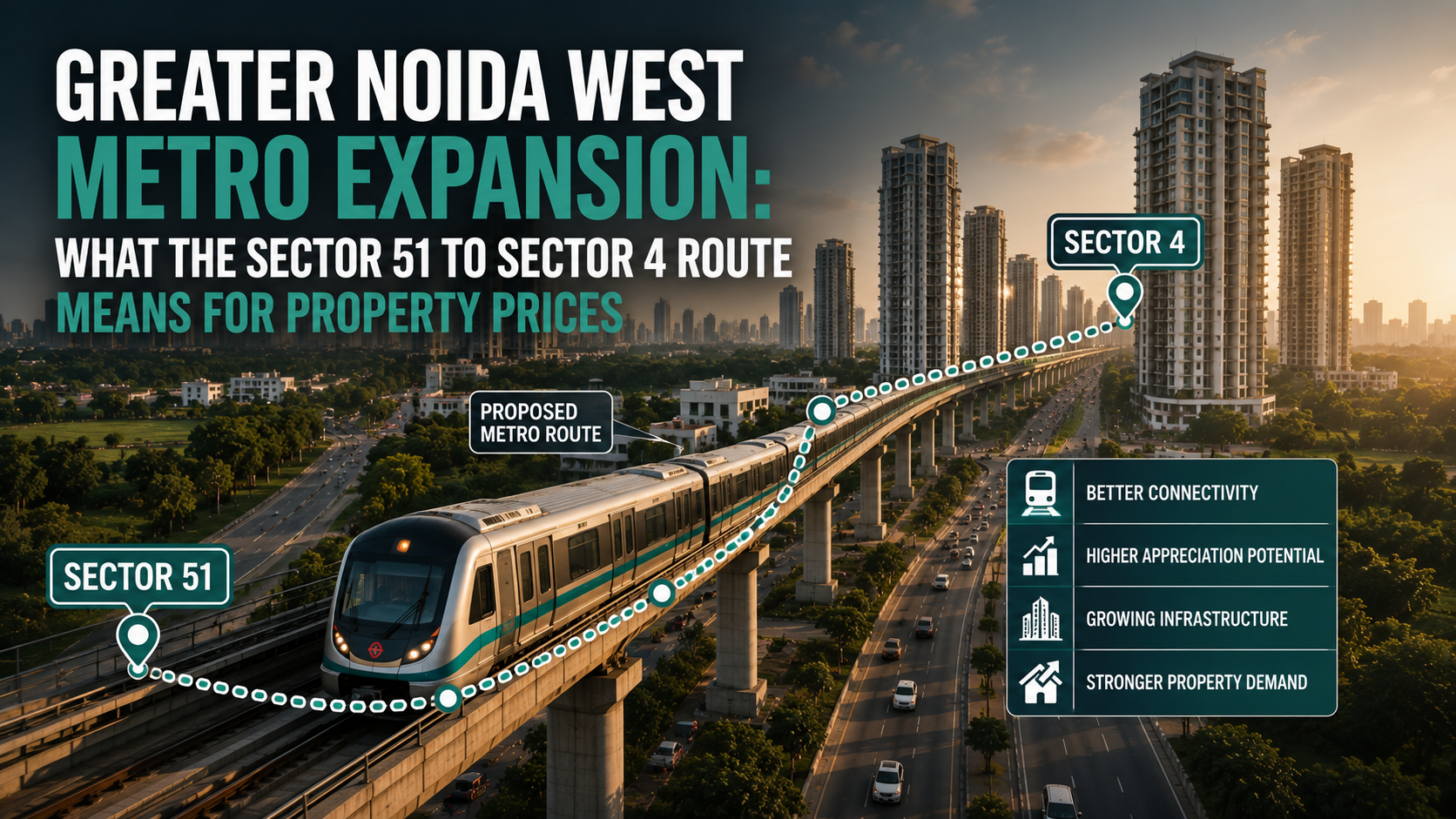
The Public Investment Board has officially cleared the revised Greater Noida West Metro corridor, featuring a highly strategic five-station route from Noida Sector 51 to Greater Noida West Sector 4 (Kisan Chowk). This infrastructure milestone will finally integrate the Aqua Line, the Delhi Metro Blue Line, and the upcoming Namo Bharat RRTS, promising immense commute relief for over 5 lakh residents and triggering a massive surge in local real estate valuations.
Greater Noida West, historically and popularly known as Noida Extension, has organically evolved into one of the most densely populated and sought-after residential micro-markets in the entire National Capital Region. Over the past decade, the skyline has transformed with hundreds of high-rise societies, sprawling commercial avenues, and a population that has rapidly crossed the five-lakh mark. The area boasts excellent internal roads and modern housing infrastructure, but it has suffered from one glaring foundational flaw: the absolute lack of heavy public transit.
For years, the residents of Greater Noida West have relied almost entirely on personal vehicles, shared auto-rickshaws, and private cabs to navigate their grueling daily commutes to Delhi, Gurugram, and central Noida. The infamous, kilometer-long traffic snarls at Gaur Chowk (Kisan Chowk) and the heavy pressure on the Parthala signature bridge have become daily struggles for the working class.
However, the public transport narrative of this region is finally undergoing a monumental and long-awaited shift. In a massive development in July 2026, the Greater Noida West Metro project crossed a highly critical administrative hurdle. The Public Investment Board has given its positive clearance to the revised metro corridor proposed by the Noida Metro Rail Corporation. This critical approval effectively clears the runway for the final Union Cabinet nod, bringing the Sector 51 to Sector 4 metro route out of the planning files and closer to ground reality.
Anyone who has been tracking the real estate and infrastructure developments of Greater Noida West knows that this metro line has been a subject of intense speculation and multiple revisions. The original Detailed Project Report, which was approved by the state cabinet a few years ago, envisioned a massive 17.4-kilometer extension. That older plan included eleven stations, pushing deep into Noida Extension and terminating all the way at Knowledge Park V.
However, urban planning requires constant adaptation to overlapping infrastructure projects. The central government recently finalized the alignment for the highly ambitious Namo Bharat Rapid Rail Transit System (RRTS), which is designed to connect Ghaziabad directly to the upcoming Noida International Airport in Jewar. Because this high-speed RRTS corridor is also slated to pass directly through Greater Noida West, the authorities realized that running a parallel, 11-station local metro line on the exact same route would result in a massive duplication of resources and funding.
To ensure better financial viability and seamless multimodal integration, the Noida Metro Rail Corporation strategically revised and shortened the Detailed Project Report. The newly approved plan is a highly focused, 8.4-kilometer elevated corridor featuring just five stations. While some local residents initially expressed disappointment over the shortened route, urban planners point out that this integrated approach is far superior. It prevents redundant construction and ensures that the local metro perfectly complements the high-speed regional rail network rather than competing against it.
The new, optimized 8.4-kilometer stretch is designed to act as a crucial transit bridge, directly linking the isolated populations of Greater Noida West with the broader, established Delhi-NCR metro grid. The corridor is estimated to require an investment ranging between ₹900 crore and ₹1,500 crore, jointly funded by the central government, the state government, and local development authorities.
The route will feature five strategically placed elevated stations, each serving a distinct catchment area:
This is arguably the most important station on the new alignment. The current Noida Aqua Line has faced heavy criticism because its Sector 51 terminal does not physically connect to the Delhi Metro Blue Line at Sector 52, forcing commuters to exit the station and take an inconvenient walkway. The new extension fixes this foundational flaw. The new route will feature a station at Sector 61, which will serve as a direct, seamless interchange with the Delhi Metro Blue Line. This means a resident boarding the train in Greater Noida West can seamlessly transfer at Sector 61 and travel straight to Connaught Place, Anand Vihar, or Dwarka without ever stepping out onto the street.
Moving further along the Vikas Marg, the Sector 70 station will cater to the densely populated, established residential sectors of central Noida. This station will provide immediate transit relief to the massive housing societies in Sectors 70, 71, and 74, offering them an alternative to the heavily congested road networks below.
As the elevated tracks move closer to the Hindon river and the Parthala bridge, the stations at Sector 122 and Sector 123 will act as vital transit nodes. These sectors are currently witnessing a surge in new residential and commercial developments. Having dedicated metro stations will transform these developing pockets into highly accessible, premium real estate hubs, significantly reducing the vehicular load on the nearby bridge.
The crown jewel of this extension is the terminal station at Sector 4, widely known as Gaur Chowk or Kisan Chowk. This intersection is the absolute epicenter of Greater Noida West. By dropping a major metro station right at the entrance of the township, the authorities are providing immediate transit access to over five lakh residents living in the immediate vicinity. This station will eliminate the need for thousands of daily commuters to drive their cars to the Sector 52 station just to board a train to Delhi.
The strategic brilliance of ending the local metro line at Sector 4 becomes evident when looking at the broader regional transport map. The revised plan is not just about getting people to Delhi; it is about plugging Greater Noida West into the global aviation map.
According to the aligned transport strategies, the Sector 4 (Kisan Chowk) metro station will eventually serve as a massive multimodal interchange hub. The upcoming Namo Bharat RRTS corridor, stretching from Ghaziabad to the Noida International Airport at Jewar, will feature a major transit stop at this exact location.
Once both projects are operational, a resident living deep inside Greater Noida West can simply take a short feeder bus or auto to the Sector 4 station, switch to the Namo Bharat high-speed rail, and reach the Jewar International Airport in a matter of minutes. This creates India's first truly end-to-end public transport loop from a major residential township directly to an international aviation hub. The ability to travel to central Delhi via the Blue Line or fly out of Jewar via the RRTS—all from one central junction—will completely redefine the livability index of Noida Extension.
Infrastructure projects of this magnitude require immense bureaucratic coordination, but the recent clearances suggest that the administrative wheels are turning rapidly. The positive nod from the Public Investment Board was the most significant hurdle. The project file now moves to the Union Cabinet for the final, formal stamp of approval.
Once the central government clears the file, the Noida Metro Rail Corporation will immediately initiate the tendering process to select the construction contractors. If the bureaucratic momentum is maintained, the ground-breaking ceremonies and active civil construction are widely expected to commence by the early months of 2027. While civil construction of an elevated metro line typically takes about three years, the relatively short 8.4-kilometer length of this corridor means it could be fast-tracked and operationalized much sooner than traditional, longer metro lines.
The confirmation of the metro route is sending massive shockwaves through the local real estate market. Urban infrastructure is the absolute biggest catalyst for property appreciation, and Greater Noida West is sitting on the edge of a massive valuation boom.
For the past few years, property prices in the region have grown steadily based on the sheer quality of the housing societies and the expansion of internal commercial malls. However, the lack of a metro acted as a psychological ceiling for property rates. High-net-worth individuals and premium tenants often bypassed the area strictly because of the exhausting commute. The formal approval of the Sector 51 to Sector 4 line completely shatters that ceiling.
Real estate experts predict an immediate, sharp appreciation in the capital values of apartments located within a two to three-kilometer radius of the proposed Sector 4 metro station. Societies that offer walkability to the upcoming station will command extreme premiums. Homebuyers who invested in this micro-market a few years ago are already sitting on substantial equity, and this infrastructure upgrade will multiply those gains. For those sitting on the fence, the window to buy affordable property in Greater Noida West is rapidly closing, as developers are already beginning to adjust their base selling prices upward in anticipation of the metro.
The commercial real estate sector will witness an even more aggressive boom. Gaur Chowk is already a thriving retail hub, featuring massive high-street shopping avenues, multiplexes, and corporate office towers. The daily footfall generated by a terminal metro station will instantly multiply the customer base for these commercial establishments. Retailers and global brands that were previously hesitant to open flagship stores in Noida Extension due to transit issues will now aggressively compete for leasing space. This guarantees a massive spike in commercial rental yields for shop owners and investors in the immediate vicinity.
For investors focused on passive income, the metro extension turns Greater Noida West into a rental paradise. A massive demographic of young IT professionals, corporate employees, and students working in Noida and Delhi prefer renting in Greater Noida West due to the superior quality of gated societies. Their only grievance has been the commute. With seamless, air-conditioned metro connectivity directly to Delhi and the Noida Expressway corporate belt, the tenant demand will skyrocket, driving up monthly rental rates and virtually eliminating residential vacancies.
The approval of the Greater Noida West Metro extension is much more than just a transport upgrade; it is the final piece of the puzzle that legitimizes the township. For over a decade, the region has been viewed as a slightly disconnected, affordable housing alternative to the premium sectors of central Noida. Today, it is stepping out of that shadow.
As the pillars for the new elevated tracks begin to rise along the Vikas Marg, they will symbolize the end of exhausting traffic jams and the beginning of a highly connected, modern urban lifestyle. The integration of the Aqua Line, the Delhi Metro Blue Line, and the high-speed Namo Bharat RRTS will transform Greater Noida West from a congested suburban pocket into one of the most accessible, highly valued, and seamlessly integrated real estate destinations in northern India. For the five lakh residents who have waited patiently for this day, the future of their commute—and the value of their homes—has never looked brighter.
