Published On:
September 6, 2026
Updated On:
September 6, 2026
The Greater Noida Authority has officially approved a 4-kilometre elevated road connecting the Tilapta intersection to the Dadri Container Depot, a strategic infrastructure upgrade designed to separate heavy industrial freight from local passenger traffic, drastically reducing daily gridlocks and boosting surrounding real estate values.
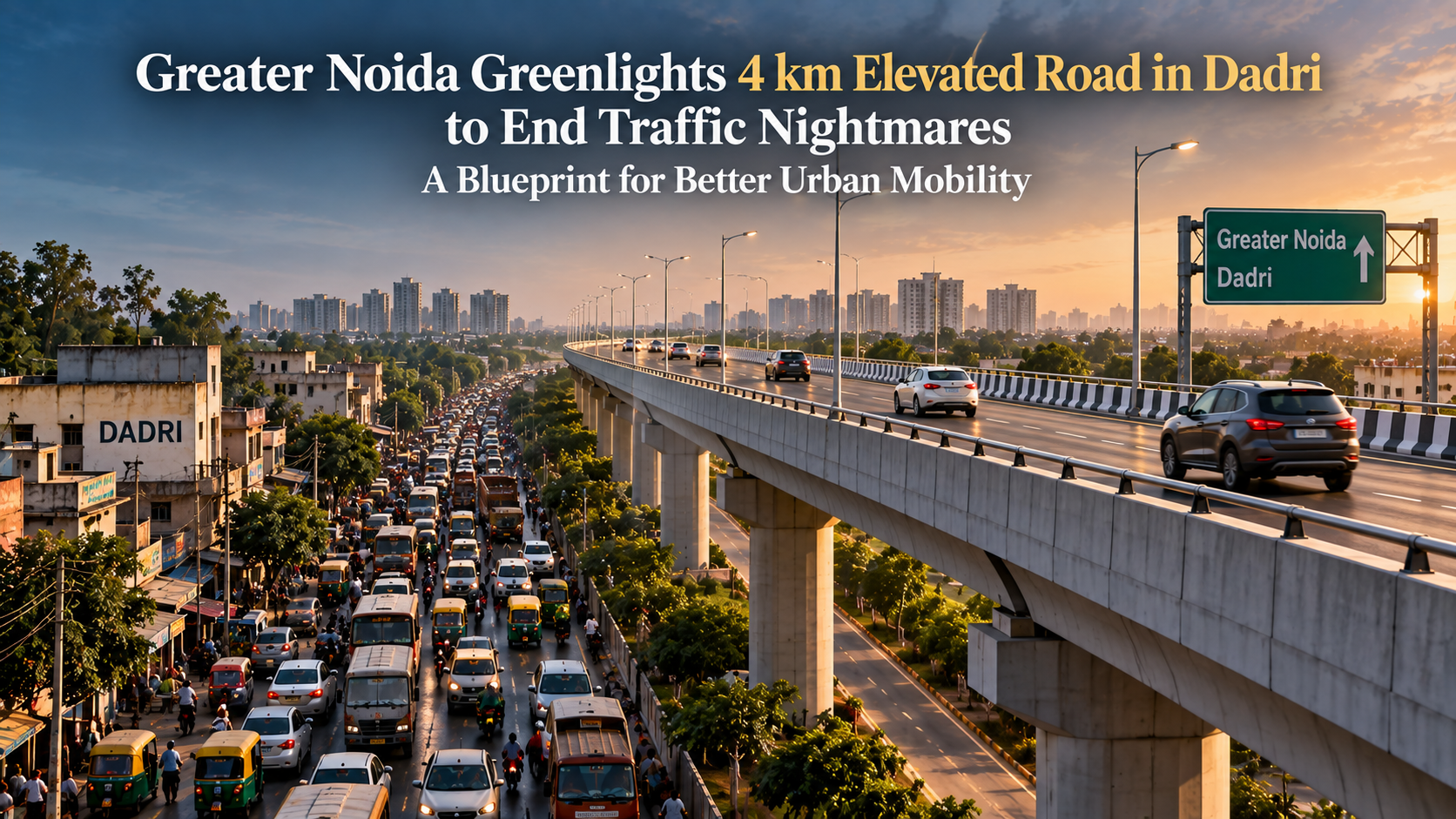
For years, navigating the roads around Dadri has been a severe test of patience for thousands of daily commuters. The region, positioned at a highly strategic logistical juncture, has experienced immense industrial and residential growth. However, this rapid economic expansion has come at a massive cost to local urban mobility. The primary artery serving this area, the Dadri-Surajpur-Chhalera route, was originally designed to handle moderate traffic. Today, it is completely overwhelmed by a chaotic, unsegregated mix of heavy logistics vehicles, multi-axle freight trailers, local passenger cars, two-wheelers, and public transport.
The root of this massive congestion lies in the presence of the Inland Container Depot in Dadri, one of the largest dry ports in northern India. Every single day, thousands of massive container trucks rumble through the narrow city lanes to load and unload export-import cargo. When these heavy freight vehicles are forced to share the same ground-level intersections with office-goers and school buses, the result is a perpetual state of gridlock. The situation is further aggravated by existing bottlenecks around the Dadri Railway Overbridge and the Roopbas Bypass, where traffic from multiple arterial roads converges. The morning and evening peak hours witness miles of stalled vehicles, leading to massive productivity losses, high fuel wastage, and immense commuter frustration. Recognizing that minor road widening would never solve this fundamental structural problem, civic authorities have finally taken a decisive, vertical approach to urban planning.
To permanently cure this logistical paralysis, the Greater Noida Authority has given its preliminary approval for the construction of a brand-new, four-kilometre elevated road directly targeting this specific bottleneck. The planned elevated corridor will act as a high-speed bypass, stretching seamlessly from the Tilapta intersection police post straight to the gates of the Container Depot in Dadri.
The primary objective of this massive infrastructure project is the total segregation of traffic. By building a robust upper deck, the authorities intend to isolate the heavy industrial trucks from regular passenger vehicles. The Uttar Pradesh Bridge Corporation has been officially tasked with drafting the comprehensive Detailed Project Report and conducting the necessary on-ground feasibility studies. This engineering blueprint will finalize the exact alignment, the structural width required to safely accommodate heavy freight, and the estimated financial outlay for the project. Senior officials from the authority have confirmed that while the preliminary administrative sign-off is complete, the actual ground-breaking civil work will commence immediately after the final technical report is vetted and approved.
The concept of dual-level traffic segregation is a proven urban engineering strategy used in advanced logistics hubs worldwide. Once the elevated road is operational, freight trailers and massive container trucks approaching from regional highways will be directed onto the elevated ramp at the Tilapta intersection. This gives them a direct, uninterrupted line to the depot without ever having to navigate local neighbourhood intersections, stop at pedestrian crossings, or wait at multiple traffic signals.
Meanwhile, the existing ground-level street will be liberated from the massive physical footprint of these trucks. It will remain open exclusively for local drivers, two-wheelers, and light commercial vehicles. Taking these massive trucks out of the daily street traffic eliminates the constant start-and-stop gridlock that currently plagues the route. Local drivers will no longer have to blindly navigate around parked or slow-moving trailers. The segregation ensures that heavy freight can move at an optimized, steady speed above, while neighbourhood traffic flows smoothly and safely below.
The positive impact of this elevated road extends far beyond simply cutting down travel times; it represents a major environmental and civic intervention. One of the most severe consequences of the current traffic crisis is the alarming level of localized air pollution. When thousands of diesel-powered heavy trucks are forced to idle in endless traffic jams, they emit massive volumes of toxic tailpipe smoke, particulate matter, and greenhouse gases directly into the surrounding residential neighbourhoods. By providing a signal-free elevated corridor, trucks will maintain a steady cruising speed, which significantly optimizes engine efficiency and drastically cuts down on idle emissions. Removing these vehicles from the surface streets means noticeably cleaner air and a much healthier living environment for local families.
Furthermore, the project will save the municipal corporation crores of rupees in recurring maintenance costs. Heavy multi-axle trucks exert immense structural pressure on standard asphalt roads, leading to rapid surface degradation, deep rutting, and the constant formation of dangerous potholes. By moving this heavy load onto a specially engineered concrete elevated structure designed explicitly for high weight-bearing capacity, the ground-level city lanes will be protected from heavy wear and tear. This ensures that the surface roads remain smooth, durable, and safe for passenger cars and two-wheelers for much longer periods.
In the realm of real estate, infrastructure is destiny. The announcement of the Dadri elevated road is already sending highly positive signals through the local property market. Historically, residential areas situated directly along heavy logistics corridors suffer from depressed property values. The constant noise pollution, dust, and safety hazards associated with thousands of passing trucks make these locations less desirable for families. However, the decision to elevate the freight traffic fundamentally changes the real estate equation for the entire region.
Infrastructure upgrades of this magnitude almost always push up property values across nearby neighbourhoods. By eliminating the surface-level chaos, the surrounding streets will become significantly quieter, cleaner, and safer. Shorter drive times to commercial hubs and stress-free daily commutes immediately draw fresh interest from both end-user families and long-term real estate investors. Property consultants anticipate a strong appreciation in capital values and rental yields in the immediate vicinity as the project moves from the planning stage to active construction.
The benefits of the 4-km elevated road will not be restricted just to Dadri; the positive ripple effects will clear up secondary traffic bottlenecks across several key micro-markets in the region.
In Dadri Town, which will enjoy direct, immediate access to the new elevated road corridor, there is already a high and growing demand for residential plots and affordable apartment complexes. The elimination of heavy traffic will transform the town from a congested logistics pass-through into a highly livable suburban hub.
Surajpur, an established industrial and commercial zone situated along the route, will also reap massive benefits. It is a highly popular area for worker housing, mid-segment modern apartments, and light manufacturing units. Better road connections will help thousands of people working in these nearby industrial zones drastically cut down their morning commutes, making Surajpur an even more attractive destination for the industrial workforce.
The rapidly growing residential hub of Greater Noida West, known for its high concentration of premium high-rise apartment projects and top-tier amenities, will also feel the positive impact. Demand for flats in Greater Noida West remains exceptionally high, and as secondary traffic clears up along the connected feeder roads leading towards Dadri and the industrial belts, residents will experience much smoother exits from their sectors.
Similarly, buyers hunting for properties in well-planned, premium sectors like Delta 1 can count on stress-free connections to regional highways. Known for its proximity to the metro network, premium residential plots, and independent builder floors, Delta 1 will benefit from the overall decongestion of the surrounding arterial grid, cementing its status as a highly desirable residential pocket.
To fully grasp the importance of this specific elevated road, it must be viewed as a critical puzzle piece within the broader, ambitious infrastructure vision being executed across the National Capital Region. Greater Noida is rapidly positioning itself as the premier logistics and manufacturing hub of northern India.
The region is flanked by massive macro-infrastructure projects, including the Eastern Peripheral Expressway, the upcoming mega-city project of New Noida, and the rapidly developing aviation and logistics ecosystem around the upcoming Noida International Airport in Jewar. For these massive projects to function efficiently, the internal arterial roads connecting them to existing dry ports like the Dadri Container Depot must be absolutely seamless.
The new elevated road acts as a vital missing link. It ensures that export-oriented goods manufactured in the region can reach the container depot without choking the city’s internal residential traffic. It aligns perfectly with the state government's broader vision of creating dedicated freight corridors that operate independently of passenger traffic, thereby enhancing the overall ease of doing business and attracting massive foreign and domestic industrial investments to the district.
While the optimism surrounding the project is incredibly high, civic authorities are ensuring that the planning phase is executed with absolute precision to avoid future cost overruns or engineering flaws. The project is currently in the advanced planning and feasibility stage. The Uttar Pradesh Bridge Corporation is meticulously mapping out the exact structural alignment, assessing the required land clearances, and evaluating the soil conditions for erecting the massive support pillars.
Once the Detailed Project Report is finalized and submitted to the Greater Noida Authority, the financial budgeting will be locked in, followed by the floating of construction tenders. While large-scale elevated structures over active, heavy-traffic zones present significant logistical challenges during the construction phase—requiring careful traffic diversions and night-time building schedules—the long-term payoff makes the temporary inconvenience entirely worthwhile.
The approval of the 4-km elevated road in Dadri is a massive victory for forward-thinking urban planning. It acknowledges a fundamental reality of modern economic growth: industrial logistics and residential living can only coexist peacefully if they are physically segregated.
By taking the bold step to elevate massive freight trucks onto a dedicated, high-speed path, the Greater Noida Authority is not just solving a localized traffic jam; they are completely redesigning the daily experience of the city's residents. Lower lanes will be freed up, the air will become noticeably cleaner, and the routine, agonizing bottlenecks will be permanently eliminated.
For the thousands of families, office-goers, and industrial workers who navigate this route daily, the promise of faster, hassle-free travel across the area is finally within reach. As the blueprints transition into concrete pillars over the coming months, this elevated corridor will stand as a testament to how targeted infrastructure investments can simultaneously save municipal resources, supercharge local real estate markets, and dramatically elevate the everyday quality of urban life.
