Published On:
September 6, 2026
Updated On:
September 6, 2026
The Greater Noida Authority has officially greenlit a 7km double-decker flyover connecting Ek Murti Chowk to the Delhi-Meerut Expressway, bypassing the notorious Shahberi bottleneck. This Rs 756-crore infrastructure marvel is set to transform daily commuting, significantly boost local real estate demand, and spur further economic growth in Greater Noida West.
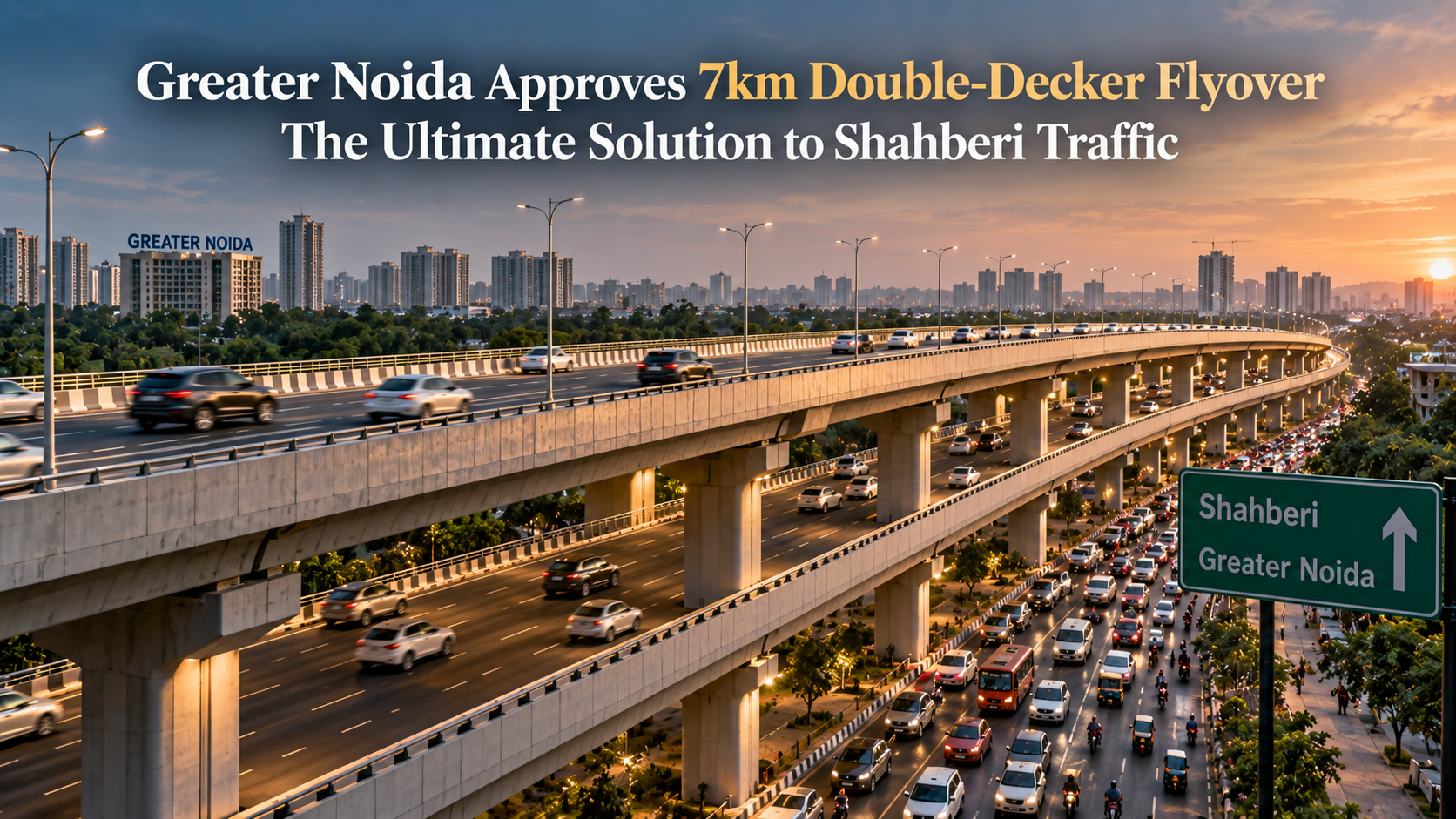
For thousands of residents living in the sprawling high-rises of Greater Noida West, the morning commute has long been a test of patience. Despite the region boasting wide internal avenues and modern residential societies, the external connectivity has historically been choked by a few critical bottlenecks. The most notorious of these is the Shahberi stretch. Anyone travelling from Greater Noida West towards Ghaziabad, Crossings Republik, or the Delhi-Meerut Expressway knows the absolute frustration of being stuck in endless, bumper-to-bumper traffic jams along this narrow corridor.
Over the past decade, Greater Noida West, previously known as Noida Extension, has witnessed an astronomical rise in population. As more families moved into sectors like Gaur City, Sector 1, and Techzone IV, the number of private vehicles hitting the roads multiplied exponentially. Unfortunately, the old village roads bridging these modern sectors to major national highways were never designed to handle such immense urban density. The resulting traffic gridlock at Shahberi became a daily hurdle, wasting precious hours, increasing vehicular pollution, and causing immense stress for office-goers.
However, a massive wave of relief is finally on the horizon. The Greater Noida Authority, during its 144th board meeting in September 2026, officially approved a monumental infrastructure project designed to bypass this chaos completely. A brand-new seven-kilometre double-decker flyover is set to revolutionize regional connectivity, ensuring that the drive between Greater Noida West and the capital region is seamless, fast, and entirely congestion-free.
To appreciate the brilliance of the proposed double-decker flyover, one must first understand exactly why traditional road-widening methods failed spectacularly in this specific area. The existing road passing through Shahberi is incredibly narrow, measuring roughly fifteen metres in width. On either side of this crucial road, rampant unauthorized construction, local retail shops, encroached spaces, and bustling fruit vendor markets have firmly established themselves over the years.
When urban planners and traffic engineers initially looked for solutions to ease the congestion, the standard approach of widening the surface road was quickly ruled out. Acquiring heavily built-up land along this stretch would require massive demolition drives, lengthy legal battles, and extensive compensation payouts, potentially stalling the project for decades. Even building a conventional single-deck elevated corridor was deemed completely inadequate because the sheer volume of two-way traffic funnelling into this narrow 15-metre strip requires maximum lane capacity to function smoothly.
This highly complex urban challenge forced the National Highways Authority of India to think vertically. After conducting extensive feasibility studies and evaluating alternative routes, the experts recommended a double-decker road corridor as the most practical and efficient solution. By stacking two separate elevated roadways on top of a single set of structural pillars, the authorities can effectively double the traffic-handling capacity without requiring a massive expansion of the ground-level footprint. This innovative design completely circumvents the ground-level encroachments, preserving the local markets below while offering a high-speed express route for long-distance commuters above.
The engineering blueprint for this infrastructure marvel is both highly ambitious and incredibly practical. Backed by an estimated budget of Rs 756 crore for its crucial first phase, the detailed project report was prepared and will be spearheaded by the National Highways Authority of India. The total route length will span seven kilometres, acting as a direct, uninterrupted link between Ek Murti Chowk in Greater Noida West and the Delhi-Meerut Expressway.
The double-tiered design ensures that conflicting traffic streams are completely segregated, thereby eliminating intersection delays entirely. The upper deck of the flyover is specifically designated to carry vehicles travelling outward from Greater Noida West directly towards the Delhi-Meerut Expressway. This means commuters heading to Delhi or Meerut can bypass all local ground traffic, skipping multiple signals and localized bottlenecks.
Conversely, the lower deck will cater to the heavy influx of traffic pouring in from Ghaziabad and the densely populated Crossings Republik township. By entirely separating the inbound and outbound regional traffic on two different elevated planes, the existing surface roads will be left relatively empty, primarily serving local neighbourhood traffic and pedestrians. Once completed, this multi-level corridor will reduce a harrowing forty-five-minute traffic crawl through Shahberi into a smooth, five-minute breeze.
Infrastructure and real estate are intrinsically linked, and the formal approval of this double-decker corridor is already sending massive positive shockwaves through the local property market. Improved connectivity is the single biggest driver of property appreciation, and Greater Noida West is uniquely positioned to benefit from this specific development.
For years, potential homebuyers hesitated to invest in certain pockets of Greater Noida West solely because of the dreaded Shahberi traffic jam. The fear of an exhausting daily commute to commercial hubs in Delhi and central Noida deterred many end-users. Now, with a clear, state-backed plan to eliminate this bottleneck, buyer confidence has skyrocketed overnight. Real estate experts and local property consultants are already reporting a sharp surge in fresh inquiries for modern society flats, luxury apartments, and commercial retail spaces situated along the 130-metre road.
Prime localities such as Gaur City, Sector 1, and Techzone IV are witnessing renewed interest from middle-class families and affluent investors alike. These areas offer excellent internal infrastructure, wide avenues, and high-quality gated communities, which will soon be paired with world-class external highway connectivity. The project is also a massive blessing for the residents of Crossings Republik and Shahberi itself. The drastic reduction of heavy, polluting traffic on surface roads will significantly improve the local air quality and reduce noise pollution, elevating the overall livability index of these specific neighbourhoods.
Furthermore, investors who had previously purchased vacant residential plots or commercial spaces in the vicinity are holding onto their assets tightly, anticipating a steep spike in capital values. When commuting to Delhi becomes practically frictionless via the Delhi-Meerut Expressway, the residential attractiveness of Greater Noida West will easily rival, and potentially surpass, many established luxury sectors of central Noida.
While the double-decker flyover grabbed the primary headlines, the recent Greater Noida Authority board meeting was a watershed moment for the region's overall urban development. The board recognized that a rapidly growing city requires a holistic approach to infrastructure, leading to the approval of several other massive civic projects that will collectively shape the economic future of the district.
Chief among these additional approvals is the green signal for a massive ten-lane expressway link. This new twelve-kilometre road will stretch from Junpat directly to the Eastern Peripheral Expressway. This is a highly strategic move designed to dramatically improve heavy freight and passenger access to Dadri and the upcoming Bodaki transport hub. By linking the internal city grids directly to the Eastern Peripheral Expressway, the authorities are ensuring that commercial trucks and logistics vehicles can bypass residential zones entirely, significantly reducing fatal accidents and daily road wear.
The board also demonstrated a very strong commitment to public safety and disaster management. Recognizing the urgent need for rapid emergency response in a highly populated urban zone, the authority allocated thirty flats in the Omicron-1A sector, entirely free of cost, to the National Disaster Response Force. This critical allocation will allow the NDRF 8th Battalion to set up a permanent, highly equipped disaster response camp right in the heart of the city, ensuring immediate deployment during natural calamities or structural emergencies.
In a move aimed at inclusive urban growth, the board addressed the pressing need for worker housing. Massive land parcels in the villages of Patwari and Birondi have been officially earmarked for the construction of Economically Weaker Section flats. These housing units will primarily serve the vast population of migrant construction workers who serve as the backbone of the city's real estate boom, providing them with safe, dignified, and regulated living spaces.
Adding to the social infrastructure footprint, the authority also granted approval for a modern, three-storey public library to be built in the Alpha 1 sector. Spanning over 1,360 square metres, this facility aims to foster an environment of learning and provide a quiet, resource-rich space for students, researchers, and local residents.
To truly gauge the long-term importance of the Shahberi double-decker flyover, it must be viewed as a crucial puzzle piece within a much larger, rapidly evolving transport ecosystem. Greater Noida West is not developing in isolation; it is swiftly becoming the central node of the entire National Capital Region's mobility network.
This new flyover will work in perfect synergy with several other mega-projects currently transforming the landscape. The operational Noida International Airport at Jewar is already turning the wider region into a global economic hotspot. To support the airport's massive traffic projections, local roads like the 130-metre wide avenue are undergoing intense upgrades. Furthermore, the recently completed Gaur Chowk underpass has successfully eliminated another major historic bottleneck, allowing free-flowing traffic across one of the area's busiest intersections.
When you combine the Gaur Chowk underpass, the widened 130-metre road, the upcoming proposed metro rail connectivity extensions, and this new double-decker access to the Delhi-Meerut Expressway, a very clear picture emerges. Greater Noida West is rapidly transforming into one of the most seamlessly connected urban centres in northern India. Residents will soon enjoy multiple high-speed multimodal transport options, whether they are commuting to a corporate office in Gurugram, catching an international flight from Jewar, or heading into central Delhi for a weekend outing.
With the Detailed Project Report firmly approved and a massive budget of Rs 756 crore allocated for the first phase, the focus now shifts entirely to ground-level execution. The financial burden of this massive undertaking will be shared equitably among the Yamuna Expressway, Noida, Greater Noida, and Ghaziabad authorities, perfectly reflecting the true regional importance of the corridor.
Executing a double-decker flyover over an active, highly congested traffic zone like Shahberi will undoubtedly present severe logistical challenges for the engineers. The construction phase will require meticulous traffic diversion planning to ensure that the daily lives of residents are not completely paralyzed while the massive concrete pillars are erected. However, the short-term inconvenience of construction barricades and diverted routes is a very small price to pay for a permanent, structural solution to a decade-old problem.
The approval of the 7km double-decker flyover is far more than just a standard road construction project. It is a bold, decisive statement by civic authorities that they are willing to leverage advanced engineering to solve incredibly complex urban challenges. By finally curing the Shahberi traffic paralysis, Greater Noida West is effectively unlocking its full potential, cementing its status as the most promising, well-connected, and future-ready residential and commercial destination in the National Capital Region.
