Published On:
January 29, 2026
Updated On:
January 30, 2026
A JLL India report reveals that global corporations leased nearly 60% of India's office space in 2025, driven by Global Capability Centres (GCCs). Bengaluru remains the top destination, with overall leasing rising 8% to 83.3 million sq ft across seven major cities.
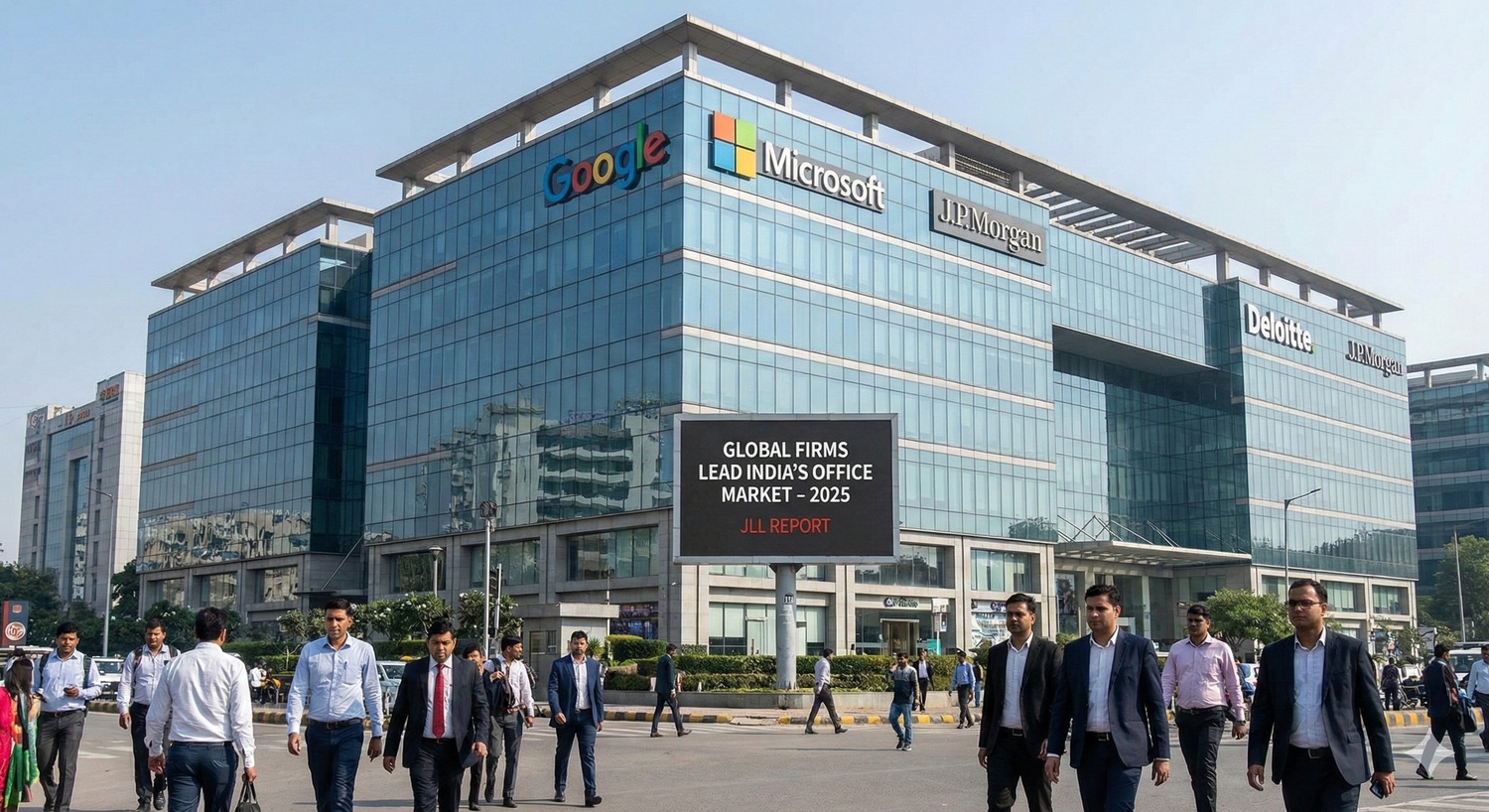
If 2024 was a year of cautious recovery, 2025 has officially become the year of global dominance in India's commercial real estate sector. In a landscape often dictated by fluctuating economic tides, the Indian office market has not just survived; it has thrived, rewriting the rulebook on absorption and demand.
Recent market data indicates a massive structural shift: global firms have leased nearly 60% of India's office space in 2025. This isn't a temporary spike but a clear signal that multinational corporations (MNCs) are doubling down on India, moving beyond traditional outsourcing to establish deep-rooted, strategic operational hubs. With gross leasing volumes touching approximately 83.3 million square feet across top cities, the narrative is clear—India is open for business, and the world is moving in.
The primary engine behind this leasing frenzy is the evolution of Global Capability Centers (GCCs). Historically viewed as cost-saving back offices, these centers have metamorphosed into R&D and innovation headquarters. In 2025 alone, international firms leased over 31 million square feet specifically for GCC setups.
This aggressive expansion is driven by a need for high-end talent rather than just arbitrage. Companies in the BFSI (Banking, Financial Services, and Insurance), engineering, and technology sectors are setting up centers of excellence here to drive global transformation. The availability of a skilled, English-speaking workforce combined with high-quality infrastructure makes India an irresistible proposition. Unlike in the past, these firms are not just renting desks; they are curating ecosystems that foster innovation, pushing the demand for large, campus-style developments.
While the demand is pan-India, the geography of this growth tells a fascinating story of urbanization and infrastructure.
Bengaluru continues to wear the crown as the preferred destination for global occupiers. The city alone accounted for a significant chunk of the total leasing volume, driven by its mature tech ecosystem. For a global tech giant looking to expand its AI or cloud capabilities, Bengaluru remains the default choice due to its dense concentration of engineering talent.
However, the story of 2025 is also about the broadening of the canvas. Hyderabad has emerged as a fierce competitor, attracting massive pre-commitments thanks to its superior infrastructure and proactive government policies. Similarly, Pune is seeing a resurgence, particularly from manufacturing and engineering clients who prefer the city’s industrial DNA combined with IT capabilities.
Delhi-NCR and Mumbai continue to hold their ground, with Mumbai seeing traction from financial heavyweights securing premium spots in Bandra Kurla Complex (BKC) and Lower Parel, while NCR remains the hub for corporate headquarters and diverse GCCs.
A defining trend of 2025 is the discerning nature of the tenant. Global firms are no longer satisfied with basic concrete shells; they demand Grade-A, sustainable, and "smart" buildings. This behavior, often termed the "flight to quality," is reshaping development standards.
Multinational tenants have strict Environmental, Social, and Governance (ESG) mandates. They are actively seeking buildings with LEED or WELL certifications, prioritizing energy efficiency and employee well-being. Developers have responded by upgrading their portfolios, knowing that a green-certified building commands a rental premium and ensures lower vacancy rates. This alignment between tenant values and developer output has significantly elevated the quality of Indian office stock.
Interestingly, the rigid 9-to-5 desk model is evolving even as leasing numbers hit record highs. The demand for flexible workspaces (co-working and managed offices) has grown in tandem with traditional leasing.
Global firms are adopting a "Core + Flex" strategy. They lease a central headquarters (Core) for their permanent staff while utilizing flexible spaces (Flex) for spillover teams, project-based workforces, or regional sales teams. This hybrid model allows companies to remain agile, scaling up or down without long-term capital lock-ins. In 2025, flex space operators were among the most active players in the market, leasing millions of square feet to cater to this enterprise demand.
The momentum generated in 2025 sets a robust foundation for the future. With a strong pipeline of high-quality supply entering the market and vacancy rates in prime manufacturing hubs tightening, the outlook remains bullish. Analysts predict that if the current trajectory holds, India’s office leasing market could soon breach the 100 million square feet milestone.
The dominance of global firms serves as a vote of confidence in India's economic resilience. As geopolitical supply chains realign and companies seek stable, talent-rich geographies, India’s office market is poised to remain a bright spot in the global real estate arena. For investors and developers, the message is unmistakable: build world-class, sustainable infrastructure, and the global giants will come.
