Published On:
April 27, 2026
Updated On:
April 27, 2026
The upcoming Ghaziabad Outer Ring Road is set to eliminate severe traffic bottlenecks around Rajnagar Extension and NH-9 by diverting heavy vehicles away from city limits. With tenders expected soon and massive infrastructure projects simultaneously underway, the region is bracing for a significant boost in commuter convenience and real estate demand.
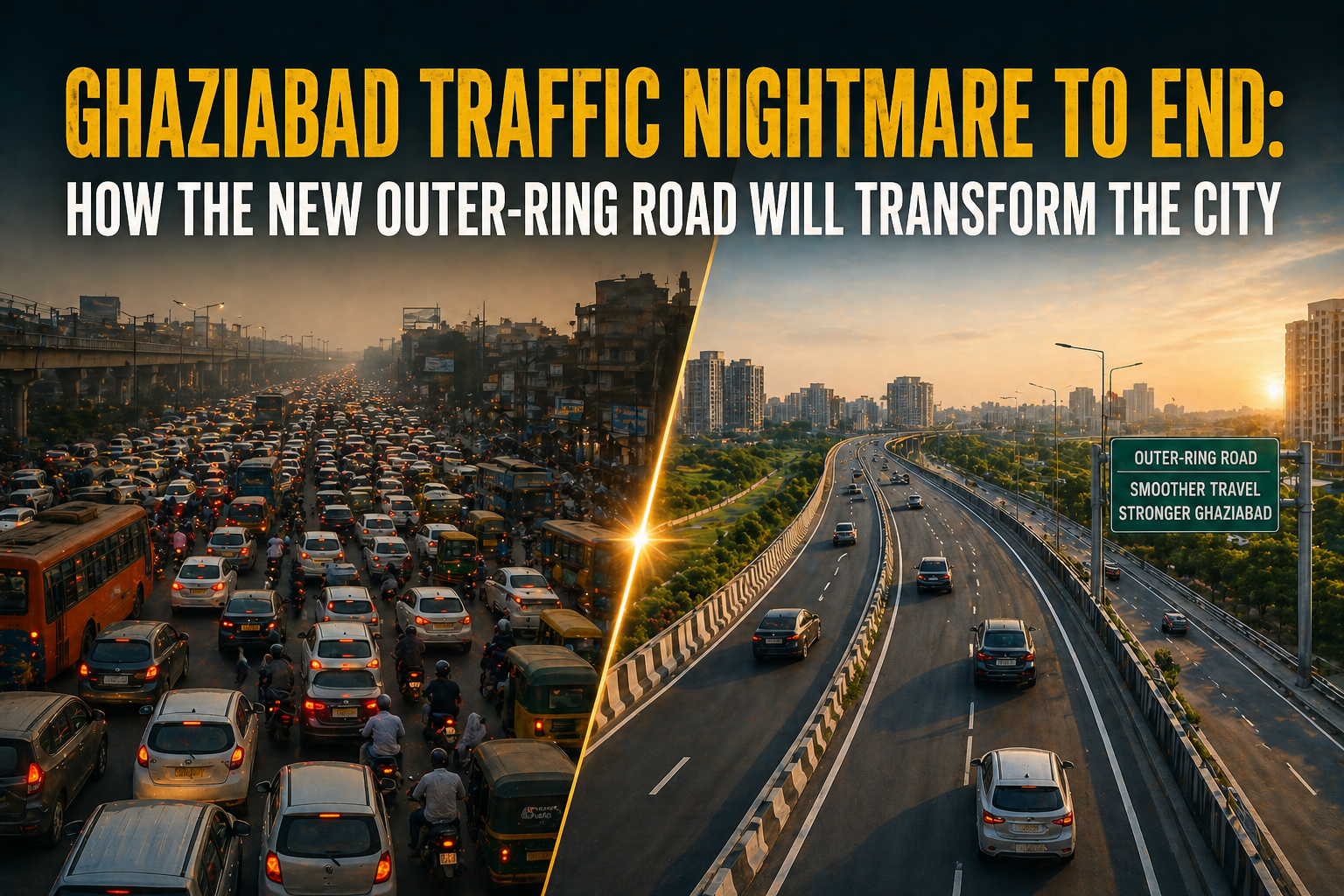
For years, the narrative surrounding Ghaziabad has been a tale of two contrasting realities. On one hand, the city has evolved into one of the most dynamic real estate hubs in the National Capital Region, boasting sprawling residential complexes, elevated highways, and modern transit systems. On the other hand, anyone who has driven through its internal arteries during peak hours knows the exhaustion of its notorious traffic. The daily commute, especially near Rajnagar Extension and the Delhi-Meerut Expressway stretch of NH-9, has often felt like an endless test of patience.
However, a monumental shift is on the horizon. The long-awaited Ghaziabad Outer Ring Road project is finally moving from the drafting table to ground reality. With the Ghaziabad Development Authority aggressively pushing the necessary land acquisition and the tender process expected to commence shortly, this infrastructure marvel is designed to bypass the city's core, entirely redefining how vehicles navigate the district. For daily commuters and real estate investors alike, this development is the ultimate game-changer that promises to unlock the city's true potential.
To understand the magnitude of this upcoming project, one must first look at why Ghaziabad's traffic reached such a critical breaking point. The city is geographically positioned as a vital gateway between the national capital, New Delhi, and the expansive hinterlands of Western Uttar Pradesh and Uttarakhand. Because of this strategic location, Ghaziabad handles a staggering volume of transient traffic.
Currently, thousands of heavy commercial trucks, interstate buses, and logistics vehicles are forced to pass through the crowded internal roads of the city simply because they lack a dedicated bypass route. Areas like Rajnagar Extension, which were initially planned as peaceful residential enclaves, have been forced to absorb this heavy vehicular load. The consequences are visible every single day. Residents step out of their luxury high-rises only to be greeted by gridlocked roads, blaring horns, and deteriorating air quality.
The pressure on NH-9 and the Hindon Elevated Road has multiplied exponentially. While these expressways were built to accelerate travel, the exit nodes plunging into the city often become severe choke points. The absence of a cohesive peripheral road meant that local city traffic and long-distance highway traffic were constantly colliding on the same narrow stretches. The new Outer Ring Road is engineered to permanently decouple these two conflicting streams of traffic.
The solution proposed by urban planners is elegantly simple in its concept but massive in its execution. The primary objective of the Ghaziabad Outer Ring Road is to create a seamless outer corridor that acts as a shield for the city’s internal road network. By providing a dedicated, high-speed peripheral route, vehicles traveling from outside the city can entirely bypass the dense residential and commercial zones.
According to the latest project layouts, the ring road will stretch across crucial transit nodes, creating a critical six-kilometer bypass mechanism for Rajnagar Extension. The route is meticulously planned to connect the D-section near the City Forest in Noor Nagar directly to the Northern Road in Shahpur Nij Morta. While a significant portion of this broader connectivity network has already seen preliminary development, the final, crucial stretches are now being fast-tracked.
The infrastructure design guarantees that this will not be just another suburban street. It is being built to handle heavy, continuous traffic loads, ensuring that commercial fleets can maintain highway speeds without braking for city intersections. Once fully operational, this corridor will effectively filter out the unnecessary vehicular bulk that currently paralyzes the city center.
A project of this scale requires tremendous administrative will and financial backing, particularly when it comes to securing the necessary land in a densely populated urban sprawl. The Ghaziabad Development Authority has taken a highly proactive stance to ensure the project does not face the classic delays associated with infrastructure in the National Capital Region.
The authority is in the final stages of a comprehensive land acquisition drive, backed by an allocated budget of approximately sixty-five crore rupees specifically earmarked for this phase. To seamlessly connect the peripheral route, land is being actively procured across several strategic villages. Thousands of square meters are being acquired in Attor, Morta, Morti, and Shahpur Nij Morti.
Beyond just the main ring road, the planning authority is also laying down a grid of supporting arterial roads to ensure smooth dispersal of traffic. This includes the development of broad twenty-four-meter and forty-five-meter wide roads that will connect inner villages and high-rise complexes directly to the new ring road. For instance, dedicated link roads are being carved out to connect the Noor Nagar village embankments and the residential zones behind major complexes like River Heights. This micro-level planning ensures that the benefits of the Outer Ring Road trickle down to the deepest residential pockets of Rajnagar Extension.
For the thousands of professionals who commute daily between Ghaziabad, Noida, and Delhi, the completion of this project will feel like breathing fresh air. The timeline set by the authorities is aggressive, with an internal target aiming for project completion within ten months of the ground construction commencing.
The immediate aftermath of the road’s opening will trigger a domino effect of positive changes. First and foremost, the travel time during morning and evening rush hours will see a drastic reduction. Without the constant interruption of heavy commercial trucks navigating tight city turns, local commuters will experience a smooth, predictable drive to their workplaces.
Secondly, the relentless pressure on NH-9 will finally subside. As long-distance travelers and logistics fleets are diverted onto the new peripheral road, the expressways leading into Delhi will become significantly less congested at the border checkpoints. Furthermore, the reduction in stop-and-go traffic will lead to a noticeable drop in localized vehicular emissions, directly contributing to a cleaner, healthier living environment for the residents of Ghaziabad.
Infrastructure and real estate share a deeply symbiotic relationship, and nowhere is this more evident than in Rajnagar Extension. Over the past decade, this micro-market has transformed from an affordable housing destination into a preferred choice for mid-segment and luxury homebuyers. However, the one persistent caveat for prospective buyers has always been the traffic situation.
The announcement of the upcoming tender process for the Outer Ring Road has already begun to shift market sentiments. Real estate developers and property consultants are anticipating a significant appreciation in property values across the corridor. When the primary friction point of a neighborhood is removed, the intrinsic value of the location naturally skyrockets.
For end-users, Rajnagar Extension is about to become an exponentially more attractive proposition. The area already boasts excellent internal amenities, reputable schools, modern retail spaces, and high-quality residential societies. With the traffic stress eliminated, the perception of the locality will shift from a congested suburb to a highly accessible, premium urban enclave. Investors who recognize this transition are already positioning themselves to capitalize on the expected jump in capital appreciation. The equation is straightforward: smoother connectivity inevitably translates to sustained residential demand and robust property valuations.
It is crucial to view the Outer Ring Road not as an isolated project, but as a core component of a much larger, highly ambitious urban overhaul. The local development authority has unveiled a massive developmental roadmap for the year 2026, armed with a projected expenditure exceeding two thousand one hundred crore rupees. This blueprint is designed to permanently elevate Ghaziabad’s status, ensuring it vigorously competes with neighboring real estate giants like Noida and Gurugram.
A cornerstone of this broader vision is the upcoming International Cricket Stadium in Rajnagar Extension. Slated to be built on a public-private partnership model at an estimated cost of nearly four hundred crore rupees, this thirty-five thousand capacity stadium is set to ignite a new sports-tourism economy in Western Uttar Pradesh. A project of this magnitude, which will host international matches and attract tens of thousands of visitors, absolutely requires flawless peripheral road networks to manage crowd dispersal. The Outer Ring Road will serve as the critical infrastructure backbone supporting the stadium and its surrounding luxury Aerocity-themed township.
Furthermore, the city is heavily investing in the massive Harnandipuram Township. Spanning an astonishing five hundred and twenty-one hectares, this mixed-use urban sprawl is designed to maximize the utility of the Delhi-Meerut Expressway and the newly functional Regional Rapid Transit System. The township will feature designated zones for commercial development, green belts, and premium housing. The Outer Ring Road and its connecting elevated corridors will seamlessly integrate these new mega-projects, ensuring that Ghaziabad expands systematically rather than succumbing to unplanned urban chaos.
As the administrative gears turn, the immediate next steps will be critical for the project's success. With the land acquisition hurdles largely cleared, the formal tendering process is the last bureaucratic barrier. Once the tenders are floated and a capable contractor is selected, the city will finally see heavy machinery hitting the ground.
For residents, this means a temporary period of construction-related diversions. However, the short-term inconvenience will pale in comparison to the long-term rewards. Citizens should keep a close watch on the contractor selection phase, as the expertise of the executing agency will dictate the speed and quality of the construction.
For real estate investors, the current landscape presents a highly lucrative, time-sensitive window. The twenty-four to thirty-six-month horizon is widely considered the sweet spot for investment. Entering the market while the road is still in the tendering and early construction phase allows investors to purchase assets before the final price corrections occur. Once the asphalt is laid and the road is opened to public traffic, the premium on properties in Rajnagar Extension and surrounding micro-markets will have already been priced in.
The Ghaziabad Outer Ring Road may not carry the futuristic glamour of a high-speed bullet train or the towering verticality of a new skyscraper, but its impact on the daily lives of citizens will be far more profound. It represents a fundamental maturation of the city’s urban planning. For too long, infrastructural development in the region was reactive—building flyovers only after traffic jams became unbearable. This project signifies a proactive approach, building capacity for the future rather than just fighting the fires of the present.
As the heavy trucks finally bypass the city limits and the internal roads are handed back to the citizens, Ghaziabad will experience a quiet but monumental transformation. The exhaust fumes and blaring horns will give way to smoother commutes and enhanced livability. For a city that has spent years battling the side effects of its own rapid growth, the new Outer Ring Road is not just a strip of tarmac; it is the definitive pathway to a more organized, prosperous, and breathable future.
