Published On:
February 24, 2026
Updated On:
February 24, 2026
Powered by the seamless connectivity of the Delhi-Meerut Expressway and the Namo Bharat RRTS, Ghaziabad is rapidly shedding its affordable-housing identity to emerge as a premium real estate hotspot, with new luxury developments confidently breaching the ₹3 crore mark.
For decades, the real estate narrative within the National Capital Region followed a highly predictable script. South and Central Delhi were the undisputed bastions of generational wealth. Gurugram emerged as the glitzy, high-priced corporate hub, while Noida and Greater Noida positioned themselves as meticulously planned alternatives for the upwardly mobile middle class. In this established hierarchy, Ghaziabad was universally perceived as the affordable cousin—a peripheral, budget-friendly suburb where buyers compromised on luxury and commute times in exchange for lower property prices.
However, the geographical and economic map of eastern NCR is currently undergoing a structural, high-octane transformation. Ghaziabad is no longer just a fallback option for budget-conscious buyers; it is aggressively rewriting its real estate identity. A powerful wave of premium residential project launches is entirely redefining price benchmarks across the city, with a slew of newly introduced luxury properties confidently commanding prices upwards of ₹3 crore.
This monumental shift from a purely price-driven market to a premium, product-driven lifestyle destination is not the result of speculative bubbles or overnight trends. It is a calculated market evolution fueled by world-class infrastructure upgrades, a fundamental change in post-pandemic buyer psychology, and the relentless desire for expansive, low-density living spaces.
The primary engine driving this unprecedented real estate boom is, undoubtedly, the Delhi-Meerut Expressway. To understand the profound impact of this infrastructure marvel, one must recall the historical nightmare of commuting along the old National Highway 24. For years, traveling from Ghaziabad to central Delhi meant enduring punishing, hours-long traffic bottlenecks. This severe infrastructural friction actively discouraged high-net-worth individuals and senior corporate executives from investing or living in the eastern NCR belt.
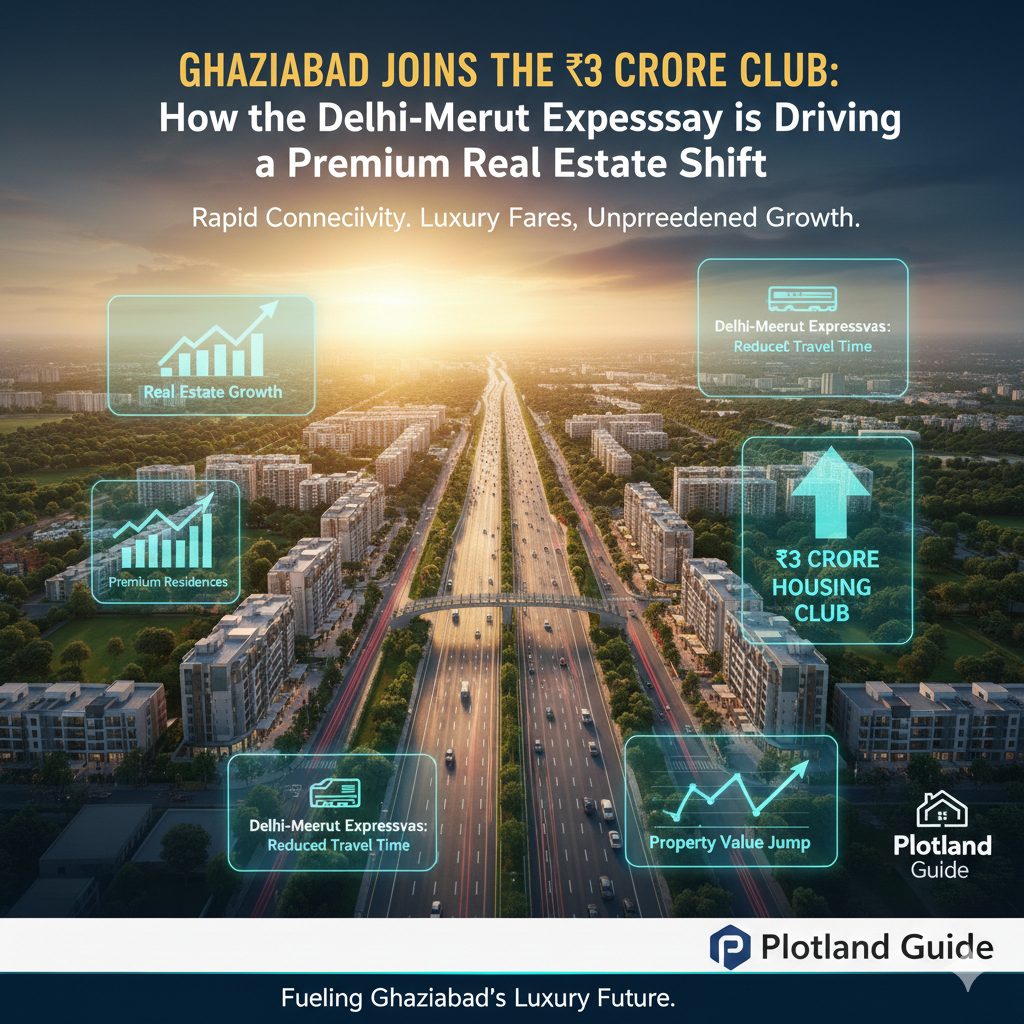
The completion and operationalization of the 14-lane Delhi-Meerut Expressway completely shattered this barrier. By providing a signal-free, access-controlled, high-speed corridor, the expressway has slashed the travel time between Ghaziabad and the heart of Delhi to a mere 30 minutes during normal traffic hours.
This dramatic reduction in commute time has single-handedly leveled the playing field. In many cases, a resident living in a premium high-rise along the NH-24 corridor can now reach central Delhi business districts significantly faster than a commuter traveling from the deeper sectors of Noida or the outer edges of Gurugram.
Furthermore, the expressway does not exist in a vacuum. Its impact is heavily amplified by the recent, full operationalization of the Namo Bharat Regional Rapid Transit System (RRTS). With high-speed trains connecting Delhi to Meerut via major Ghaziabad transit nodes, the region has achieved an unparalleled level of multimodal connectivity. This infrastructure-led confidence has transformed Ghaziabad from a distant suburb into a highly integrated, easily accessible premium residential hub.
The emergence of the ₹3 crore housing club in Ghaziabad is deeply tied to a radical shift in what modern homebuyers expect from their living spaces. The post-pandemic era fundamentally altered the psychology of the affluent Indian buyer. The demand for cramped, high-density compact apartments has plummeted within the premium segment. Today, buyers are fiercely prioritizing space, privacy, high-end build quality, and comprehensive design integrity.
To cater to this evolving appetite, real estate developers in eastern NCR are entirely discarding their old blueprints. Instead of constructing conventional, densely packed apartment towers, they are introducing sprawling, low-density residential estates. These new projects are specifically engineered to offer a luxurious "bungalow-in-the-sky" experience, perfectly packaged within a secure, vertical format.
When a buyer invests ₹3 crore in Ghaziabad today, they are acquiring massive spatial layouts. The configurations dominating this new premium tier are expansive 3BHK and 4BHK homes that range anywhere from 3,000 to an astonishing 4,000 square feet. These residences are characterized by double-height ceilings, sweeping panoramic balconies that act as extended outdoor living rooms, and highly flexible interior designs that accommodate dedicated home offices, private gyms, and servant quarters.
Beyond the individual apartments, the lifestyle ecosystem surrounding these towers is what truly justifies the premium pricing. Developers are heavily integrating hospitality-led amenities into their projects. It is now common to find new developments along the expressway boasting massive, 1.5 lakh square foot community clubhouses, temperature-controlled swimming pools, elevated air lounges, private screening theaters, and professionally managed concierge services. Luxury buyers in Ghaziabad are no longer just paying for raw square footage; they are paying for a highly differentiated, deeply curated lifestyle that has historically been severely underserved in the eastern NCR corridor.
To truly appreciate the magnitude of Ghaziabad's entry into the ₹3 crore segment, it is essential to contextualize it within the broader pricing dynamics of the National Capital Region. Just a few years ago, the sweet spot for the NCR housing market hovered comfortably below the ₹1 crore mark. That baseline has been entirely erased.
Across the region, the entry-level benchmark for anything resembling premium housing has aggressively shifted upwards to the ₹2.5 crore to ₹3 crore bracket. For instance, the base price in established sectors of Noida has skyrocketed from an earlier average of roughly ₹5,000 per square foot to currently demanding anywhere between ₹8,000 and ₹12,000 per square foot. Even peripheral areas like Noida Extension, which were once marketed at deeply affordable rates, have witnessed massive capital appreciation.
Against this backdrop, Ghaziabad's premium real estate proposition remains incredibly highly attractive. While a ₹3 crore price tag represents a historic peak for the city, it still offers a substantial discount when compared to the astronomical valuations seen in Gurugram's luxury sectors or central South Delhi. Buyers are realizing that an equivalent ₹3 crore investment in Ghaziabad secures a significantly larger footprint, superior low-density amenities, and a brand-new architectural product, making it a highly logical financial decision for those seeking uncompromising luxury without the exorbitant metropolitan markup.
This structural upgrade is not evenly distributed across the city; it is highly concentrated within specific, strategically located micro-markets that directly benefit from the expressway's alignment.
The NH-24 corridor is currently the epicenter of this premium transformation. Vast tracts of land that were previously underutilized are being converted into ultra-luxury integrated townships. Projects spanning multiple acres are offering a balanced mix of high-rise luxury towers and premium duplex villas, directly targeting families who refuse to compromise on open green spaces.
Similarly, the Indirapuram micro-market has experienced a staggering surge in property values. Benefiting immensely from its immediate proximity to the Delhi border, the elevated expressway, and the expanding metro and RRTS networks, Indirapuram has seen real estate prices surge by over 70% in recent times. Areas like Siddharth Vihar are also rapidly emerging as highly coveted luxury hubs, drawing massive investments from national-level developers eager to capitalize on the connectivity premium.
When zooming out to look at the broader city-wide metrics, the numbers are phenomenal. Driven by robust end-user demand and a massive influx of renewed investor confidence, overall property prices in Ghaziabad have appreciated by an estimated 131% over the past four years. This rapid value creation firmly cements the city's status as one of the highest-performing real estate markets in northern India.
The demographic profile of the Ghaziabad homebuyer is experiencing a profound shift. The traditional narrative of local, middle-class residents upgrading to slightly larger apartments no longer tells the whole story. The ₹3 crore and above segment is actively drawing a highly diverse and affluent buyer pool.
A significant portion of this demand originates from senior corporate professionals, successful entrepreneurs, and established business families who currently reside in congested areas of Delhi. Frustrated by the lack of parking, shrinking green spaces, and aging infrastructure in the capital, these high-net-worth individuals are leveraging the expressway to migrate outward. They are enthusiastically trading their cramped city dwellings for sprawling, resort-style living environments in Ghaziabad, secure in the knowledge that their daily commute to Delhi remains fast and frictionless.
Additionally, there is a notable influx of Non-Resident Indian (NRI) investors. NRIs typically look for properties that offer global standards of living, stringent security, and professional facility management. The new wave of gated, low-density townships along the NH-24 corridor perfectly matches this international criteria, drawing significant foreign capital into the micro-market.
The most crucial takeaway from Ghaziabad's luxury leap is the underlying stability of the market. Real estate analysts and industry leaders universally agree that this pricing shift reflects deep structural confidence rather than fleeting speculative activity.
Unlike past real estate booms that were heavily driven by investors flipping properties for quick margins, the current demand in the ₹2.5 crore to ₹4 crore segment is overwhelmingly driven by genuine end-users. Families are purchasing these homes with the clear intent of living in them for decades. They are meticulously scrutinizing the build quality, the architectural design, and the long-term liveability of the projects before signing on the dotted line.
As the region's infrastructure continues to evolve—with the Hindon Airport expanding its commercial operations and further metro line extensions on the horizon—the eastern NCR corridor is poised for sustained, long-term growth. The "discount" gap between Ghaziabad and its more expensive neighbors like Noida and Gurugram will inevitably continue to narrow as the city's premium lifestyle ecosystem matures.
Ultimately, the Delhi-Meerut Expressway has done far more than just lay down fourteen lanes of asphalt. It has actively dismantled old geographical prejudices and unlocked the true economic potential of an entire region. By perfectly aligning world-class connectivity with visionary, high-end residential development, Ghaziabad has permanently shed its outdated affordable tag. It has proudly taken its rightful seat at the table of premium NCR real estate, proving that when infrastructure leads, luxury living and immense capital appreciation are guaranteed to follow.
