Published On:
February 10, 2026
Updated On:
February 10, 2026
The 594-km Ganga Expressway is set to revolutionize Uttar Pradesh's economy by connecting Meerut to Prayagraj and cutting travel time to just six hours. As the project nears its February 2026 completion deadline, it promises to unlock massive industrial growth, boost real estate in 12 districts, and serve as the backbone for the state's trillion-dollar economic vision.
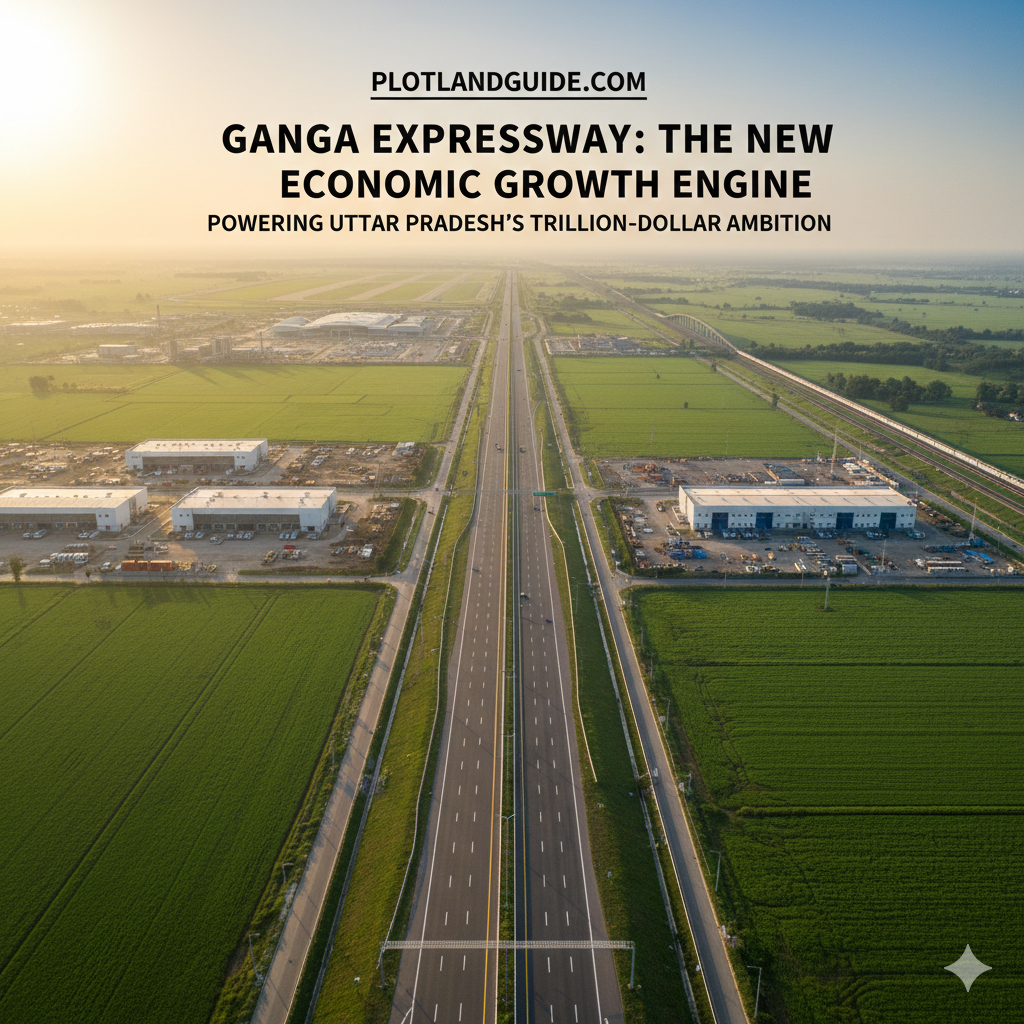
Uttar Pradesh is currently witnessing an infrastructural renaissance, and at the heart of this transformation lies a project of colossal scale—the Ganga Expressway. Spanning an impressive 594 kilometers, this greenfield project is not just a ribbon of asphalt; it is being hailed as the spinal cord of the state’s economy.
As the ambitious February 2026 deadline for completion draws near, the buzz around this corridor is palpable. From real estate investors to industrial giants, everyone is looking at the Ganga Expressway as the next frontier of growth. The state administration has rightly identified this project as a critical "growth engine" that will propel Uttar Pradesh towards its goal of becoming a one trillion-dollar economy.
But what exactly makes this expressway so special? Unlike previous projects that focused largely on the National Capital Region (NCR), the Ganga Expressway cuts through the hinterland, bringing the "silent" districts of the state onto the map of modern India. This blog dives deep into how this mega-project is set to rewrite the economic destiny of the region.
The primary utility of any expressway is speed, and the Ganga Expressway delivers this in spades. Once operational, it will slash the travel time between Meerut in the West and Prayagraj in the East from the current grueling 12 hours to a breezy 6 hours.
Starting from Bijauli village in Meerut and terminating at Judapur Dandu in Prayagraj, the route threads through 12 key districts: Meerut, Hapur, Bulandshahr, Amroha, Sambhal, Budaun, Shahjahanpur, Hardoi, Unnao, Rae Bareli, Pratapgarh, and Prayagraj.
This alignment is strategic. It effectively bridges the gap between the industrial hubs of Western UP and the cultural and agricultural heartlands of Eastern UP. For logistics companies, this means a truck can now complete a round trip within a single day, drastically reducing fuel costs and turnaround times.
The term "growth engine" is not just marketing fluff; it is backed by a solid industrial master plan. The Uttar Pradesh Expressways Industrial Development Authority (UPEIDA) has planned extensive industrial corridors along the route.
1. Manufacturing and Logistics HubsLarge parcels of land are being earmarked in districts like Hardoi, Sambhal, and Unnao for industrial clusters. These areas, which were previously bypassed by major industry due to poor connectivity, are now becoming attractive destinations for:
2. The Shahjahanpur AirstripA unique feature of this expressway is the 3.5-kilometer emergency airstrip being constructed in Shahjahanpur. While primarily for the Indian Air Force, its presence signals the strategic importance of the region, potentially attracting defense-related manufacturing ancillary units to the vicinity.
For real estate investors, the Ganga Expressway is the new gold rush. The "early mover advantage" is currently playing out in real-time.
Unlocking Hidden ValueWhile property markets in Noida and Lucknow are well-established, the expressway is unlocking value in Tier-2 and Tier-3 cities.
Investors are realizing that as connectivity improves, urbanization follows. The expressway will likely trigger the development of new "smart townships" along its nodes, offering affordable housing options with world-class connectivity.
Uttar Pradesh is often called the granary of India, and the Ganga Expressway passes right through its most fertile plains.
Farm-to-Market ConnectivityFor decades, farmers in this belt struggled with post-harvest losses due to slow transport. Perishable goods like fruits, vegetables, and dairy often couldn't reach major urban markets in time. This expressway changes the equation. A farmer in Pratapgarh or Amroha can now transport fresh produce to the massive consumption markets of Delhi-NCR or Prayagraj in a matter of hours. This direct access is expected to increase farmers' income significantly and encourage the setting up of cold storage chains along the highway.
The timing of the expressway's completion is synchronized with the state’s tourism goals. Prayagraj, the endpoint of the expressway, is the host of the Maha Kumbh. The expressway will serve as the primary artery for millions of pilgrims traveling from Western India and Delhi.
Beyond the Kumbh, the road connects several religious and historical centers. By making travel less fatigue-inducing, it encourages weekend tourism. Families in Delhi can now comfortably plan a weekend trip to the holy Sangam in Prayagraj or explore the historic sites of Kalinjar and Chitrakoot (via connecting link roads), boosting the local hospitality and service sectors.
The project is designed with the future in mind.
The Ganga Expressway is more than a construction milestone; it is a statement of intent. It signifies a shift in Uttar Pradesh’s economic gravity, moving development away from just the NCR ring and spreading it deep into the state’s interior.
By integrating 12 districts into a high-speed economic grid, the state government is ensuring that growth is inclusive and widespread. For the economy of Uttar Pradesh, this expressway is indeed the engine that was needed to shift gears. As the final layers of asphalt are laid and the February 2026 deadline approaches, the stage is set for a new era of prosperity that travels at 120 kmph.
For investors, businesses, and residents, the message is clear: The road to the future is here, and it runs through the heart of Uttar Pradesh.
