Published On:
March 2, 2026
Updated On:
March 2, 2026
The Ganga Expressway is receiving a massive 140-km extension, seamlessly connecting Uttar Pradesh to Uttarakhand via a newly finalized Meerut-Amroha-Bijnor-Haridwar alignment. This monumental infrastructure upgrade will cut the Meerut-to-Haridwar travel time to just over an hour, triggering unprecedented economic, tourism, and real estate growth across the entire northern corridor.
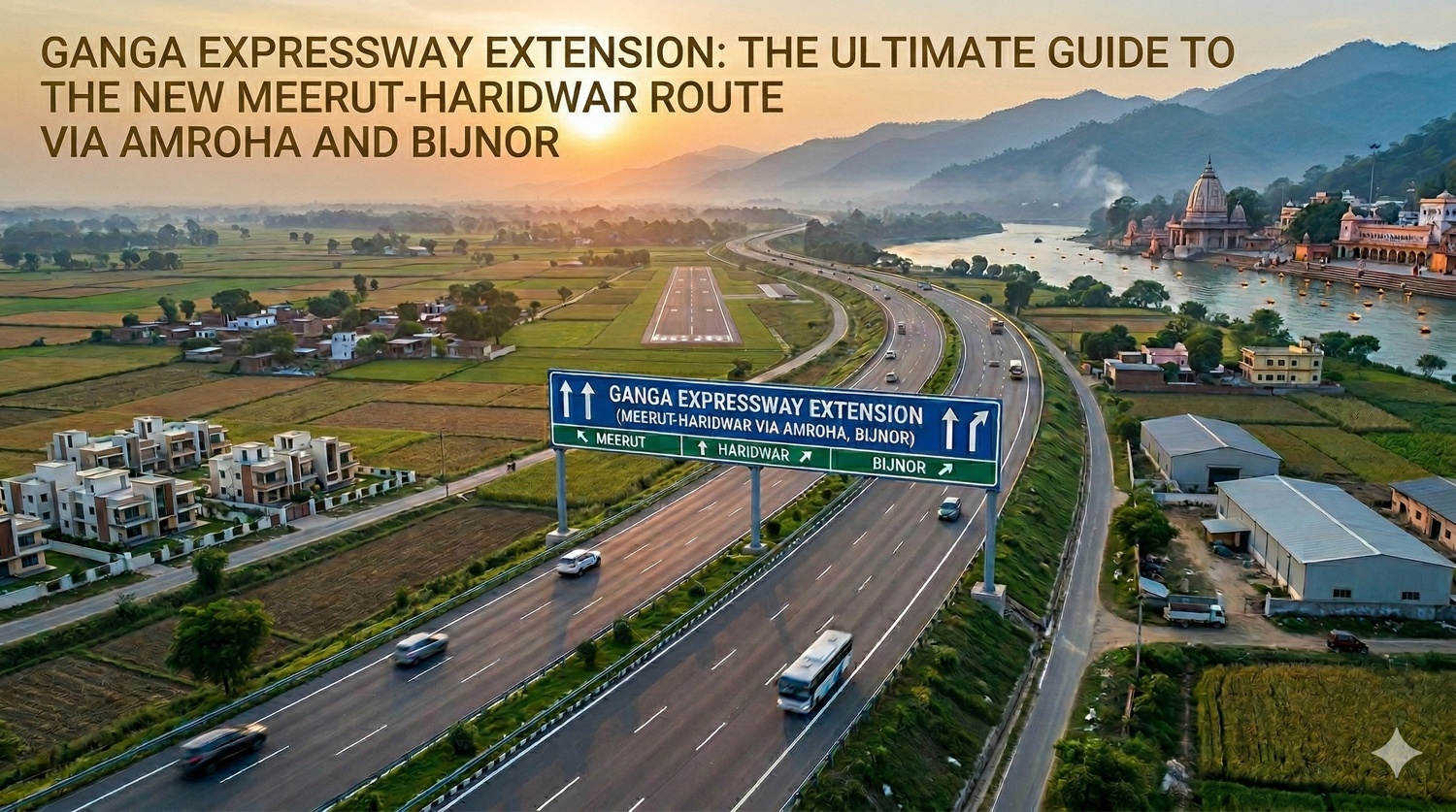
India's infrastructure narrative is currently undergoing a massive and rapid transformation, with the state of Uttar Pradesh emerging as the undisputed powerhouse of national expressway development. For decades, traveling across the vast expanse of India's most populous state was a grueling, time-consuming affair fraught with traffic bottlenecks and poorly maintained state highways. However, the aggressive introduction of access-controlled, greenfield expressways has entirely rewritten the rules of regional connectivity. At the absolute heart of this infrastructural renaissance is the highly anticipated Ganga Expressway, a monumental project initially designed to bridge the eastern and western boundaries of Uttar Pradesh. But in a strategic move that is set to redefine interstate transit in North India, the project has just received a massive upgrade.
The latest development surrounding this mega-project involves a highly impactful extension that pushes the expressway network beyond the borders of Uttar Pradesh, extending it right into the spiritual heart of Uttarakhand. This comprehensive expansion will link Meerut directly to Haridwar, carving a completely new path through the districts of Amroha and Bijnor. The broader implications of this expansion are profound, touching upon everything from daily commuting and religious tourism to large-scale industrial investments and local real estate markets. As both state governments give the final green light to this ambitious alignment, it is time to unpack what this means for travelers, investors, and the future of North Indian mobility.
The Big Update: Extending the Lifeline to Haridwar
Initially, the grand vision for the Ganga Expressway focused strictly on a 594-kilometer stretch connecting Meerut in western Uttar Pradesh to Prayagraj in the east. While that foundational phase is already recognized as a marvel of modern engineering, the authorities quickly realized the immense potential of extending this corridor northward. The Uttar Pradesh Expressways Industrial Development Authority (UPEIDA) recently proposed an extension plan to the Uttarakhand government, which was met with prompt agreement and collaborative enthusiasm.
The finalized expansion adds approximately 140 kilometers to the existing expressway network. Rather than forcing a direct, challenging line from Meerut to Haridwar—which faced earlier disagreements, land acquisition pushbacks, and logistical hurdles—the new alignment takes a smarter, more inclusive route. It will branch out, passing through Amroha and Bijnor before culminating in Haridwar. By intentionally integrating Bijnor into the high-speed road network, the government is effectively bringing a previously overlooked agricultural region into the mainstream economic fold. This strategic diversion not only resolves earlier planning conflicts but also maximizes the socio-economic footprint of the highway, ensuring that more towns, farming hubs, and local businesses can tap into the expressway's prosperity.
Why the Route Changed: Technical and Environmental Triumphs
Infrastructure projects of this magnitude are rarely straightforward, and plotting the route to Haridwar was no exception to the rule. The original blueprint suggested bringing the expressway into Haridwar along the left bank of the river Ganges. However, rigorous environmental impact assessments and complex technical evaluations indicated that this would not be the most sustainable or efficient approach in the long run.
Taking these crucial ecological factors into account, the newly approved alignment dictates that the expressway will exit on the right side of the Ganges as it approaches Haridwar. This structural shift is a masterclass in adaptive urban planning, carefully balancing the desperate need for rapid modernization with the deep ecological sensitivity of the Ganges basin. Discussions surrounding land acquisition, utility shifting, and environmental clearances have already advanced significantly. By meticulously adhering to environmental impact assessment guidelines, the planners are ensuring that the region's rich biodiversity and the sacred river's delicate ecosystem remain entirely protected. This thoughtful, transparent approach has even garnered immense support from local farming communities, who view the streamlined land acquisition process and the promise of enhanced rural connectivity as a historic victory for their local economy.
Slicing Travel Times: A Boon for Commuters and Pilgrims
The most immediate and tangible benefit of the Ganga Expressway and its new Uttarakhand extension is the sheer amount of time it gives back to the people. Currently, navigating the congested national highways from Meerut to Haridwar is an exhausting ordeal that can take several unpredictable hours. Once the Amroha-Bijnor-Haridwar stretch is fully operational, this grueling journey will be compressed into a breezy 1 to 1.5-hour drive.
For residents of Delhi and the broader National Capital Region (NCR), this timeline reduction is nothing short of revolutionary. Weekend getaways, wellness retreats, or sudden pilgrimage trips to Haridwar and Rishikesh will no longer require exhaustive planning or dealing with notorious traffic bottlenecks.
Looking at the broader picture, the core Phase 1 of the expressway from Meerut to Prayagraj will slash travel time from a back-breaking 12 hours down to a mere 6 hours. Engineered to support cruising speeds of 100 to 120 kilometers per hour, the six-lane access-controlled highway—which is fully designed to be expandable to eight lanes in the future—promises a frictionless driving experience. This drastic reduction in travel time translates directly to massive fuel savings, significantly reduced carbon emissions from idling traffic, and a much lower logistical cost for the transportation of commercial goods across the state.
Unlocking the Tourism and Spiritual Corridor
The Ganges is the spiritual artery of India, and a high-speed expressway running parallel to it is bound to have a massive, transformative impact on cultural and religious tourism. By seamlessly connecting eastern Uttar Pradesh—including the districts of Purvanchal—directly to Haridwar, the extended expressway creates an uninterrupted spiritual corridor that was previously impossible to navigate quickly.
Devotees traveling from cities like Varanasi, Prayagraj, and Pratapgarh will now have a straight, high-speed route to the holy cities of Haridwar and Rishikesh without having to navigate through the congested center of the state. This becomes especially critical when looking ahead to massive congregations and religious festivals like the Mahakumbh Mela. The expressway will serve as the primary conduit for millions of pilgrims, ensuring the safe, organized, and rapid movement of people.
Beyond traditional religious tourism, the inclusion of Bijnor and Amroha in the route opens up entirely new avenues for eco-tourism and heritage exploration along the banks of the Ganges. Local economies that heavily rely on hospitality, transport, and artisanal crafts will experience an unprecedented influx of visitors, turning quiet riverfront towns into bustling hubs of cultural exchange and commerce.
Phase 1 Nearing Completion: The Meerut to Prayagraj Mega Stretch
While the Haridwar extension beautifully sets the stage for future growth, the foundational Phase 1 of the Ganga Expressway is already making major headlines as it inches closer to its grand inauguration. Spanning a massive 594 kilometers, this Rs 36,200-crore mega-project weaves through 12 major districts: Meerut, Hapur, Bulandshahr, Amroha, Sambhal, Budaun, Shahjahanpur, Hardoi, Unnao, Raebareli, Pratapgarh, and Prayagraj.
As of early 2026, the civil construction work is virtually complete, hitting the 96 to 100 percent mark across various regional packages. The heavy lifting—massive earthworks, main carriageway laying, and complex bridge construction over railway lines and rivers—is officially done. Currently, the site is buzzing with crucial finishing touches, including the installation of directional signage, intricate road marking, landscaping, and the rapid setup of toll plazas. Trial runs are actively being conducted to test the roughness index and riding comfort, ensuring the surface meets stringent international driving standards. With the state government aggressively pushing for a rapid launch, the expressway is slated to be opened to the public by the end of March or early April 2026, marking a historic milestone in India's infrastructure journey.
Cutting-Edge Technology and Unmatched Safety Measures
What truly sets the Ganga Expressway apart from older highway projects is its heavy reliance on modern, proactive technology to ensure commuter safety and road longevity. In a groundbreaking move, the state government partnered with international tech firms and universities, utilizing Swiss AI-based technology to monitor road quality during the construction phase itself. Highly sensitive sensors were deployed to track even the most minute rises and dips in the asphalt, allowing engineers to rectify defects before the road even opened to the public.
Once operational, the safety grid will be entirely AI-driven. Advanced surveillance cameras are currently being installed across the entire 594-kilometer stretch. This intelligent system is designed to automatically detect traffic violations such as overspeeding or wrong-side driving, instantly beaming real-time alerts to central control rooms established in Meerut and Prayagraj. If an accident or breakdown occurs, mobile response teams and dedicated ambulances can be dispatched immediately, drastically reducing critical response times. Furthermore, the expressway is equipped with emergency call boxes every 10 kilometers and features a remarkable 3.5-kilometer dedicated airstrip in Shahjahanpur, specifically designed to facilitate emergency landings for Indian Air Force fighter jets, adding a layer of crucial strategic and defense value to the project.
The Economic and Real Estate Ripple Effect
A highway of this scale is never just a road; it is a powerful catalyst for wealth creation. The Ganga Expressway is being meticulously designed as an economic powerhouse. The government has strategically planned the development of massive industrial clusters, modern warehousing hubs, and expansive food processing units along the expressway's route. This targeted industrialization is expected to generate massive local employment, entirely changing the socio-economic fabric of towns that were previously dependent solely on seasonal agriculture.
For the real estate sector, the finalized Amroha-Bijnor-Haridwar extension is the equivalent of striking gold. Areas around Bijnor and Amroha, which previously saw stagnant property values due to poor interstate connectivity, are now witnessing an immediate surge in massive investor interest. Prime land parcels near proposed interchanges and service roads are being snapped up by logistics companies and commercial developers aiming to build transit hotels, fueling stations, and storage facilities.
Similarly, the residential real estate market in Meerut and Haridwar is bracing for an absolute boom. With the commute between the NCR and Haridwar becoming utterly effortless, premium real estate developers are already scouting for vast land tracts to build luxury weekend homes, holistic wellness retreats, and upscale retirement communities in Uttarakhand. The expressway effectively transforms remote, inaccessible agricultural lands into highly coveted commercial real estate, offering incredible long-term value appreciation for early investors. Additionally, this infrastructure push empowers local farmers who are receiving handsome compensation and rehabilitation benefits through the streamlined, transparent land acquisition process.
A Greener, More Sustainable Highway for the Future
Despite its intimidating scale, there is a strong, uncompromising commitment to keeping the project as environmentally sustainable as possible. To successfully counterbalance the carbon footprint of massive construction and future vehicular emissions, a colossal plantation drive has been deeply integrated into the project's core design. Millions of indigenous saplings are being planted along both sides of the expansive corridor and within the central median. This dense green belt will not only act as a natural sound barrier for neighboring villages but will also help significantly in mitigating dust pollution and improving the local microclimate.
Additionally, the implementation of advanced FASTag systems at the toll plazas ensures the seamless, non-stop movement of vehicles. This modern tolling approach completely eliminates the long queues that traditionally lead to heavy engine idling and unnecessary fuel consumption. By actively prioritizing smooth traffic flow and expansive, well-maintained green covers, the Ganga Expressway is setting a brand new benchmark for sustainable, eco-conscious infrastructure development in the country.
The Road Ahead for North India
The Ganga Expressway, particularly with its newly minted extension connecting Uttar Pradesh to Uttarakhand, is much more than a marvel of civil engineering; it is a profound engine for deep regional integration. By brilliantly linking the dynamic economic hubs of the National Capital Region and western UP with the culturally rich and resource-heavy districts of the east—and now the spiritual centers of the north—the expressway is effectively erasing geographical disadvantages that have held back regional growth for decades.
As we look eagerly toward the official inauguration of the Meerut-Prayagraj stretch and the rapid commencement of groundwork on the Haridwar extension, it is abundantly clear that the physical and economic landscape of North India is changing forever. The travel times are drastically shrinking, the economic opportunities are multiplying at an unprecedented rate, and the real estate landscape is being completely redrawn from the ground up. For the millions of daily commuters, local farmers, devoted pilgrims, and savvy investors who will utilize this corridor, the Ganga Expressway is not just a faster route to their destination; it is the ultimate fast lane to a significantly more prosperous and connected future.
