Published On:
March 28, 2026
Updated On:
March 30, 2026
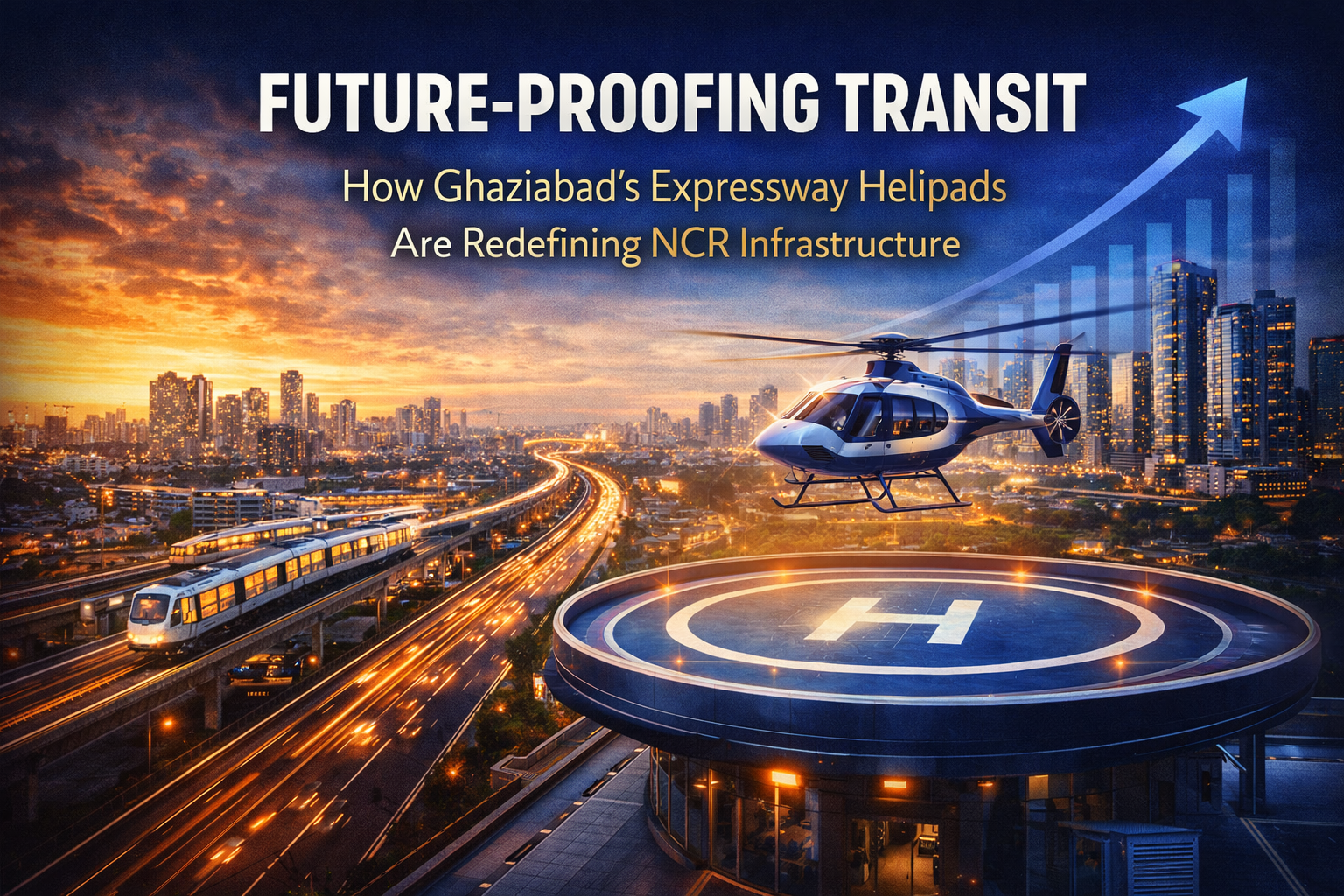
The strategic plan to develop helipads along the Delhi-Meerut and Delhi-Dehradun expressways in Ghaziabad marks a revolutionary upgrade in India’s highway infrastructure. Designed primarily to facilitate rapid air ambulance services and disaster management, this massive project is simultaneously triggering a wave of real estate appreciation, transforming surrounding land parcels and commercial plots into premium investment assets.
The National Capital Region is currently undergoing one of the most aggressive and transformative infrastructure overhauls in its history. For decades, the primary objective of highway development was simply to lay down more asphalt to accommodate the exploding volume of vehicular traffic. The goal was linear: move cars from point A to point B as quickly as possible. However, the modern era of urban planning and highway engineering demands a far more sophisticated approach. Highways are no longer envisioned merely as roads; they are being designed as comprehensive, high-tech transit corridors equipped to handle complex logistical, medical, and security challenges.
A prime example of this visionary shift is the latest initiative rapidly taking shape in western Uttar Pradesh. Authorities have greenlit a massive project to construct dedicated helipads directly along the operational Delhi-Meerut Expressway and the highly anticipated Delhi-Dehradun Expressway. Focused primarily within the strategic administrative boundaries of Ghaziabad, this development is an absolute game-changer. It elevates the regional infrastructure to global standards, ensuring that these high-speed corridors are fully equipped for rapid aerial interventions. Beyond the immediate logistical and medical benefits, this futuristic addition is sending powerful shockwaves through the regional economy, fundamentally altering real estate dynamics and setting a new benchmark for how modern Indian expressways will be built.
To understand the sheer magnitude of adding aviation infrastructure to a highway, one must first look at the corridors themselves. The Delhi-Meerut Expressway has already completely redefined the daily commute for thousands of professionals and the movement of heavy commercial freight. By slashing travel times between the capital and Meerut from a grueling, unpredictable two-and-a-half-hour ordeal to a smooth forty-five-minute drive, it effectively blurred the geographic lines separating these cities.
Similarly, the upcoming Delhi-Dehradun Expressway is an engineering marvel designed to cut the journey from the national capital to the foothills of Uttarakhand down to roughly two and a half hours. These roads are engineered for high speeds, featuring advanced access control, automated tolling systems, and elevated wildlife corridors.
Yet, with high-speed transit comes an inherent set of risks and logistical challenges. When thousands of vehicles travel at maximum permissible speeds, the statistical probability of severe accidents inevitably rises. Furthermore, these long uninterrupted stretches of road can become logistical bottlenecks during severe natural disasters or massive traffic gridlocks. The traditional model of relying solely on ground-based emergency services is simply no longer sufficient for highways of this scale and importance. Integrating dedicated helipads into the highway architecture is the definitive solution to these modern challenges.
The primary and most critical driver behind the construction of these helipads is the preservation of human life. In the realm of emergency trauma medicine, there is a universally recognized concept known as the "golden hour." This refers to the crucial sixty-minute window immediately following a severe traumatic injury. Medical professionals assert that if a critically injured patient receives advanced surgical care within this precise timeframe, their chances of survival increase exponentially.
Historically, achieving this on Indian highways has been exceptionally difficult. When a major collision occurs on a high-speed corridor, the resulting wreckage often causes immediate, severe traffic tailbacks. Ground ambulances, despite having sirens and right-of-way, frequently find themselves trapped miles away in the very traffic jam caused by the accident they are trying to reach. Even if they manage to reach the victims, navigating back through the congested highway network to a super-specialty urban hospital can take hours, tragically costing lives.
The introduction of helipads completely bypasses this fatal flaw in ground logistics. By positioning landing zones at strategic intervals—likely near major toll plazas, dedicated rest areas, or key district interchanges in Ghaziabad—authorities are laying the groundwork for a highly responsive air ambulance network. In the event of a catastrophic accident, a medical helicopter can be dispatched directly from a top-tier hospital in Delhi or Noida, land securely on the expressway's dedicated helipad, stabilize the victims, and airlift them straight to a trauma center in a matter of minutes. This seamless aerial evacuation capability brings the region's highway safety protocols in line with the highest international standards, ensuring that rapid, life-saving medical intervention is always within reach.
Whenever a government implements world-class, future-proof infrastructure, the real estate market is the first sector to aggressively react. The integration of aviation facilities along the Ghaziabad stretches of these expressways is acting as a massive catalyst for property appreciation. The landscape of property investment in the National Capital Region is highly sensitive to connectivity upgrades, and this development is drastically shifting investor focus.
The broader real estate markets across the Yamuna Expressway, the rapidly expanding YEIDA sectors, and the highly organized grids of Noida have consistently demonstrated a profound economic truth: the deployment of mega-infrastructure invariably skyrockets surrounding land values. Investors who strategically target plotted developments and commercial land acquisitions understand that proximity to advanced, multi-modal transit corridors guarantees exceptional, long-term wealth creation.
The helipad project in Ghaziabad is replicating this exact appreciation model. Land parcels that sit in the vicinity of these proposed landing zones are no longer being viewed merely as suburban outskirts; they are being rapidly repositioned as highly premium assets. The logic driving this land rush is highly sound. When an area is officially equipped to handle rapid medical evacuations, disaster response, and high-level corporate aerial transit, it immediately attracts a much higher caliber of secondary development.
Developers are aggressively scouting the region to acquire large tracts of land for premium gated communities, massive warehousing facilities, and specialized commercial hubs. For logistics companies, the assurance that their primary transport corridors are monitored and supported by aerial infrastructure adds a massive layer of operational security. For residential buyers, knowing that their neighborhood sits on a corridor equipped with rapid air medical evacuation provides an unparalleled sense of safety. Consequently, the demand for clear, legally sound plotted land along the Delhi-Meerut and Delhi-Dehradun corridors is surging, mirroring the massive investment waves historically seen around major airport and highway intersections in the southern NCR districts.
While emergency medical services remain the absolute highest priority, the utility of these highway helipads extends deeply into the realms of administrative efficiency and corporate mobility. The National Capital Region is the absolute epicenter of the country's political and economic power. The movement of high-ranking government officials, visiting international dignitaries, and top-tier corporate executives across this vast geographic expanse is a daily logistical challenge.
Traditionally, moving a VVIP from central Delhi to an industrial site in Meerut or a development project in western Uttar Pradesh required heavily armed convoys. These convoys not only consume massive security resources but also require the temporary halting of civilian traffic, causing intense public frustration and massive logistical delays across the highway network.
Strategically placed helipads along these expressways completely eliminate this friction. Officials and corporate leaders can be seamlessly airlifted from the capital and dropped directly at secure, designated points along the highway in Ghaziabad. From there, they can comfortably complete the final few miles of their journey via a much smaller, localized ground escort. This hybrid transit model drastically reduces the burden on local traffic police, entirely eliminates the need to block civilian highway lanes, and allows for highly efficient, rapid movement of key decision-makers across the state’s industrial belts.
Beyond daily transit and medical emergencies, these landing zones serve a highly critical function in the broader framework of national security and disaster management. The geographic areas surrounding the Delhi-Dehradun and Delhi-Meerut corridors encompass a mix of dense urban populations, massive industrial zones, and sprawling agricultural belts. In the unfortunate event of a major natural disaster, such as severe flooding, seismic activity, or large-scale industrial accidents, ground infrastructure is almost always the first casualty. Roads buckle, bridges become impassable, and entire districts can be instantly cut off from state relief efforts.
In these extreme scenarios, the highway helipads transform into absolute lifelines. They provide the National Disaster Response Force and military units with pre-surveyed, structurally sound, and strategically located staging grounds. Heavy-lift helicopters can utilize these concrete pads to rapidly drop tons of critical relief supplies, deploy specialized rescue teams, and evacuate large numbers of stranded citizens. By building these landing zones directly into the highway architecture during peacetime, the government is proactively ensuring that the region possesses a robust, decentralized aerial supply chain ready to activate the moment a crisis strikes.
The decision to integrate helipads into the Ghaziabad segments of the Delhi-Meerut and Delhi-Dehradun expressways is not an isolated local upgrade; it represents a fundamental paradigm shift in how the nation views public infrastructure. It signals a complete departure from the outdated mindset of building single-purpose roads, moving firmly toward the creation of deeply resilient, multi-functional transportation networks.
This initiative is establishing a powerful, highly visible precedent. As regional authorities and private highway developers draft blueprints for the next generation of mega-corridors across the country, the inclusion of dedicated aerial support infrastructure will likely transition from a luxury feature to a mandatory safety requirement. The successful execution of this project in Uttar Pradesh will undoubtedly serve as the primary case study for integrating air and ground logistics.
Ultimately, the transformation of these expressways through the addition of helipads is a massive victory for everyone involved. For the daily commuter, it provides an invaluable layer of safety and the reassurance of rapid medical support. For the administrative machinery, it offers a highly efficient tool for crisis management and secure transit. And for the strategic real estate investor, the continuous infrastructural fortification of these corridors ensures that land acquisitions in the surrounding regions will continue to yield exceptional, generation-defining returns. As the concrete is poured for these landing zones, Ghaziabad is firmly cementing its position not just as a gateway to the state, but as the blueprint for the future of Indian mobility.
