Published On:
February 11, 2026
Updated On:
February 11, 2026
The Delhi government, in collaboration with NBCC, has launched a massive initiative to refurbish 18,000 dilapidated flats in slum clusters, focusing on structural safety and civic amenities like drainage and community spaces. This project aims to transform "ghost" housing inventories in areas like Bhalswa and Sultanpuri into habitable, dignified living spaces for thousands of families waiting for rehabilitation.
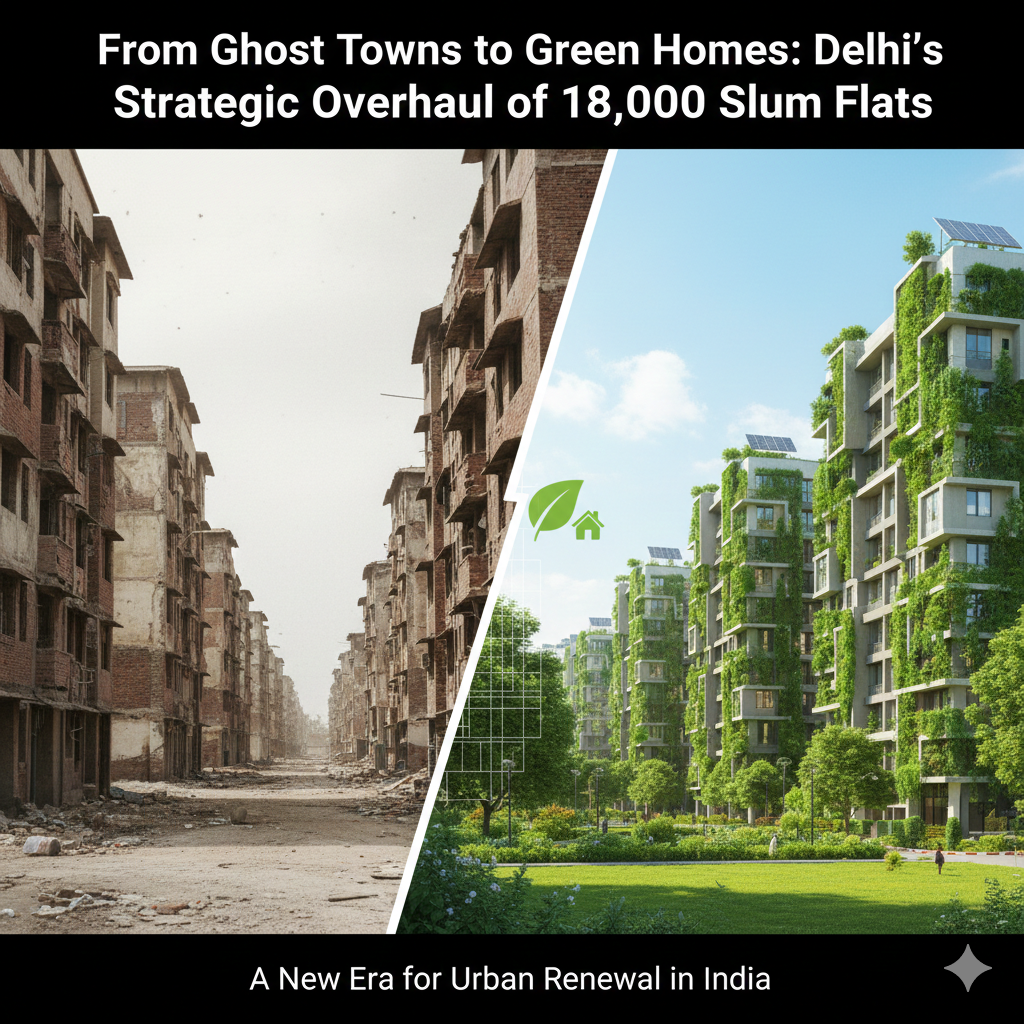
In the bustling sprawl of India’s capital, housing has always been a game of numbers. Yet, for nearly a decade, a peculiar paradox has plagued Delhi’s urban planning landscape. On one hand, thousands of families live in cramped, unsafe jhuggi-jhopri (JJ) clusters with limited access to basic sanitation. On the other, thousands of government-built flats—constructed explicitly for these families—have stood vacant, slowly decaying into "ghost towns" in areas like Bhalswa, Narela, and Dwarka.
The narrative, however, is finally shifting. In a decisive move that bridges the gap between construction and true habitability, the Delhi government has announced a comprehensive plan to upgrade and refurbish nearly 18,000 of these flats. This is not merely a repair job; it is a holistic urban renewal project aimed at turning concrete shells into thriving, dignified communities.
To understand the significance of this upgrade, one must first look at why these flats remained empty. Constructed under various schemes like the Jawaharlal Nehru National Urban Renewal Mission (JNNURM), many of these units were completed years ago but failed to attract or retain allottees.
The reasons were structural and systemic. Over time, unoccupied buildings suffer from "attrition by neglect." Reports from areas like Savda Ghevra and Sultanpuri painted a grim picture: missing electrical fixtures, seepage-ridden walls, and choked plumbing. But the problem extended beyond the four walls of the apartment. A house is not a home if the road leading to it is permanently waterlogged or if there are no streetlights for safety. The lack of peripheral civic infrastructure meant that shifting to these flats often felt like a step backward for slum dwellers who, despite the squalor, had established social and economic networks in their existing settlements.
Recognizing this, the Delhi Urban Shelter Improvement Board (DUSIB) has pivoted from a policy of "allotment first" to "habitability first." The current initiative acknowledges that dignity is a prerequisite for relocation.
The refurbishment plan is massive in scale and intricate in detail. Tasked with the execution is the National Buildings Construction Corporation (NBCC), a public sector giant with deep expertise in urban infrastructure. The partnership aims to deploy a multi-pronged strategy that addresses both the micro-issues of individual units and the macro-issues of the neighborhood.
The first layer of the upgrade involves the buildings themselves. Instead of the costly and environmentally wasteful route of demolition and reconstruction, the government has opted for adaptive reuse. Structural audits will guide the strengthening of pillars and beams, ensuring the longevity of the towers. Interiors are set to receive a complete overhaul—fresh plastering, waterproofing to arrest seepage, and the installation of durable electrical and plumbing fittings. The goal is to ensure that when a family unlocks their door for the first time, the lights work, and the taps run.
The "civic facilities" aspect of this project is perhaps its most critical component. The new plan goes beyond the building footprint to address the common areas that define the quality of life.
This project is not concentrated in a single pocket but is spread across the strategic fringes of the capital where the potential for housing inventory is highest.
The Bhalswa and Jahangirpuri CorridorA significant portion of the focus is on Bhalswa, where thousands of flats have laid vacant. The geography here is challenging due to the proximity to landfill sites and low-lying terrain. The upgrade here is heavily focused on environmental buffering—creating green zones and better waste management systems to make the air and surroundings breathable.
West and North-West DelhiClusters in Wazirpur, Sultanpuri, and Savda Ghevra are also on the priority list. In Sultanpuri, for instance, the focus is on integrating these housing pockets with the wider city grid. By improving the approach roads and ensuring that public transport can penetrate deeper into these colonies, the government aims to solve the "last-mile" connectivity issue that often deters workers from moving to resettlement colonies.
A house becomes a community only when it is supported by social institutions. The vision for these 18,000 flats includes the development of "soft" infrastructure that supports the human lifecycle.
The plan integrates the construction of Arogya Mandir clinics within these complexes, ensuring that primary healthcare is a walk away rather than a bus ride away. For the thousands of children who will inhabit these colonies, the plan earmarks space for Anganwadis and upgrades to nearby government schools.
Community halls are also being refurbished. in the context of urban poverty, a community hall is not a luxury; it is a necessity. It serves as a space for weddings, community meetings, and during crises, as a relief center. restoring these spaces gives the residents a sense of ownership and a venue to build social capital.
The infusion of approximately ₹327 crore into these development works does more than just fix houses; it stimulates the local economy. The refurbishment process itself is labor-intensive, generating months of employment for masons, plumbers, electricians, and daily wage laborers—many of whom may come from the very communities being served.
Furthermore, occupying these flats unlocks "dead capital." A vacant building is a liability on the state’s balance sheet, consuming maintenance funds without providing value. By making them habitable, the government converts a liability into an asset. Secure housing is known to correlate directly with economic productivity. When a family no longer has to worry about the roof leaking or the slum being demolished, they can invest their energy in education and employment.
This initiative marks a maturity in Indian urban planning. It moves away from the "build-and-forget" syndrome that characterized early housing projects. By bringing in a professional agency like NBCC and securing dedicated funding for retrofitting, Delhi is setting a precedent.
It acknowledges that urban decay is reversible. It proves that with political will and technical expertise, the "sins" of past planning—bad location, poor quality, lack of amenities—can be mitigated.
As the Detailed Project Reports (DPRs) are finalized and the machinery rolls into Bhalswa and Seelampur, the city watches with bated breath. For the 18,000 families waiting in the queue, this is not just an infrastructure project. It is the long-awaited delivery of a promise—a promise of a home that is safe, clean, and truly theirs. The transformation of these 18,000 flats could very well be the blueprint for a slum-free, inclusive Delhi of the future.
