Published On:
February 10, 2026
Updated On:
February 10, 2026
Uttar Pradesh is rapidly transforming into India’s logistics capital by developing world-class Multi-Modal Logistics Parks (MMLPs) at strategic intersections of rail, road, and water corridors. With the new 2024 policy offering industry status and massive subsidies, the state presents a golden opportunity for investors to tap into a seamless, high-speed supply chain ecosystem.
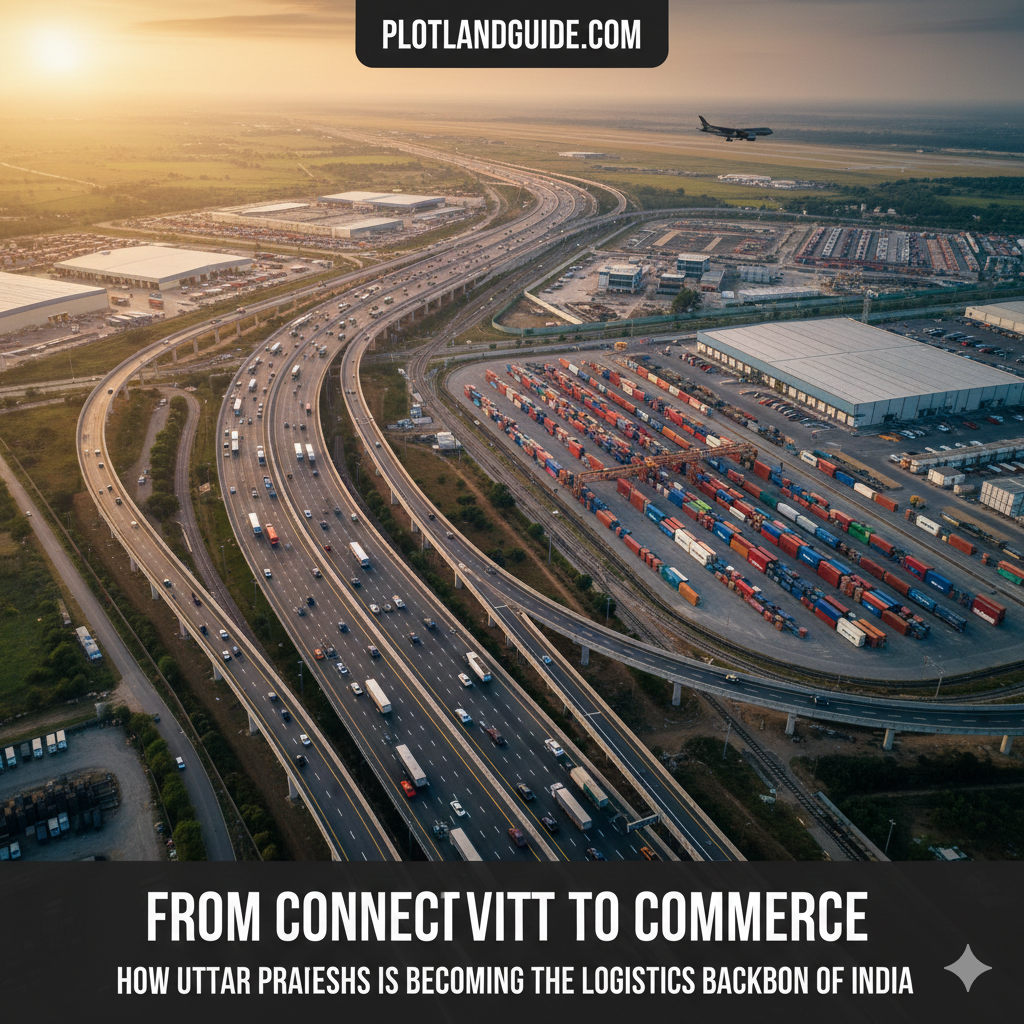
For decades, the narrative surrounding Uttar Pradesh’s economy often focused on its vast consumer base and agricultural output. However, a silent revolution is currently reshaping the state’s identity. We are witnessing a strategic pivot where Uttar Pradesh is moving beyond being just a market to becoming the central engine of India’s supply chain. The catalyst for this transformation? A robust network of Multi-Modal Logistics Parks (MMLPs).
In the world of commerce, speed and cost are the only currencies that matter. Traditional logistics in India have long been plagued by high costs—accounting for nearly 13-14% of GDP compared to the global average of 8%. The solution lies in "multi-modality," the ability to seamlessly switch freight between road, rail, air, and water. Uttar Pradesh, by virtue of its geography and deliberate infrastructure planning, is perfectly positioned to lead this shift.
This isn’t just about building warehouses; it is about creating an integrated ecosystem where a container arriving at a dry port can be whisked away by a freight train, transferred to a truck on an expressway, or loaded onto a barge on the Ganga, all within hours.
At the heart of this logistics revolution lies a project that is unique not just in India, but globally. The Multi-Modal Logistics Hub (MMLH) at Dadri, Greater Noida, is a textbook example of strategic infrastructure planning.
What makes Dadri special? It is the precise point of convergence for India’s two most critical economic arteries: the Eastern Dedicated Freight Corridor (EDFC) and the Western Dedicated Freight Corridor (WDFC). The EDFC connects the coal and steel belts of Bengal and Jharkhand to the north, while the WDFC connects the manufacturing hubs of the north to the bustling ports of Mumbai and Gujarat.
Spread across nearly 825 acres, the Dadri MMLH is designed to serve as a massive "dry port." It will handle close to 1.2 million TEUs (Twenty-foot Equivalent Units) of container cargo annually. For businesses in the National Capital Region (NCR) and Western UP, this is a game-changer. Goods that previously took days to reach the ports of JNPT or Mundra via congested passenger rail tracks will now reach in less than 24 hours via the dedicated freight corridors.
The facility is being equipped with state-of-the-art rail yards, custom clearance zones, and warehousing facilities, effectively bringing the seaport to the hinterland. This proximity to the Jewar International Airport further adds an air-cargo dimension, creating a true tri-modal hub.
While Dadri masters rail and road, Varanasi is rewriting the rules of river transport. The Multi-Modal Terminal at Ramnagar, Varanasi, on National Waterway-1 (River Ganga), is a pioneering project that reconnects Uttar Pradesh to the Bay of Bengal via water.
Water transport is universally acknowledged as the most eco-friendly and cost-effective mode of moving freight, yet it remained underutilized for decades. The Varanasi terminal changes this. With a capacity to handle millions of tonnes of cargo, it allows industries in Eastern UP to ship bulk commodities like cement, fertilizers, and textiles directly to Haldia and Kolkata ports.
This terminal is not operating in isolation. It is linked to the NH-7 highway and has proposed rail connectivity to the EDFC at Jeonathpur. This ensures that cargo coming by river can easily hop onto a train or truck to reach the interior markets of North India, completing the "hub and spoke" model that modern logistics demands.
Infrastructure is hardware, but policy is the software that makes it run. The Uttar Pradesh Government’s Multi-Modal Logistics Park Policy 2024 is the code that is aggressively attracting private capital into this sector.
Recognizing that logistics is an industry in its own right, the state has granted "Industry Status" to the sector. This is a crucial distinction—it means logistics parks can now avail land, electricity, and financing at industrial rates, which are significantly lower than commercial rates.
Key Incentives Driving Investment:
These incentives are designed to attract not just domestic giants but global logistics players who are looking for reliable bases to manage their India operations.
An MMLP is only as good as the roads that lead to it. This is where Uttar Pradesh’s aggressive expressway expansion acts as a force multiplier. The state is crisscrossed by a network of expressways that is unrivaled in the country:
This "Connectivity Web" ensures that a logistics park in Lucknow or Kanpur isn't just serving the local city; it can effectively service markets in Bihar, Madhya Pradesh, and Nepal within a single day’s drive. For e-commerce companies, this means the ability to offer same-day or next-day delivery to millions of new consumers.
Uttar Pradesh has set an ambitious target of becoming a $1 trillion economy. Logistics will be the backbone of this growth. By reducing the cost of moving goods, UP manufacturing becomes instantly more competitive. A textile factory in Kanpur or a brassware artisan in Moradabad can now compete with global exporters because their logistics costs are no longer a handicap.
Furthermore, MMLPs are massive employment generators. Beyond the direct jobs in warehousing and transport, they spawn an entire micro-economy of packaging, grading, testing, and repair services. They also reduce wastage, particularly in the agriculture sector, by providing modern cold-storage solutions integrated with transport, ensuring farmers get better value for their produce.
The development of Multi-Modal Logistics Parks in Uttar Pradesh is not just an infrastructure upgrade; it is a paradigm shift. It represents a move away from fragmented, siloed transport to a synchronized, efficient, and high-speed network.
For investors, logistics operators, and businesses, the message is clear: The infrastructure is ready, the policy is favorable, and the connectivity is unmatched. Uttar Pradesh is no longer just a state you drive through; it is the place where your business can drive forward. The transition from being a landlocked state to a "land-linked" powerhouse is complete, and the doors to the future of logistics are wide open.
Ready to explore investment opportunities in UP's logistics sector? The time to move is now.
