Published On:
February 5, 2026
Updated On:
February 5, 2026
After months of anticipation and revised timelines, the Noida International Airport at Jewar is officially set for inauguration in February 2026. With physical infrastructure complete and final regulatory nods from the DGCA in the last stages, this blog details the launch schedule, the reasons behind the past delays, and the transformative impact this mega-project will have on the NCR real estate market.
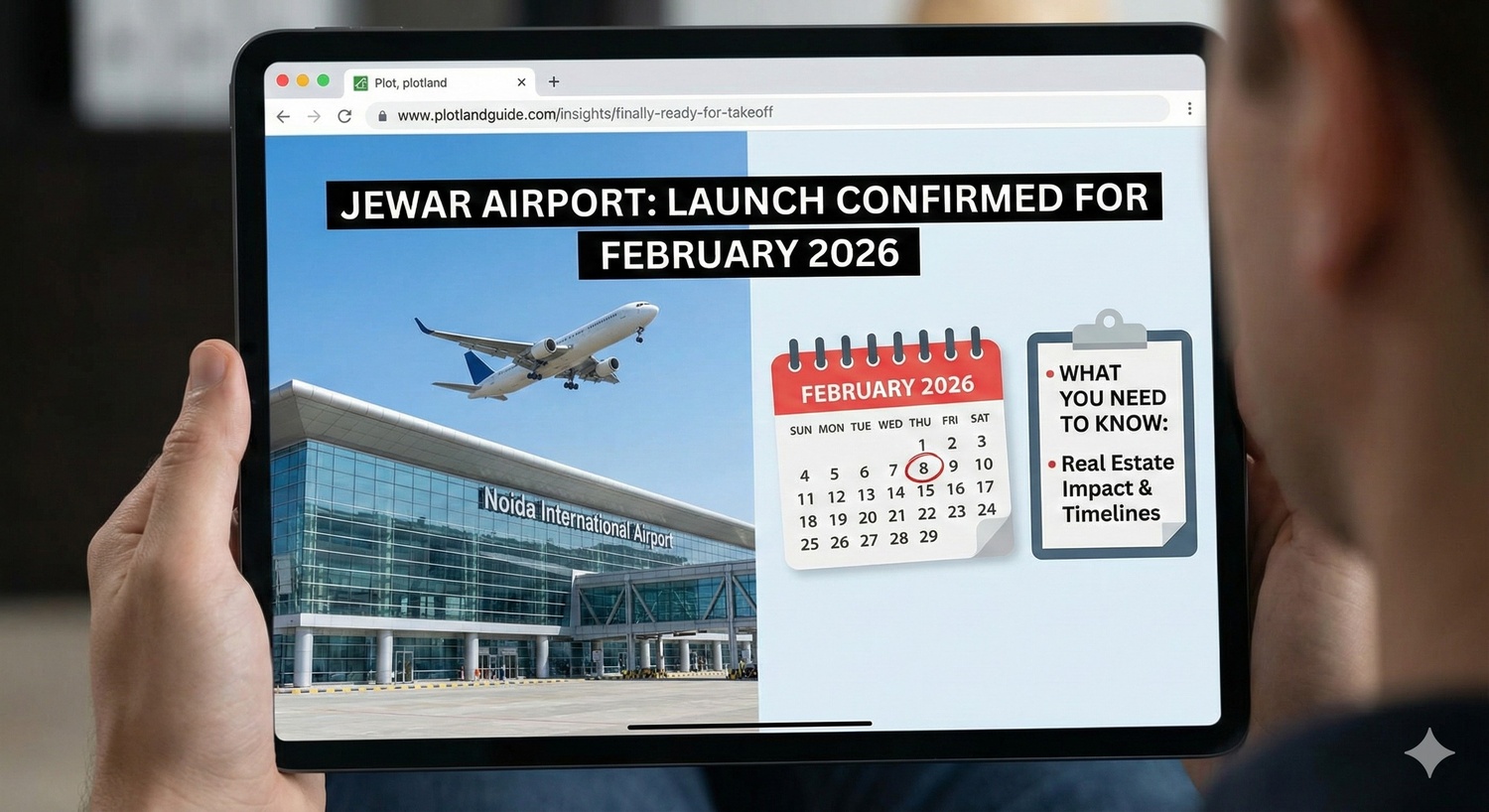
For residents of the National Capital Region (NCR), the Noida International Airport—popularly known as Jewar Airport—has been a topic of immense anticipation and, at times, understandable frustration. It was the promise of a world-class aviation hub that would not only decongest Delhi’s Indira Gandhi International Airport but also rewrite the economic destiny of Western Uttar Pradesh. After missing its initial deadline of late 2024 and the subsequent target of 2025, the moment of truth has finally arrived.
As we step into February 2026, the wait is officially over. The Uttar Pradesh administration has confirmed that the greenfield airport is ready for operations, with a grand inauguration scheduled for later this month. This is not just another tentative date on a calendar; it is the culmination of years of engineering marvels, regulatory navigation, and massive infrastructure planning.
The runway is paved, the Air Traffic Control (ATC) tower stands tall, and the terminal building is receiving its final polish. But why did it take this long? What were the hurdles that pushed the timeline to 2026? And most importantly, for investors and travelers, what does this opening mean for the region's future? This comprehensive guide dives deep into the launch details, the anatomy of the delays, and the "Jewar Effect" that is already sending shockwaves through the property market.
The speculation has been put to rest. Following a high-level review meeting in Lucknow, the state leadership has announced that the Noida International Airport (NIA) will witness its historic inauguration in February 2026. The event is expected to be presided over by the Prime Minister, signaling the national importance of this infrastructure project.
Current Status on the GroundUnlike previous deadlines where construction was still catching up, the situation on the ground today is one of readiness. The first phase of the airport, which includes a 3,900-meter runway and a terminal capacity of 12 million passengers annually, is physically complete. The mandatory calibration flights—critical tests where an aircraft flies repeatedly to check navigation aids and runway lighting—were successfully conducted in late 2025. These tests confirmed that the hardware is safe and ready for commercial liners.
The Final Regulatory LapThe only remaining step between "construction complete" and "flights taking off" is the paperwork. Specifically, the airport is in the final stages of receiving its Aerodrome License from the Directorate General of Civil Aviation (DGCA). This license is the ultimate green light required for any commercial airport to operate in India. Simultaneously, the Bureau of Civil Aviation Security (BCAS) is wrapping up its final security audits. Authorities have indicated that these are now procedural formalities rather than operational hurdles, paving the way for the February launch.
To appreciate the achievement of 2026, one must understand the complexities that led to the delays. Constructing a greenfield airport of this magnitude is never a straight line, but Jewar faced a unique set of challenges that pushed its timeline back by approximately 17 months.
One of the most significant reasons for the delay, which came to light during late 2025 audits, was related to the perimeter security. Aviation norms in India are stringent. The initial boundary setup, which included chain-link fencing in certain sectors, was flagged by security agencies. To ensure an impenetrable secure zone, the requirement was upgraded to a solid concrete perimeter wall extending deep underground to prevent any intrusion—human or animal. Retrofitting and completing this 14-kilometer fortified boundary took additional time but was non-negotiable for passenger safety.
The construction of a modern airport relies on a global supply chain. Specialized baggage handling systems, advanced navigation radars, and terminal screening equipment were sourced from international vendors. Global logistical disruptions and manufacturing backlogs meant that critical components arrived later than scheduled. The developers chose to wait for the best-in-class equipment rather than compromising with interim solutions, a decision that cost time but ensured quality.
As a 100% Foreign Direct Investment (FDI) project developed by Zurich Airport International AG, the project was subject to rigorous clearances from the Ministry of Home Affairs. This included security vetting for key management personnel and expatriate leadership. While standard for strategic assets like airports, these clearance processes added layers of bureaucratic timelines that were not initially factored into the aggressive 2024 targets.
Unlike projects that open in a half-baked state, the developers and the state government were keen on a flawless launch. The terminal interiors, featuring intricate designs inspired by local culture blended with Swiss efficiency, required meticulous finishing. The authorities decided that a delayed but perfect airport was preferable to an on-time but incomplete one.
When the first passengers walk through the doors this month, they will be stepping into India’s first "Net-Zero Emissions" airport. The design philosophy of Noida International Airport sets it apart from other hubs in the country.
Sustainability FirstThe terminal has been designed to operate on solar power and advanced water harvesting systems from Day 1. The use of sustainable materials and a design that maximizes natural light will significantly reduce the carbon footprint, setting a new benchmark for green infrastructure in India.
Digital-First Passenger ExperiencePassengers can expect a seamless "contactless" journey. The airport is integrated with the DigiYatra biometric system at all touchpoints—from entry to boarding gates. The goal is to minimize queuing times and ensure a smooth flow, leveraging the operational expertise of Zurich Airport, which is known for having some of the most efficient processes in the world.
The Multi-Modal HubPerhaps the most revolutionary aspect is the Integrated Ground Transportation Centre (GTC). Unlike older airports where the metro station or bus terminal is an afterthought located far away, the GTC at Jewar is the heart of the complex. It will eventually host a metro station, a high-speed rail station (connecting to the Delhi-Varanasi Bullet Train corridor), and taxi bays, all within a short walk from the terminal building.
While travelers are excited about flights, investors are looking at the ground beneath them. The confirmation of the February 2026 opening has acted as a massive adrenaline shot for the real estate market in the Yamuna Expressway Industrial Development Authority (YEIDA) region.
The "Jewar Effect" on PricesIn the last five years, land prices in sectors closest to the airport—specifically Sectors 18, 20, and 22D—have witnessed exponential growth. What was once available for ₹15,000-₹18,000 per square meter is now trading at premiums of ₹40,000 to ₹50,000 per square meter or more in the secondary market. The "peripheral surge" has also lifted markets in Tappal and Dankaur, which have seen appreciation of up to 200% as buyers priced out of the core sectors look for entry points.
Commercial and Logistics BoomThe airport is not just moving passengers; it is designed to move cargo. This has triggered a rush for warehousing and industrial land. Logistics giants are securing massive parcels along the Yamuna Expressway to set up fulfillment centers. The logic is simple: proximity to an international cargo hub drastically reduces shipping times. Consequently, commercial plots that were stagnant for a decade are now commanding seller-driven prices.
Future Outlook: The Post-Launch JumpMarket analysts predict another correction—this time upwards—once flights actually begin. The "execution risk" will be zero once the airport is operational, which typically invites institutional investors and end-users who were previously sitting on the fence. We can expect a further 20-30% appreciation in the immediate vicinity within the first six months of operations.
The inauguration in February 2026 marks the beginning of Phase 1.
The opening of the Noida International Airport in February 2026 is more than just an infrastructure milestone; it is a geopolitical and economic statement. It shifts the center of gravity of the National Capital Region eastward, turning the once-dusty fields of Jewar into a global gateway.
For the traveler, it promises a relief from the congestion of IGI Airport. For the state of Uttar Pradesh, it is a crown jewel of development. And for the investor, it validates the patience held over the last few turbulent years. The delays are in the past; the future is officially ready for takeoff. As the Prime Minister flags off the first flight this month, the engine of Western UP’s economy will roar to life, and the echoes will be heard for decades to come.
