Published On:
June 22, 2026
Updated On:
June 22, 2026
The upcoming 31-kilometer Faridabad-Jewar Greenfield Expressway is set to revolutionize NCR connectivity by reducing travel time from 90 minutes to a mere 15 to 20 minutes. With a revised budget of ₹3,630 crore and an expected completion by early 2027, this six-lane corridor will unlock massive real estate potential and seamlessly link major industrial hubs to the Noida International Airport.
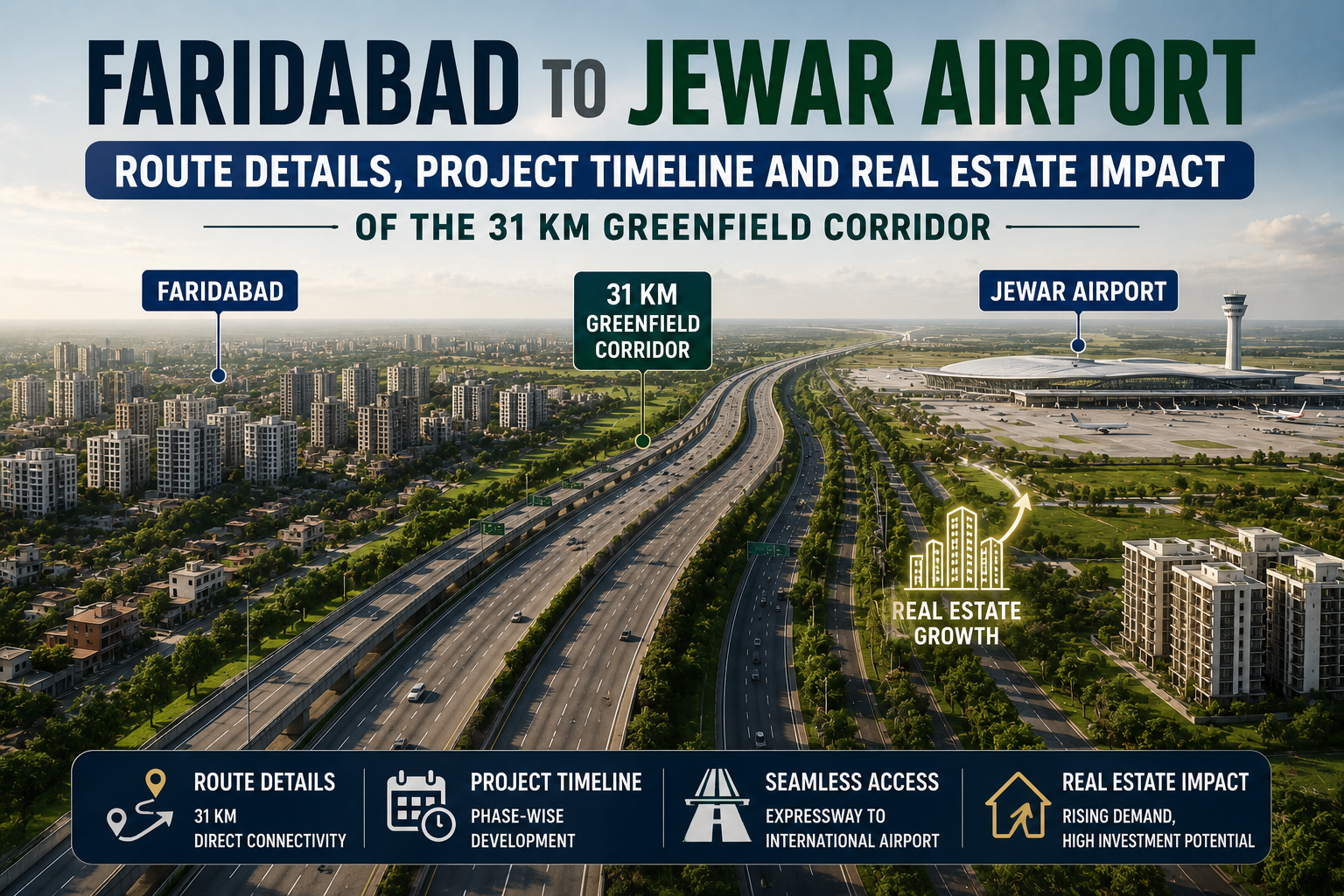
The National Capital Region has long been the economic powerhouse of northern India, but its rapid expansion has consistently outpaced its road networks. For decades, traveling from the heavily industrialized zones of Faridabad to the eastern peripheries of Uttar Pradesh required navigating a labyrinth of congested city roads and overburdened highways. However, the ongoing development of the Noida International Airport at Jewar has served as a massive catalyst for a complete overhaul of regional connectivity. To ensure this new global aviation hub functions efficiently, the government is weaving a complex web of high-speed road networks around it. The crown jewel of this logistical master plan is the Faridabad to Jewar Greenfield Expressway.
This 31-kilometer access-controlled corridor is much more than just a stretch of fresh asphalt. It represents a fundamental shift in how people and freight will move across state borders. By bridging the geographical divide between the industrial muscle of Haryana and the emerging aviation gateway of Uttar Pradesh, this greenfield project promises to redraw the economic map of the region. Whether you are a daily commuter exhausted by endless traffic jams, a logistics operator looking to optimize delivery routes, or a real estate investor hunting for the next big growth corridor, understanding the route details, technical specifications, and updated timelines of this expressway is absolutely essential.
The Faridabad-Jewar Greenfield Expressway is designed to be a high-speed, seamless conduit connecting two rapidly growing urban nodes. The route officially originates at Sector 65 in Ballabgarh, Faridabad. At this crucial starting point, the expressway ties directly into the link road of the monumental Delhi-Mumbai Expressway. From there, the alignment slices eastward through the industrial and agricultural belts of Haryana, eventually crossing the Yamuna River to enter Uttar Pradesh. The journey concludes at Dayanatpur village, situated right on the doorstep of the upcoming Noida International Airport in the Gautam Buddha Nagar district.
Out of the total 31.42 kilometers, approximately 22 kilometers traverse through the state of Haryana, while the remaining 9 kilometers fall within the boundaries of Uttar Pradesh. The expressway has been meticulously planned to integrate several key regions, passing through multiple villages that previously relied on narrow, winding local roads. In Haryana, the corridor navigates past settlements such as Shahpur, Chandawali, Fafunda, Panhera Khurd, Mohna, and Baghpur. Upon crossing the state line into Uttar Pradesh, it touches villages including Jhuppa, Phalaida Bangar, Amarpur, Karauli Bangar, Vallabhnagar, and finally, Dayanatpur. By cutting through these specific areas, the project not only facilitates high-speed interstate transit but also brings these rural and semi-urban pockets into the mainstream economic fold.
Executed by the National Highways Authority of India under the ambitious Bharatmala Pariyojana Phase I, the expressway is being constructed on a Hybrid Annuity Model. The infrastructure is being engineered to meet world-class standards, featuring a primary six-lane configuration that is designed to be fully expandable to eight lanes to accommodate future traffic surges.
To ensure that the high-speed movement of vehicles does not disrupt local village life or agricultural activities, the project incorporates a comprehensive network of service roads. A 10-kilometer service lane is being constructed on either side of the main carriageway, providing safe and convenient access for local residents. The sheer scale of the civil engineering involved is staggering. The blueprint includes the construction of 121 bridges and culverts, ensuring that the natural flow of water bodies and existing local pathways remain completely uninterrupted.
One of the most critical structural components currently underway is the massive bridge spanning the Yamuna River. Heavy machinery is already deployed on-site, with girder installation progressing steadily to bridge the natural boundary between the two states.
In a major design evolution that occurred after the initial project announcement, the planners recognized that running a massive surface-level highway through the rapidly urbanizing sectors of Faridabad could severely bisect neighborhoods and disrupt local city planning. The corridor traverses an area heavily earmarked for high-density urban development under the Faridabad Master Plan 2031. To mitigate this, a significant design revision was incorporated, transforming approximately 11 kilometers of the route into an elevated highway.
This elevated section is not merely a structural enhancement; it is a strategic urban planning decision designed to protect expansion zones and ensure sustainable development. By lifting a third of the expressway off the ground, authorities are preserving valuable land underneath for local civic infrastructure and cross-city traffic flow. Constructing an elevated corridor of this magnitude requires immense foundational work. The engineering teams are tasked with driving 3,000 deep concrete piles into the earth to support the massive piers. As of early 2026, roughly 1,200 of these piles have already been successfully completed, and the casting of the upper road structure girders has commenced to accelerate delivery.
This massive structural upgrade naturally impacted the project's financial outlay. In March 2026, the central government approved a revised capital cost of ₹3,630.77 crore, up from the original estimate of roughly ₹2,414 crore. This revised budget specifically included the additional funds required for the elevated segment, with the Haryana government agreeing to bear a substantial portion of this specific cost to facilitate their state's urban development goals.
The true brilliance of the Faridabad-Jewar Greenfield Expressway lies in its ability to act as a central nervous system for regional logistics. It does not exist in isolation; rather, it intercepts and connects with almost every major highway network in the vicinity through nine highly complex interchanges.
The journey begins with a massive three-leg interchange near Sector 65 in Faridabad, providing flawless entry and exit points to the Delhi-Mumbai Expressway. As travelers move eastward, they will encounter a spectacular cloverleaf interchange at Mohana village. This specific junction is an engineering highlight, linking the new greenfield route directly to the Eastern Peripheral Expressway. This means commercial freight moving from the northern states can easily transition toward the airport without ever touching city roads.
Furthermore, the expressway provides direct linkage to the Western Peripheral Expressway, integrating the heavy manufacturing hubs of Gurugram, Manesar, and Palwal into the airport's immediate catchment area. In addition to intersecting road networks, the project features a massive Road Over Bridge that crosses the Dedicated Freight Corridor, ensuring that the movement of heavy rail cargo continues unhindered below while passenger traffic flows smoothly above. The final stretch merges effortlessly with the Yamuna Expressway, providing a direct gateway not only to the airport terminals but also toward the cities of western Uttar Pradesh.
For the everyday commuter and logistics provider, the most tangible benefit of this massive infrastructure investment is the unbelievable reduction in travel time. Currently, a traveler attempting to drive from the industrial sectors of Faridabad to the Jewar region has to endure a grueling journey of nearly 90 kilometers. This trip involves navigating the chaotic traffic of Delhi, crossing the border into Noida, and then driving down the Greater Noida Expressway. Depending on the time of day, this ordeal can easily consume an hour and a half.
The new greenfield corridor fundamentally alters this reality. By charting a direct, straight-line path across the river, the total distance is drastically slashed by almost 66 percent, bringing the journey down to just 31 kilometers. Once the asphalt is laid and the toll gates become operational, vehicles cruising at expressway speeds will be able to complete this trip in a mere 15 to 20 minutes. This 20-minute airport access makes Faridabad an incredibly viable residential option for the thousands of aviation professionals, airline crew members, and ground staff who will soon be employed at the massive international facility.
Large-scale infrastructure projects frequently encounter shifting timelines due to design upgrades, land acquisition hurdles, and environmental clearances. The Faridabad-Jewar Greenfield Expressway is no exception. The physical construction officially commenced on June 22, 2023, after the contract was awarded to a major private infrastructure firm.
The original completion target was aggressively set for mid-2025 to roughly align with the initial operational phases of the Noida International Airport. However, the strategic decision to incorporate the massive 11-kilometer elevated corridor necessitated a revision of the project schedule. While the foundational work and earthmoving for the at-grade sections have progressed rapidly, the complex engineering required for the elevated structures and the Yamuna River bridge demands additional time.
According to the latest project updates available in 2026, the executing agencies are pushing aggressively to open specific, highly critical sections of the road for partial operations within the year. The revised target for the full, end-to-end completion of the entire 31-kilometer access-controlled expressway is now set for April 2027. Despite the slight extension in the timeline, the intense pace of piling work, soil testing, and girder casting currently visible on the ground reflects a deep commitment to delivering this critical transport artery as swiftly as structurally possible.
The real estate market is highly sensitive to infrastructure developments, and the 31-kilometer stretch of the Faridabad-Jewar Expressway is sending massive ripple effects across the property landscape of the National Capital Region. The project is acting as a massive signal to investors that the geographical isolation of Faridabad is officially over.
By linking Faridabad’s established, robust industrial muscle to Jewar’s emerging global gateway, the corridor is changing the entire economic math of the region. The industrial sectors of Ballabgarh are suddenly firmly on the radar of massive multinational corporations and end-users who operate in Noida or the airport zone. The direct link to the Delhi-Mumbai Expressway is providing a massive boost to the warehousing sector. Land parcels situated near key interchanges, particularly around Mohana and Baghpur, are witnessing intense developer interest. Logistics operators are aggressively scouting for space to set up massive cargo sorting facilities, cold storage units, and distribution hubs, anticipating the massive volume of freight that will soon flow through the airport.
On the residential front, the corridor is unlocking serious value. As travel times shrink, homebuyers who previously found central Noida or Gurugram unaffordable are turning their attention to the emerging micro-markets along the Faridabad and Palwal stretches. The areas surrounding the Uttar Pradesh border, which were previously dominated by agricultural land, are now being evaluated for high-density township projects and commercial retail spaces. Budget hotels, transit accommodations, and commercial complexes are expected to mushroom near the major entry and exit loops once the cargo and passenger movement picks up momentum.
As the massive concrete piers continue to rise along the 31-kilometer alignment, the broader vision of the National Capital Region's future comes into sharp focus. The Faridabad-Jewar Greenfield Expressway is not just a road designed to make catching a flight slightly more convenient. It is a highly strategic economic enabler.
By seamlessly converging multiple expressways, integrating dedicated freight corridors, and connecting heavy manufacturing zones directly to an international aviation hub, this project elevates the entire region's logistics efficiency to global standards. It ensures that the massive investments being poured into the Jewar Airport are fully unlocked, providing businesses with the rapid transit capabilities they need to compete on an international stage. When the barricades are finally removed and the first vehicles glide effortlessly from Faridabad to the airport terminals in under twenty minutes, it will mark the dawn of a highly integrated, incredibly efficient, and deeply prosperous new era for the entire National Capital Region.
