Published On:
September 27, 2026
Updated On:
September 27, 2026
The highly anticipated EPE-Yamuna Expressway interchange is set to open just before Diwali, eliminating a frustrating 20-kilometer detour for commuters. This 270-crore infrastructure marvel will drastically cut travel times and provide seamless, high-speed connectivity to the upcoming Noida International Airport for travelers across the National Capital Region.
For years, navigating the intricate web of highways around the National Capital Region has been a mix of modern convenience and frustrating bottlenecks. If you are a frequent traveler driving between the distant nodes of Haryana, western Uttar Pradesh, and the rapidly developing sectors of Greater Noida, you already know the struggle of switching between major expressways. However, a monumental shift in regional transit is just around the corner, promising to reshape how millions of people travel across the NCR.
In what is arguably one of the most awaited infrastructure upgrades in the region, the vital interchange connecting the Eastern Peripheral Expressway with the Yamuna Expressway is finally nearing completion. With construction moving at a breakneck pace, the authorities are targeting a grand opening just before the Diwali festivities. This crucial infrastructural link is not just a relief for daily commuters; it is a foundational pillar for the success of the upcoming Noida International Airport at Jewar.
As the project crosses the eighty percent completion mark, it is the perfect time to dive deep into what this new interchange means for regional connectivity, the real estate market, and the everyday driver who is tired of being stuck in endless traffic jams.
To truly appreciate the value of this new cloverleaf interchange, one must first understand the current ordeal faced by thousands of motorists every single day. The Eastern Peripheral Expressway, often referred to as the Kundli-Ghaziabad-Palwal Expressway, and the Yamuna Expressway are two of the most critical high-speed corridors in northern India. Geographically, they intersect near Greater Noida. However, despite their physical proximity, there has never been a direct way to transition a vehicle from one to the other.
Currently, if a commuter is driving from cities like Meerut, Ghaziabad, Sonipat, or Palwal on the Eastern Peripheral Expressway and wishes to merge onto the Yamuna Expressway to head towards Agra or the upcoming Jewar airport, they are forced into a chaotic detour. Drivers must exit the high-speed corridor at the Bil Akbarpur toll, navigate through the densely populated and heavily congested internal roads of Greater Noida, passing through bottlenecks like Sirsa village and the notoriously jammed Pari Chowk area.
This mandatory diversion forces heavy commercial trucks, intercity buses, and passenger cars to mix with local city traffic. The result is a sluggish 15 to 20-kilometer detour that can easily add upwards of thirty to forty-five minutes to a journey, draining fuel and patience alike.
Once the new interchange opens, this nightmare will instantly become a thing of the past. Vehicles will be able to seamlessly glide from the Eastern Peripheral Expressway directly onto the Yamuna Expressway via beautifully engineered connecting ramps, completely bypassing the urban chaos of Greater Noida.
While the immediate traffic relief is a massive win for daily commuters, the strategic importance of this project is entirely tied to the Noida International Airport. As the mega-airport in Jewar prepares to commence commercial passenger operations, road access remains the primary lifeline for travelers trying to reach the terminals.
An airport is only as successful as its connectivity. Passengers flying out of the new facility will be drawn from a vast catchment area that extends far beyond Noida and Delhi. The airport is designed to serve the aviation needs of western Uttar Pradesh, Haryana, and parts of Rajasthan. For these travelers, the Eastern Peripheral Expressway is the primary arterial route.
Without this connecting interchange, a passenger traveling from Kundli or Ghaziabad to catch a flight at Jewar would risk missing their departure due to unpredictable traffic in the Greater Noida city limits. By integrating the two expressways, the journey to the airport becomes predictable, high-speed, and signal-free. The interchange effectively shrinks the perceived distance to the airport, making the Jewar facility a highly attractive and practical departure point for millions of potential flyers across the broader National Capital Region.
Building a junction that seamlessly merges two massive, multi-lane expressways is an engineering feat that requires vast amounts of space and meticulous planning. Located near the villages of Jaganpur and Afzalpur, approximately ten kilometers away from the Yamuna Expressway’s zero point near Pari Chowk, the project is sprawling in its scale.
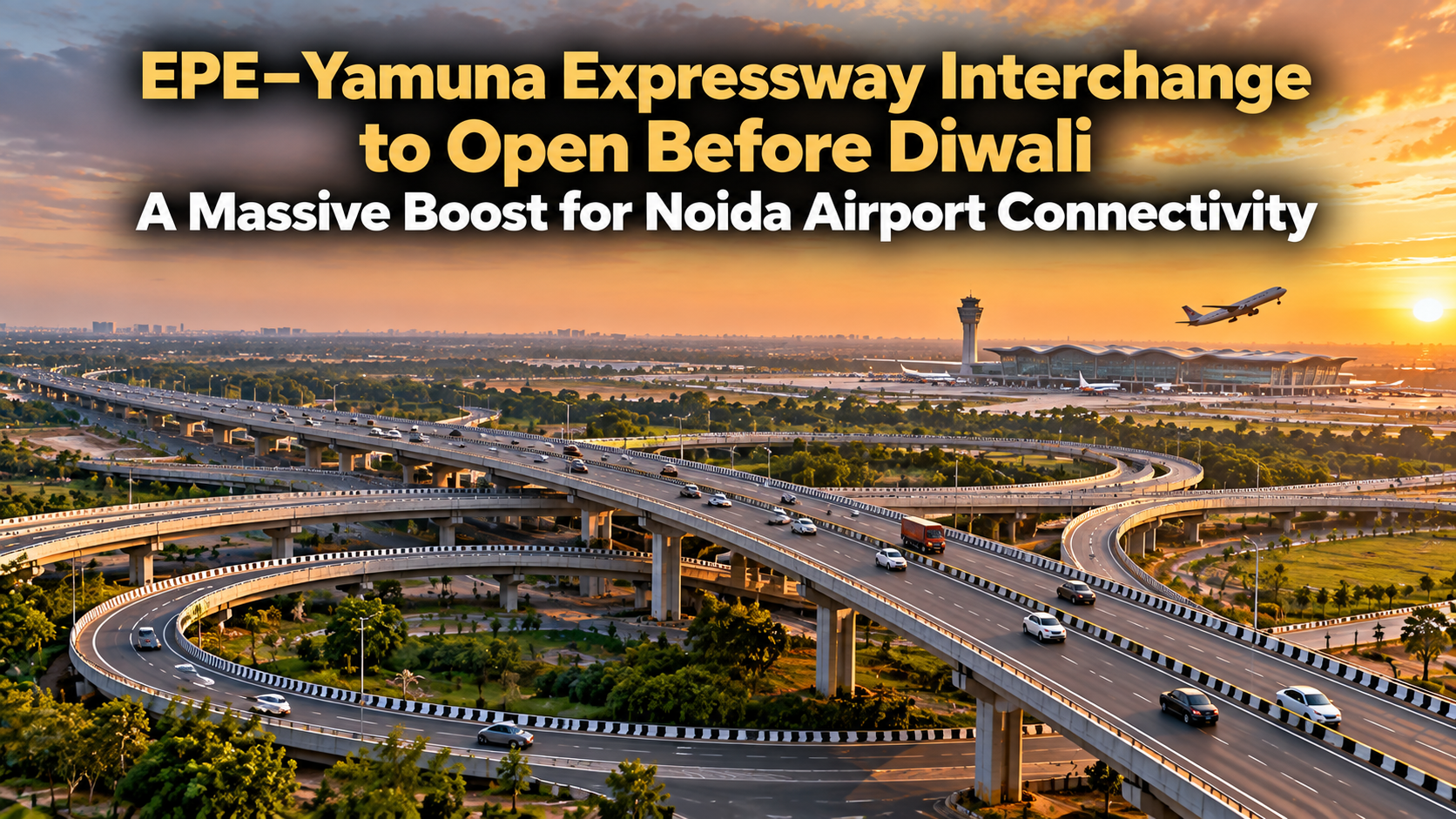
The interchange spans an impressive 83 hectares of land. It is designed as a classic cloverleaf structure, a highly efficient layout that allows traffic to transition between intersecting highways without the need for traffic lights or stopping. The complex features four dedicated entry ramps and four exit ramps, ensuring that vehicles approaching from any of the four cardinal directions can smoothly transition to their desired route. If you were to lay out all the connecting loops and ramps of this interchange in a straight line, the total length of the newly constructed road network would measure approximately 13 kilometers.
The structural foundation of the interchange is now fully complete. Construction crews are currently racing against the clock to finalize the surface-level details. The remaining tasks include laying the final coats of bitumen resurfacing, constructing the heavy-duty retaining walls, and installing vital safety infrastructure such as metal crash barriers, reflective road markings, and high-visibility directional signage. Additionally, extensive street lighting is being installed to ensure that the sweeping curves of the interchange are brightly illuminated and perfectly safe for nighttime driving.
The road to completing this vital infrastructure project has been anything but smooth. In fact, the project serves as a classic case study of the complex challenges involved in executing large-scale public works in heavily populated agrarian regions.
The concept of connecting the two expressways was officially proposed by the Yamuna Expressway Industrial Development Authority back in 2019. At its inception, the project was estimated to cost a relatively modest 75.5 crore rupees, with an optimistic completion timeline set for eighteen months. However, the project hit an immediate and formidable roadblock: land acquisition.
Local farmers, whose agricultural lands were required to build the sprawling 83-hectare cloverleaf, launched widespread protests demanding higher financial compensation for their properties. The standoff brought the earthwork to a grinding halt for several years. As the machinery sat idle, the cost of raw materials, labor, and engineering design variations began to steadily climb, pushing the initial budget into obsolescence.
The breakthrough finally arrived when the Yamuna Expressway Industrial Development Authority agreed to disburse a 64 percent additional compensation package to the affected farmers, effectively resolving the localized disputes. Furthermore, to accelerate the execution of the technically complex project, the Uttar Pradesh state cabinet made a strategic decision in April of last year to officially transfer the construction mandate to the National Highways Authority of India.
With the land disputes settled and a premier national agency at the helm, construction gathered intense momentum. However, the years of delay and the increased compensation payouts caused the final project cost to swell dramatically, reaching a revised total of 270 crore rupees.
Infrastructure development is the ultimate catalyst for real estate appreciation, and the impending opening of this interchange is already sending ripples through the property markets of Greater Noida and the Yamuna Expressway sectors.
For years, the sectors located deep along the Yamuna Expressway have been marketed as future-ready investments, heavily reliant on the promise of the upcoming airport. However, the lack of direct connectivity to the wider region acted as a psychological barrier for many end-users and investors who felt the area was simply too remote or difficult to access from traditional hubs like Ghaziabad or Haryana.
The new interchange completely shatters that narrative. By tying the Yamuna Expressway directly into the Eastern Peripheral Expressway, the residential and commercial sectors under the Yamuna Authority's jurisdiction are suddenly plugged directly into the broader regional grid. High-speed, hassle-free access makes these sectors exponentially more attractive for large-scale corporate investments, logistics hubs, and residential township developments.
Real estate analysts anticipate a surge in demand for plots, commercial spaces, and housing units in the immediate vicinity of the interchange and along the corridor leading to the Jewar airport. The ability to bypass local traffic and hit the highway instantly is a premium feature that homebuyers and corporate tenants are more than willing to pay for.
Beyond passenger travel and real estate, the most profound economic impact of this new link will be felt in the freight and logistics sector. The Eastern Peripheral Expressway was originally conceptualized as a bypass to keep heavy, polluting commercial trucks out of the congested streets of central Delhi. It serves as a vital artery for goods moving from northern states like Punjab and Haryana toward the eastern and southern parts of the country.
Simultaneously, the Yamuna Expressway corridor is rapidly transforming into a massive industrial and manufacturing hub, featuring electronic manufacturing clusters, apparel parks, and medical device manufacturing zones.
By connecting these two corridors, the government is essentially creating a frictionless logistics network. Transport trucks hauling raw materials or finished goods can now shift between the industrial zones of western Uttar Pradesh and the broader national highway network without ever having to slow down for city traffic. This reduction in transit time directly translates to lower fuel consumption, faster supply chain cycles, and significantly reduced transportation costs for the manufacturing sector.
With the authorities aiming for an October 15 completion deadline, the coming weeks are highly critical. Once the heavy machinery rolls out and the final stroke of road paint dries, the facility cannot simply be thrown open to the public on a whim.
A rigorous testing phase is mandated before any major highway junction is commissioned. Engineers and safety auditors will conduct high-speed vehicle trials to evaluate the banking of the curves, the grip of the bitumen surface, and the visibility of the signage during different times of the day and night. Any minor structural adjustments or safety reinforcements identified during these trials will need to be executed immediately.
Following successful safety audits, the National Highways Authority of India will issue a formal traffic notification, officially integrating the interchange into the active road network. Barring any unforeseen severe weather events or last-minute technical snags, all indications point toward a festive opening.
The completion of the Eastern Peripheral Expressway and Yamuna Expressway interchange is a testament to the transformative power of targeted infrastructure. It is more than just an arrangement of concrete and asphalt; it is a vital economic bridge that unlocks the true potential of the Noida International Airport and supercharges the industrial ambitions of the entire region.
As Diwali approaches, commuters who have endured years of traffic jams in Greater Noida finally have a reason to celebrate. The days of tedious detours are coming to a close, ushering in a new era of seamless, high-speed travel that will define the future of the National Capital Region.
