Published On:
July 12, 2026
Updated On:
July 12, 2026
While owning a home in India's scenic hill stations is a common dream, stringent state-specific land laws restrict outsiders from freely purchasing property to protect fragile mountain ecosystems and indigenous cultures. However, by understanding these complex regulations, investors can still legally acquire vacation homes through urban apartments or state-approved residential plots.
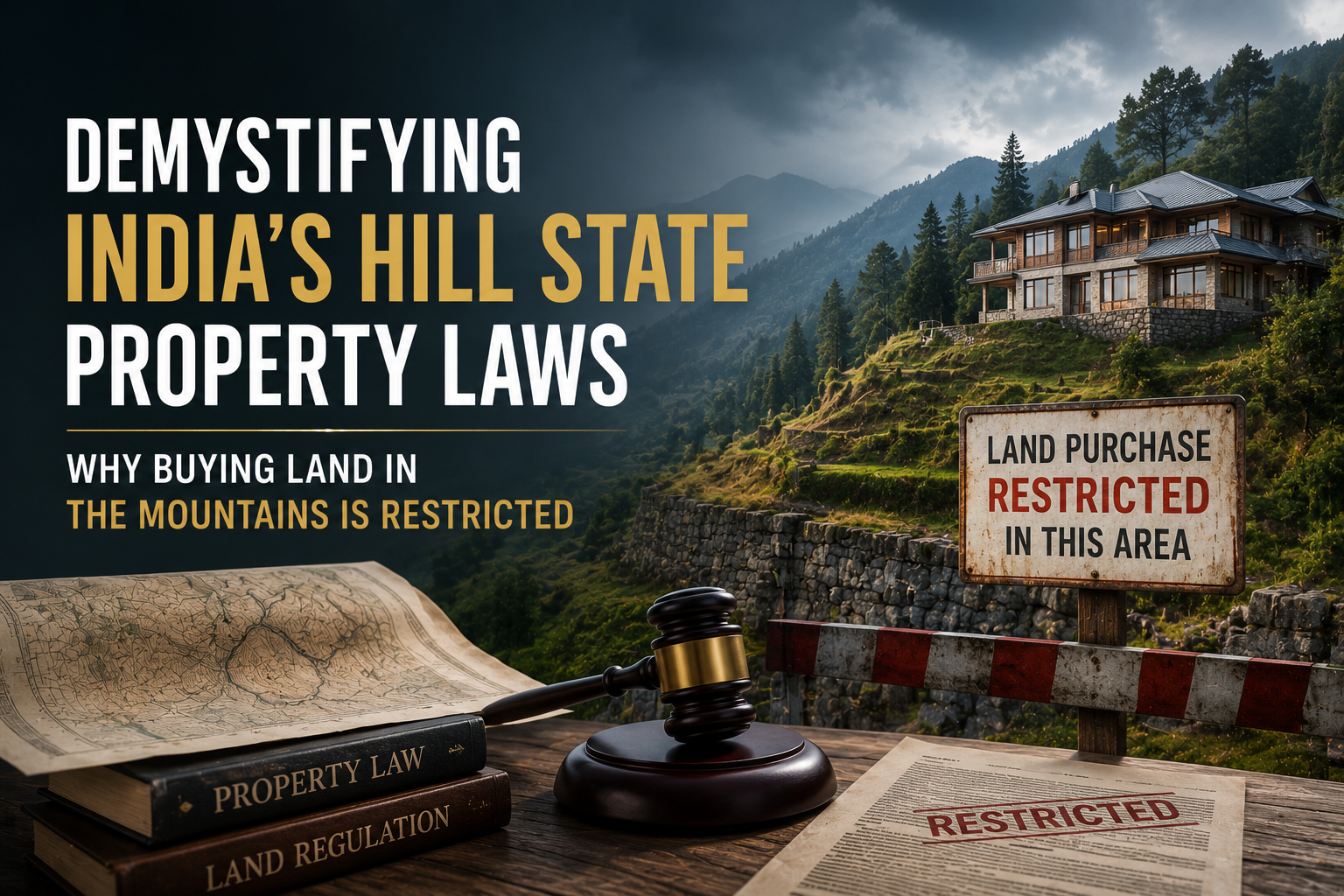
Waking up to a panoramic view of snow-capped Himalayan peaks, surrounded by pine forests and crisp mountain air, is a retirement or vacation dream shared by millions. As Indian cities become increasingly congested and polluted, the allure of escaping to a serene mountain retreat has driven a massive surge in demand for real estate in the hills. However, transitioning from a tourist to a property owner in India's mountainous regions is far from a straightforward transaction.
Unlike the plains, where real estate investments are largely governed by standard market dynamics and uniform national laws, the hill states operate under a highly specialized, restrictive legal framework. If you are a resident of Delhi, Maharashtra, Karnataka, or any other state looking to buy a sweeping plot of land in Himachal Pradesh, Uttarakhand, or the North-East, you will immediately encounter stringent legal barriers. These laws are designed specifically to regulate and, in many cases, prohibit non-residents from purchasing agricultural and open land.
Navigating this complex regulatory environment requires a deep understanding of why these rules exist, how they vary from state to state, and what legal avenues remain open for those who wish to invest in a mountain home.
The restrictions placed on land ownership in the hills are not arbitrary bureaucratic hurdles. They are deeply rooted in historical context and serve as a necessary defense mechanism for regions that are exceptionally vulnerable to unchecked human activity. The primary objective is to maintain a delicate, sustainable balance between modern real estate development and the preservation of traditional mountain life.
The Himalayan range is ecologically fragile and highly susceptible to natural disasters, including devastating landslides, flash floods, and severe soil erosion. The local topography simply cannot support the same density of concrete infrastructure as the plains. Unregulated real estate development, driven by wealthy investors looking to build sprawling commercial resorts or expansive private estates, places immense pressure on this delicate environment. Heavy, unplanned construction destabilizes mountain slopes, disrupts natural water channels, and rapidly depletes already scarce local groundwater resources. By restricting large-scale land purchases by outsiders, state governments effectively control the pace of commercialization, shielding the environment from rapid, irreversible degradation.
In mountainous terrains, arable land is a premium and scarce resource. The indigenous populations rely heavily on these limited terraced farming sectors for their daily sustenance and economic survival. If the real estate markets in these states were completely deregulated, affluent individuals and massive corporate entities from metropolitan cities could easily outbid local farmers. This would lead to the rapid conversion of crucial farming land into luxury vacation homes or commercial properties. Over time, this shift would drastically shrink the available agricultural space, potentially pushing native residents out of their traditional occupations and rendering them landless within their own home states.
Hill states and tribal regions possess distinct cultural identities, unique languages, and traditional ways of life that have remained intact for centuries. For many indigenous communities, land is not merely a financial asset to be traded on the open market; it is a sacred extension of their ancestral heritage. A massive, unchecked influx of outside buyers could rapidly alter the local demographic balance and disrupt the delicate social fabric of these regions. Property laws are therefore structured to ensure that indigenous populations retain absolute control over their ancestral lands, safeguarding their socio-economic rights and cultural autonomy against the overwhelming tide of outside capital.
While the protective philosophy remains consistent across the Himalayan belt, the specific legal frameworks governing property ownership vary significantly from state to state. Understanding these regional nuances is critical for any prospective buyer.
Himachal Pradesh boasts one of the oldest and most robust frameworks for protecting local land rights. In 1972, the state government introduced Section 118 of the Himachal Pradesh Tenancy and Land Reforms Act, a pivotal piece of legislation that strictly bars non-agriculturists from purchasing agricultural land in the state.
This law is remarkably comprehensive. It applies not only to people from other states but also to native Himachalis who do not hold agriculturist status in the official revenue records. Under this section, an outsider cannot simply purchase a scenic patch of hillside to build a private villa. The law specifically restricts the transfer of land to non-agriculturists through sale, lease, or any other type of transaction without prior, explicit permission from the state government.
However, this does not mean the doors are completely closed to investors. Non-residents can purchase pre-constructed properties, such as flats or houses, within designated municipal limits and urban areas where Section 118 does not apply. Additionally, outsiders can apply to the state government for special permission to buy land for specific approved purposes, such as setting up a tourism project, a homestay, or an industrial unit. This approval process involves rigorous background checks, field inspections by revenue officers, and strict timelines for completing the proposed construction.
Uttarakhand has historically experienced a tug-of-war between attracting real estate investment and protecting its ecology. The state's land laws have fluctuated over the past two decades, with previous administrations alternately tightening and loosening the rules. However, the legal landscape shifted dramatically with the comprehensive Bhu-Kanoon amendments passed in early 2025.
State leadership implemented these strict new regulations to curb the rampant purchase of land by outsiders and protect the cultural identity of the Pahadi people. Under the new legal framework, outsiders are subjected to a blanket ban on purchasing any agricultural or horticultural land across 11 of the state's 13 hill districts. The only exceptions are the plain-heavy districts of Haridwar and Udham Singh Nagar, though even there, transactions are heavily monitored.
For individuals looking to build a residential home, the new laws dictate that a non-resident can only purchase a maximum of 250 square meters (approximately 2,690 square feet) of land outside municipal limits. Crucially, this is a one-time purchase rule. Buyers cannot acquire multiple small plots over time or combine purchases with family members to create a larger estate.
Furthermore, the 2025 amendments introduced mandatory affidavits. Every prospective buyer must declare their intended land use, and the entire purchase process is meticulously tracked through an online government portal. If the land is used for any purpose other than what was declared, or if illegal construction takes place, the state holds the power to immediately repossess the property without compensation.
If you look further east to states like Arunachal Pradesh, Nagaland, Mizoram, and Meghalaya, the restrictions transition from regulatory hurdles to absolute constitutional barriers. Governed largely by the Sixth Schedule and special provisions under Article 371 of the Indian Constitution, land ownership in these states is deeply tied to the customary laws of the indigenous tribal communities.
In these regions, the sale of land or property to outsiders and non-tribals is strictly prohibited. The land belongs to the community or specific tribal councils, and the legal concept of individual, transferable property rights as understood in the rest of India simply does not apply. Even in Sikkim, another highly sought-after mountain destination, property ownership is exclusively reserved for individuals who hold a valid Sikkim Subject Certificate, effectively locking out any non-resident investors.
Because purchasing raw, agricultural land in the open hills is legally locked or heavily restricted for non-residents, the real estate market has naturally adapted to meet the enduring demand. Institutional investors, renowned developers, and individual buyers have shifted their focus toward fully developed, legally compliant urban pockets.
State laws generally provide exemptions for properties located strictly within defined municipal corporation limits or cantonment areas. Recognizing this, real estate developers are actively constructing luxury housing societies, premium apartment complexes, and gated villas in designated urban hubs. Cities like Dehradun, Haldwani, Solan, and the urban perimeters of Shimla have emerged as massive hotspots for real estate activity.
In these urbanized zones, non-residents can legally purchase built-up flats and apartments with all necessary government approvals already secured by the developer. This trend has fueled immense capital appreciation in tourist-heavy hubs. For a buyer, investing in a structured, urban apartment eliminates the legal anxieties of dealing with agricultural land restrictions while still offering the desired mountain lifestyle and scenic views.
If you are considering investing in a permitted property type within a hill state, extreme due diligence is required. Buying property outside city limits in the mountains involves unique challenges that do not exist in standard urban real estate.
The most critical step is ensuring the seller actually holds a clear, undisputed title to the property. In rural mountain areas, land is often jointly owned by multiple family members across generations, and selling it requires the legal consent of every single co-owner. You must confirm through official revenue records that the plot or apartment is legally classified for residential or commercial use, and not mistakenly categorized as protected forest land, agricultural land, or tribal land.
Mountain environments dictate what you can and cannot build. Before finalizing a purchase, you must understand the local building bye-laws, which are incredibly strict regarding slope stability, soil erosion, and structural safety. Certain areas are classified as landslide-prone zones or ecologically sensitive green belts where construction is completely banned.
Additionally, buyers must check the Floor Area Ratio limits, which dictate the maximum allowable height and floor area of a building to ensure it doesn't destabilize the hillside. Conducting a geological survey with a local civil engineer to check the stability of the slope is a non-negotiable step before buying any open plot of land.
Infrastructure in the hills cannot be taken for granted. Many beautiful plots exist on paper but lack physical access roads or basic utility connections. Before investing, verify whether the land has reliable access to municipal water, electricity grids, and proper sewerage systems. In remote areas, you may be required to invest heavily in alternative solutions like deep septic tanks and rainwater harvesting systems just to make the property habitable.
Attempting to bypass state restrictions through proxy transactions, informal long-term leases, or unregistered agreements is highly illegal and incredibly risky. State governments are increasingly cracking down on these shadow transactions, resulting in the property being seized by the revenue department and the buyer losing their entire investment. Always engage a reputable local advocate who understands the specific state's property laws to verify documents, draft the correct affidavits, and ensure absolute legal compliance.
The legal barriers governing real estate in India's mountainous regions serve a profoundly necessary dual purpose. They act as a vital, uncompromising shield for the country's most fragile ecosystems and protect the historical rights of local communities against the overwhelming pressure of commercialization. While these laws make it challenging for outsiders to buy land freely, they do not make it impossible.
By respecting the legal limits, shifting focus to approved urban apartments, or navigating the official channels for restricted residential plots, investors can still secure their dream home in the hills. This highly regulated framework ensures that while the demand for mountain retreats can be met in a controlled, sustainable manner, the majestic landscapes and unique cultural heritage of India's hill states remain intact and protected for future generations.
