Published On:
February 1, 2026
Updated On:
February 1, 2026
In a landmark shift for Noida's governance, the Uttar Pradesh Cabinet is considering a proposal to establish a "Metropolitan Corporation," moving away from the bureaucrat-led Noida Authority model. Triggered by a Supreme Court directive and an SIT report highlighting accountability gaps, this move promises to give residents their first-ever elected municipal body and a direct voice in the city's civic management.
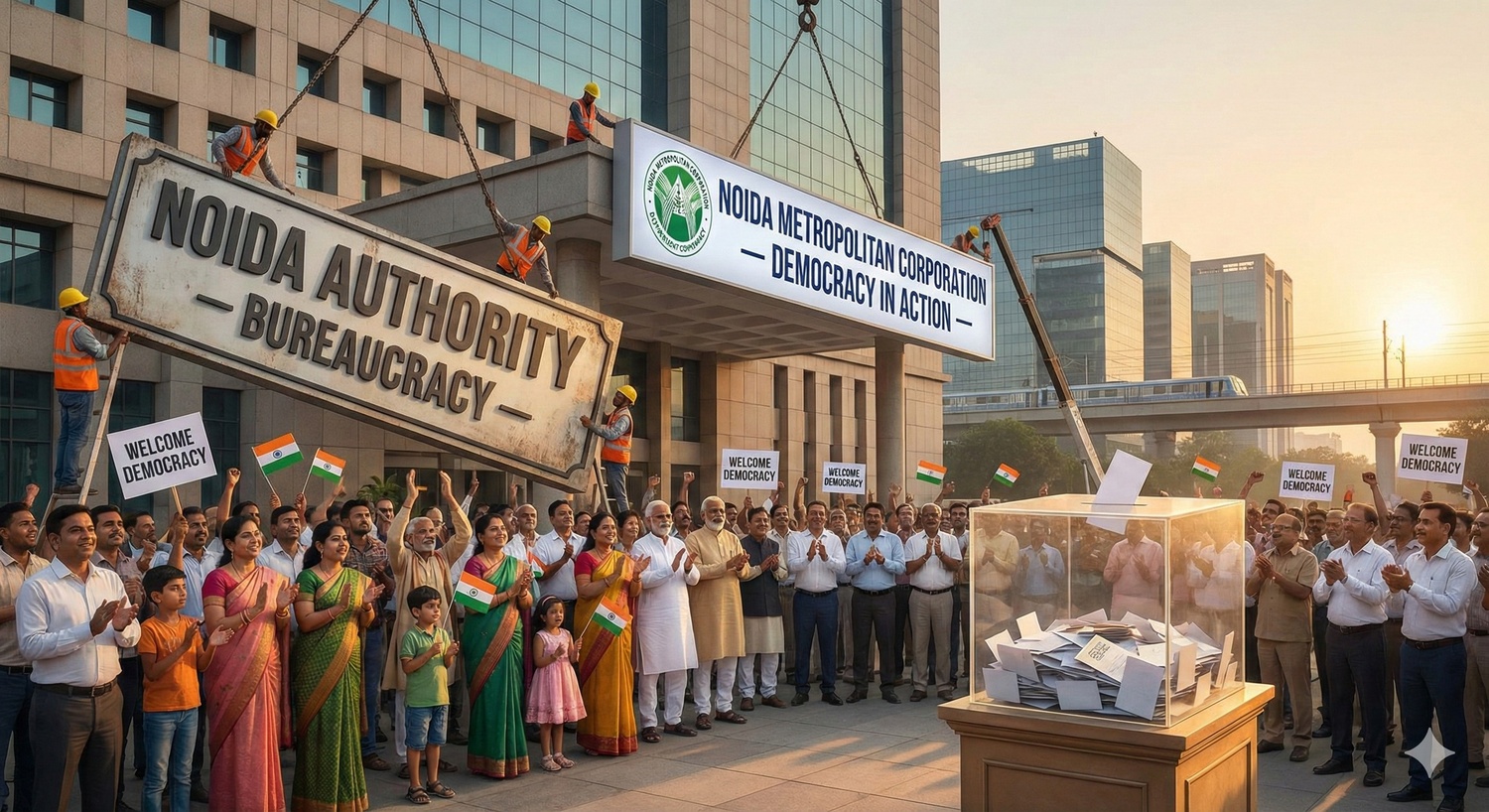
For decades, Noida has stood as a unique paradox in India’s urban landscape. It is a world-class city with gleaming skyscrapers, wide expressways, and multinational headquarters, yet it lacks the most basic element of urban democracy: an elected municipal body. While citizens in Delhi, Mumbai, and even smaller towns vote for their Mayors and Councilors, Noida’s 15 lakh+ residents have been governed entirely by unelected bureaucrats.
That era of "taxation without representation" appears to be drawing to a close.
In a significant development reported this week (January 2026), the Uttar Pradesh government has initiated the formal process to constitute a Metropolitan Corporation for Noida. This move, which involves a proposal sent to the State Cabinet, signals a fundamental restructuring of how the city is run. It is not just an administrative tweak; it is a transition from treating Noida as a mere "Industrial Township" to recognizing it as a living, breathing metropolis that requires people-centric governance.
This blog breaks down what this new proposal entails, why it is happening now, and how it will change the life of the average Noida resident.
To understand the magnitude of this change, we must look at Noida’s origins. Established in 1976 under the UP Industrial Area Development Act, Noida was conceived as an industrial engine, not a residential city. Under this Act, the city was designated as a "Notified Industrial Township." This legal status allowed the state government to bypass the 74th Constitutional Amendment, which mandates the formation of municipalities (Urban Local Bodies) in cities.
Instead, Noida has been run by the New Okhla Industrial Development Authority (NOIDA), headed by a CEO (usually an IAS officer) appointed by Lucknow. While this model allowed for rapid decision-making and land acquisition—fueling Noida’s explosive growth—it left a gaping hole in accountability. Residents had no local representative to approach for daily grievances like clogged drains, broken roads, or stray cattle.
The new proposal seeks to fill this vacuum. By forming a Metropolitan Corporation, the government effectively acknowledges that Noida has outgrown its industrial label and is now a complex urban habitat needing a democratic civic body.
Why is this happening now after 50 years? The push isn't just political; it is judicial.
In August 2025, the Supreme Court of India issued a directive to the UP government to consider a new governance framework for Noida. This order stemmed from a scathing report by a Special Investigation Team (SIT) that was probing a land compensation scam.
The SIT’s findings went beyond individual corruption cases to diagnose a systemic rot. It flagged that the "excessive concentration of power" within the unelected Noida Authority had led to a nexus between officials and builders, often at the cost of public interest. The SIT argued that the Authority’s structure lacked internal oversight and transparency. Their recommendation was clear: Replace the Authority-driven model with a Metropolitan Corporation.
The logic is simple: An elected body with ward representatives (Councilors) brings checks and balances that a bureaucratic board lacks.
For the homebuyer in Sector 75 or the business owner in Sector 18, the shift to a Municipal Corporation (Nagar Nigam) or Metropolitan Corporation brings tangible changes.
For the first time, Noida residents will likely go to the polls to elect a Mayor and Ward Councilors. This changes the power dynamic. Currently, if your sector’s park is ill-maintained, you write a letter to an official who may or may not respond. In a Corporation model, you have a local Councilor whose political survival depends on resolving these issues.
The Noida Authority’s primary expertise has always been acquiring agricultural land, developing it, and selling it. However, the SIT report noted that Noida’s land bank is nearly depleted. The city doesn't need more land acquisition as much as it needs urban management—waste disposal, water supply, sewage treatment, and traffic management. These are classic municipal functions that an elected body is better SUITED to handle.
A civic body brings the government closer to the doorstep. Instead of a centralized office that feels inaccessible, a Corporation typically has zonal offices and elected representatives who act as a bridge between the system and the citizen.
One of the biggest questions looming over this transition is the fate of the existing Noida Authority. Will it be disbanded?
It is unlikely to disappear overnight. The Industries Department has raised valid concerns regarding Investor Confidence. Noida is a magnet for Foreign Direct Investment (FDI) precisely because companies appreciate the single-window clearance system of the Authority. There is a fear that introducing a political body could bring "municipal lethargy" or populist hurdles to business approvals.
The most probable outcome is a Dual Governance Model, similar to what is seen in cities like Bengaluru (BDA vs. BBMP) or Delhi (DDA vs. MCD):
However, this split can also lead to friction. Defining who owns the drain (Authority) and who cleans it (Corporation) has been a source of eternal conflict in other Indian cities.
A major point of discussion in the Cabinet note is finances. Usually, Municipal Corporations are funded by the state exchequer or through property taxes. However, the Finance Department has reportedly clarified that the state government will not bear the financial burden of this new body.
Instead, the funds may initially come from the Noida Authority’s deep pockets. But eventually, a Corporation will need its own revenue streams. This could signal the introduction of a more structured Property Tax regime in Noida, bringing it on par with other municipal cities. While residents currently pay maintenance charges to the Authority/Builders, a formal house tax is the standard fuel for any democratic civic body.
The proposal to form a civic body for Noida is a watershed moment. It represents the maturation of the city from a state-run project into a self-governing metropolis.
While the transition will undoubtedly have teething troubles—balancing the efficiency of the Authority with the democracy of a Corporation—the move is a victory for the residents who have long demanded a voice. After 50 years of being run like a corporate boardroom, Noida is finally preparing to be run like a city: by the people, for the people. As the proposal moves through the Cabinet, all eyes are on Lucknow to see if they will finally sign off on Noida’s declaration of independence.
