Published On:
February 1, 2026
Updated On:
February 1, 2026
Delhi is set to unveil its first "double-decker" transport system this year, featuring a unique three-tier structure with cars on the ground, a flyover above, and metro trains running on the topmost deck. This engineering feat, part of Phase 4, promises to decongest critical corridors like Azadpur and Sangam Vihar while redefining urban infrastructure efficiency in space-starved cities.
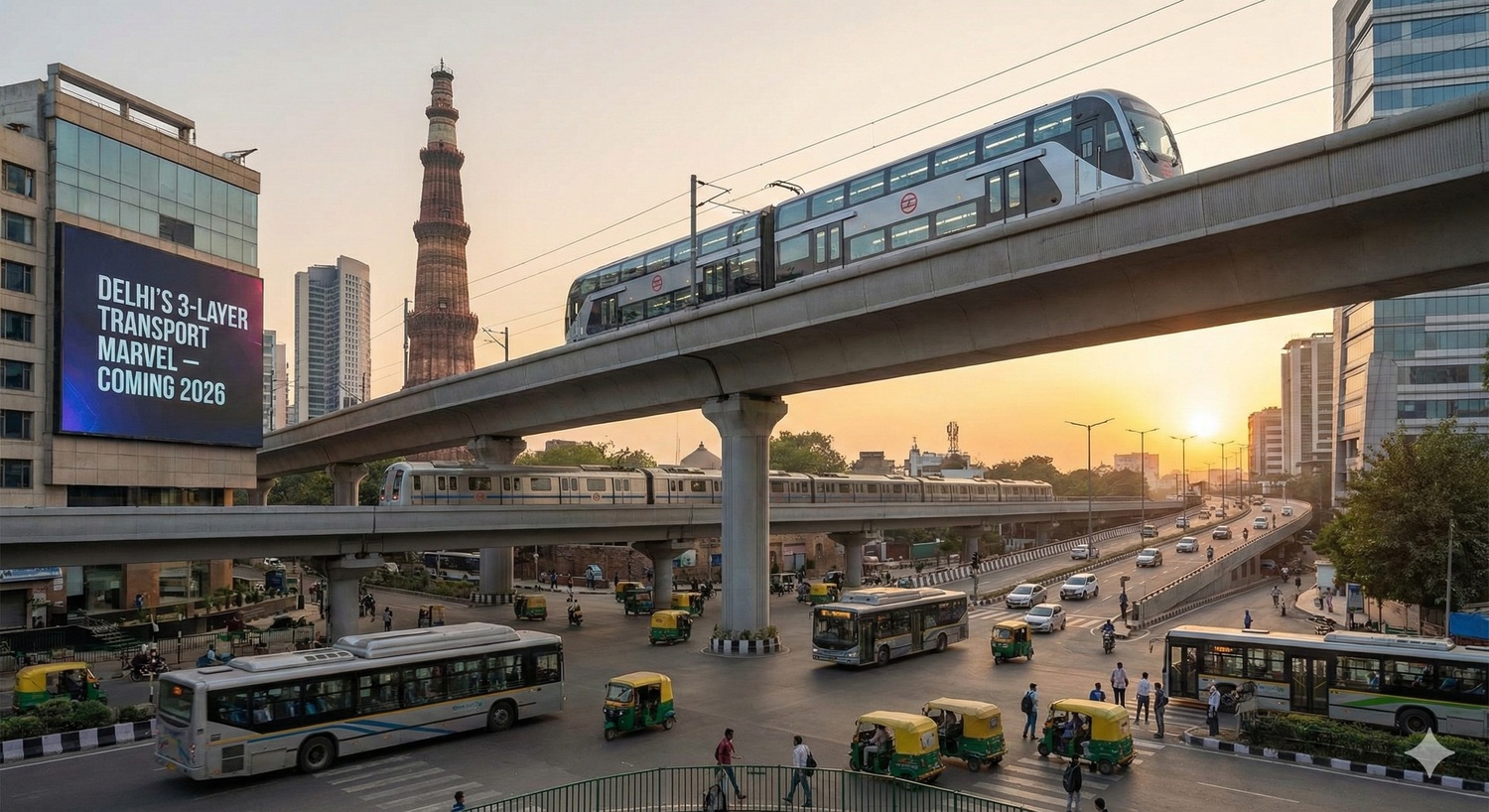
If you have driven through the congested arteries of North or South Delhi recently, you might have noticed massive concrete pillars rising from the center of the road, looking slightly different from the usual metro columns. These aren't just standard pillars; they are the backbone of a revolutionary engineering experiment that is about to change how the capital commutes.
Welcome to the era of the Double-Decker Metro System.
For years, Delhi has fought a battle for space. With roads bursting at the seams and land acquisition becoming a legal labyrinth, urban planners have had to look in the only direction left: Up. The Delhi Metro Rail Corporation (DMRC), in its ambitious Phase 4 expansion, is introducing a "Three-Layer Transport System." Imagine a busy road at ground level, a vehicular flyover hovering above it, and a metro train zooming on a viaduct even higher—all supported by a single set of pillars.
As we move through 2026, this futuristic concept is transitioning from blueprints to reality. This year marks the opening of key sections that will not only ease traffic snarls but also serve as a case study for urban mobility across India.
To understand the magnitude of this project, we need to look at the anatomy of these structures. Traditionally, building a flyover and a metro line in the same area would require two separate lanes of pillars, eating up precious road space and requiring the demolition of shops and homes.
The "Double-Decker" solution integrates these needs into a vertical hierarchy:
The genius lies in the Common Pier. A single massive pillar supports the flyover arms at the mid-level and continues upward to hold the metro tracks. This design reduces the "footprint" of the construction on the road, saving millions in land acquisition costs and minimizing the displacement of local residents.
The spotlight for 2026 is firmly on Northeast Delhi. The first of these marvels to become operational is the 1.4-kilometer stretch between Bhajanpura and Yamuna Vihar.
This densely populated belt has long suffered from chronic congestion. The roads here are narrow, flanked by bustling markets and residential colonies. Introducing a standard metro line would have been a logistical nightmare. The double-decker solution here is part of the Pink Line Extension (Majlis Park to Maujpur).
While the metro trials on this section have been successfully conducted, the opening of the flyover below was held up due to environmental clearances for tree transplantation. With those hurdles now cleared, the Public Works Department (PWD) and DMRC are racing to finish the road ramps. Once opened, this corridor will complete the "ring" of the Pink Line, making it the first circular metro route in the country, while simultaneously offering road commuters a signal-free ride above the chaos of the Wazirabad Road.
While Northeast Delhi gets the first ribbon-cutting, an even larger project is taking shape in South Delhi. The Sangam Vihar to Ambedkar Nagar stretch is perhaps the most critical intervention in this phase.
This 2.4-kilometer double-decker viaduct is part of the new Golden Line (Aerocity to Tughlakabad). Anyone who has traveled on the Mehrauli-Badarpur (MB) Road knows the pain of the rush-hour crawl. The road acts as a primary connector between Gurugram, South Delhi, and Faridabad.
Here, the engineering stakes are higher. The flyover creates a crucial bypass for vehicles heading towards the Badarpur border, while the metro line above connects the heritage district of Tughlakabad directly to the high-speed airport hub at Aerocity. This dual connectivity is expected to slash travel times by nearly 40% for residents of Khanpur, Tigri, and Sainik Farms.
The third piece of this puzzle lies in North-West Delhi. A 2.2-kilometer double-decker structure is being built between Azadpur and Ashok Vihar. This is part of the Magenta Line Extension (Janakpuri West to RK Ashram Marg).
Azadpur is home to Asia’s largest wholesale fruit and vegetable market, meaning the roads are perpetually clogged with trucks and heavy goods vehicles. A dedicated flyover for passenger vehicles, separate from the ground-level truck chaos, is a game-changer. By stacking the metro line above, the DMRC ensures that the expansion of the Magenta Line doesn't choke the lifeline of Delhi’s food supply chain.
The significance of these projects extends far beyond just saving travel time. They represent a paradigm shift in how Indian cities are planned.
In urban India, acquiring land is the biggest bottleneck for infrastructure projects. It leads to litigation, protests, and endless delays. By building vertically on the central verge of existing roads, the government bypasses this hurdle entirely.
While the construction of a double-decker pier is technically complex and more expensive per unit than a standard pillar, the overall project cost drops. The savings come from not having to build two separate foundations, not paying for land compensation, and the speed of executing two projects (road and rail) simultaneously.
The logic is simple: smoother traffic flow means less idling. By separating local traffic (ground), through traffic (flyover), and mass transit (metro), the system significantly reduces vehicular emissions in specific hotspots. Furthermore, the robust metro connectivity encourages people to leave their cars at home, aligning with Delhi’s desperate need for cleaner air.
Infrastructure is the primary driver of property values, and these three corridors are poised for a boom.
Of course, the path isn't entirely smooth. The construction phase itself has been a nightmare for residents, with diversions and dust pollution. There are also concerns about the maintenance of such massive structures. Ensuring the safety of the flyover users while heavy metro trains vibrate on the tracks above requires rigorous structural health monitoring.
Moreover, the integration of the road ramps with existing traffic flows needs careful planning to prevent bottlenecks at the entry and exit points of the flyovers. The authorities must ensure that the "landing" of the flyover doesn't just push the traffic jam 2 kilometers further down the road.
The opening of Delhi’s double-decker metro sections in 2026 is a testament to the city’s resilience and adaptability. It acknowledges a harsh reality: we have run out of horizontal space. But it also offers a hopeful solution: innovation can create space where none seems to exist.
As the first cars glide over the Wazirabad flyover while a Pink Line train thunders overhead, it will be a visual symbol of a modernizing India. It is a model that says we don't have to choose between better roads and better public transport—we can, quite literally, build one on top of the other. For the millions of commuters in the capital, this "sandwich" of transport layers is likely to be the most delicious thing they experience this year.
