Published On:
April 27, 2026
Updated On:
April 27, 2026
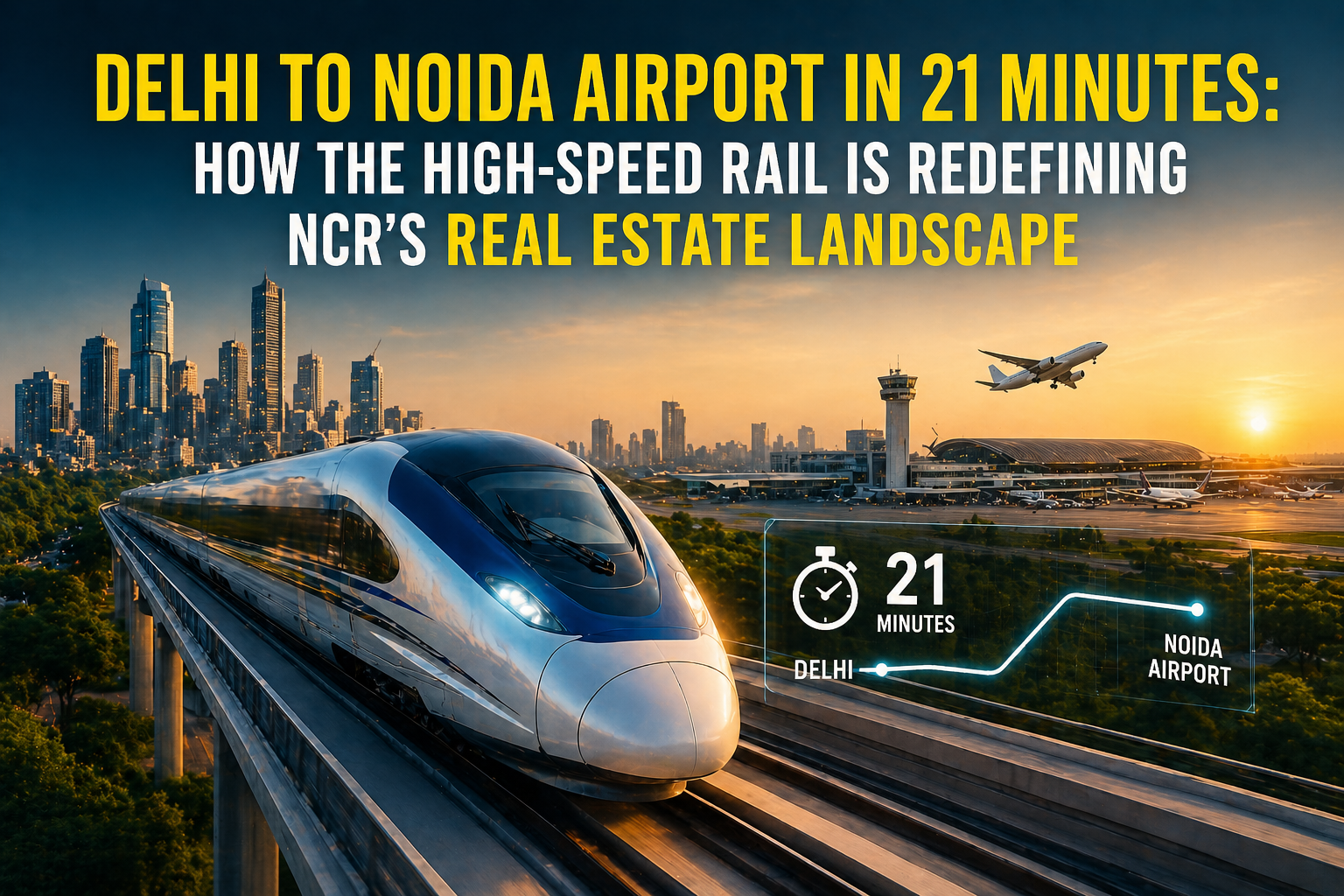
The upcoming Delhi-Varanasi High-Speed Rail will connect Delhi to the Noida International Airport in Jewar in just 21 minutes, featuring two highly strategic stations in Gautam Buddha Nagar that are set to trigger a massive real estate and economic boom across the YEIDA region.
The National Capital Region is currently undergoing an infrastructure renaissance of unprecedented scale. For years, the narrative surrounding the expansion of the capital has been dictated by expanding highways, sprawling expressways, and the slow but steady creep of metro rail networks. However, the paradigm is shifting dramatically. The focal point of this transformation is the upcoming Noida International Airport in Jewar, a megaproject designed to be India's premier aviation hub. Yet, the true game-changer is not just the airport itself, but how people will get there.
Recent developments regarding the Delhi-Varanasi High-Speed Rail corridor have confirmed a transit metric that has sent shockwaves through the real estate market: a travel time of exactly 21 minutes between Delhi's Sarai Kale Khan and the Noida International Airport. The National High Speed Rail Corporation Limited has fast-tracked the groundwork, specifically focusing on the integration of two vital stations within the Gautam Buddha Nagar district. This development is effectively erasing the perceived distance between the heart of the capital and the Yamuna Expressway, turning a historically suburban outpost into a highly accessible global transit powerhouse.
To comprehend the magnitude of this development, one must look past standard rail infrastructure and understand the technology driving it. The high-speed rail network will utilize the Japanese Shinkansen E5 Series technology, globally renowned for its flawless safety record, aerodynamic efficiency, and unparalleled passenger comfort. While the region is already familiar with the Delhi Metro and the rapidly expanding Regional Rapid Transit System, the bullet train operates on an entirely different spectrum of velocity and engineering.
Built to sustain operational speeds of up to 350 kilometers per hour, the high-speed rail bypasses the limitations of traditional urban transit. The Metro is designed for high-frequency, short-distance local commuting with stops every few kilometers. The RRTS bridges the gap between inter-city travel, maxing out around 160 kilometers per hour. The bullet train, however, is a true point-to-point velocity machine. Covering the distance from central Delhi to the deep boundaries of Greater Noida in the time it takes to drink a cup of coffee is an engineering feat that completely alters the geography of the workforce and residential living.
This is also the first time in Indian infrastructure history that an international airport will be seamlessly integrated with a true high-speed rail system from its inception, putting the Noida International Airport on par with global aviation hubs like Frankfurt, Tokyo Narita, and Shanghai Pudong.
The master plan for the high-speed rail features two dedicated and highly strategic stops within the district, each serving a distinct economic and transit purpose.
The first entry point into the region will be an elevated station situated at Noida Sector 148. The selection of this specific sector is a masterstroke in urban planning. Sector 148 already functions as a critical node and interchange for the existing Aqua Line of the Noida-Greater Noida Metro. By positioning a high-speed rail station here, urban planners are effectively transforming this sector into the primary gateway for the entire National Capital Region. Passengers arriving from various parts of Noida and Greater Noida can use the local metro network to converge at Sector 148, before boarding the bullet train for a rapid sprint to either the airport or central Delhi.
The second station is the crown jewel of the corridor's initial phase, located directly at the Noida International Airport. Unlike standard surface-level railway stations, this facility is designed as a fully integrated underground transit hub. The underground placement allows for direct, climate-controlled pedestrian linkages straight into the airport's main passenger terminals. This seamless design ensures that a traveler can step off a flight, collect their baggage, walk into the subterranean transit center, and be standing in the heart of Delhi just over twenty minutes later, completely bypassing the notorious vehicular traffic of the metropolitan highways.
To truly grasp why the 21-minute rail link is sparking such intense activity, it is essential to look at the historical context of property investment in this region. For decades, investing in the deep outskirts of the National Capital Region was viewed as a long game requiring immense patience. Those who had the foresight to purchase land in the broader Noida and Jewar areas around 2005 to 2007 understand this wealth journey intimately.
Back in the mid-2000s, acquiring raw land parcels in these areas was widely considered a highly speculative gamble. The Yamuna Expressway was still a concept, and the idea of an international airport was nothing more than a distant rumor. However, that early foresight translated into immense generational wealth. The subsequent waves of infrastructural development, followed by government land acquisitions and highly structured compensation policies, transformed patient capital into substantial fortunes.
Today, as the bullet train project moves from the drawing board to active construction, the market is experiencing the next massive wealth creation cycle. However, unlike the speculative days of two decades ago, the current boom is backed by visible, multi-billion-dollar infrastructure that is being executed at a rapid pace.
As the connectivity timeline becomes a reality, the investor spotlight has intensely shifted toward the Yamuna Expressway Industrial Development Authority (YEIDA) region. The active study and promotion of real estate in this specific corridor, particularly regarding agricultural land and residential plots, have taken center stage for savvy investors and institutional buyers alike.
The 21-minute transit metric fundamentally alters the valuation of land in the YEIDA sectors. These land parcels are no longer viewed as distant suburban investments intended for weekend farmhouses. Instead, they are prime assets sitting on the immediate periphery of an integrated global transit zone. The demand for clear-title agricultural land is surging as investors look to capitalize on future land pooling policies, commercial rezoning, and the inevitable expansion of the urban limits.
Furthermore, plotted developments authorized by YEIDA are seeing unprecedented traction. Unlike high-rise apartments, which are subject to construction delays and high density, plots offer intrinsic land value appreciation. Buyers are securing these plots not just for immediate construction, but as high-yield assets that will multiply in value the moment the first bullet train conducts its trial run. The region is witnessing a highly sophisticated buyer demographic that understands the compounding value of land situated alongside heavy-rail infrastructure.
While raw land and plots dominate the YEIDA sectors, the immediate vicinity of the Sector 148 station is experiencing a different kind of real estate boom. The promise of a direct, high-speed link to Delhi has made this specific pocket of Greater Noida an incredibly attractive proposition for end-users and luxury developers.
The market dynamics here are shifting rapidly. We are seeing a massive surge in demand for premium, gated communities and luxury flats in the sectors surrounding the upcoming elevated station. Homebuyers who previously restricted their property searches to South or West Delhi due to commute times are now actively exploring Greater Noida. The logic is straightforward: why pay exorbitant rates for an aging apartment in a congested Delhi neighborhood when the same budget can secure a sprawling, ultra-modern luxury flat in Greater Noida, with a commute time to the city center that is actually shorter via the high-speed rail?
Developers are responding to this shift by upgrading their project specifications, focusing on expansive clubhouses, smart home integrations, and global-standard amenities to attract a more affluent buyer base. The expectation of massive capital appreciation once the tracks are laid is driving brisk sales, with early-stage projects frequently oversubscribed.
The sheer velocity and scale of the Delhi-Varanasi High-Speed Rail project are also redrawing the broader investment map of the National Capital Region. For the better part of two decades, Gurgaon was the undisputed heavyweight of premium real estate and corporate investment. However, the saturation of the Gurgaon market, characterized by soaring entry costs, infrastructural bottlenecks, and limited availability of fresh land parcels, has forced investors to look for the next major growth vector.
The Yamuna Expressway, supercharged by the upcoming airport and the bullet train, provides that exact alternative. The market is witnessing a distinct pivot. Large-scale corporate investors, logistics firms, and hospitality chains are aggressively acquiring land banks in Gautam Buddha Nagar. The realization has set in that Jewar is no longer a distant outpost, but the future center of gravity for the region's aviation and commercial transit. The high-speed rail makes Jewar more accessible to central Delhi than many established micro-markets within the capital itself.
What separates this current phase of development from previous real estate cycles is the sheer certainty of execution. The National High Speed Rail Corporation is bringing global best practices to the project management, and the integration with the airport guarantees a steady, high-volume ridership from day one.
For the long-term investor, the message is clear: the window for entry-level investment in Gautam Buddha Nagar is closing rapidly. As the physical infrastructure of the stations begins to take shape at Sector 148 and the airport terminal, the speculative premium on properties will transition into established market value. The days of acquiring cheap land on the promise of future development are ending.
The arrival of the high-speed rail represents the final piece of the puzzle for the region. It validates every infrastructural promise made over the last decade. It transforms the Yamuna Expressway from a mere highway into an economic super-corridor. For those heavily invested in the dynamics of plot acquisitions, agricultural land, and strategic residential developments, the 21-minute link is the ultimate catalyst. It cements Noida's transition from a regional industrial hub into an indispensable pillar of India's future urban and economic landscape.
