Published On:
August 29, 2026
Updated On:
August 29, 2026
The newly approved 50-km elevated expressway connecting Akshardham to Noida International Airport promises a signal-free, 60-minute commute, drastically decongesting existing routes and sparking massive real estate growth across East Delhi, Noida, and Faridabad.
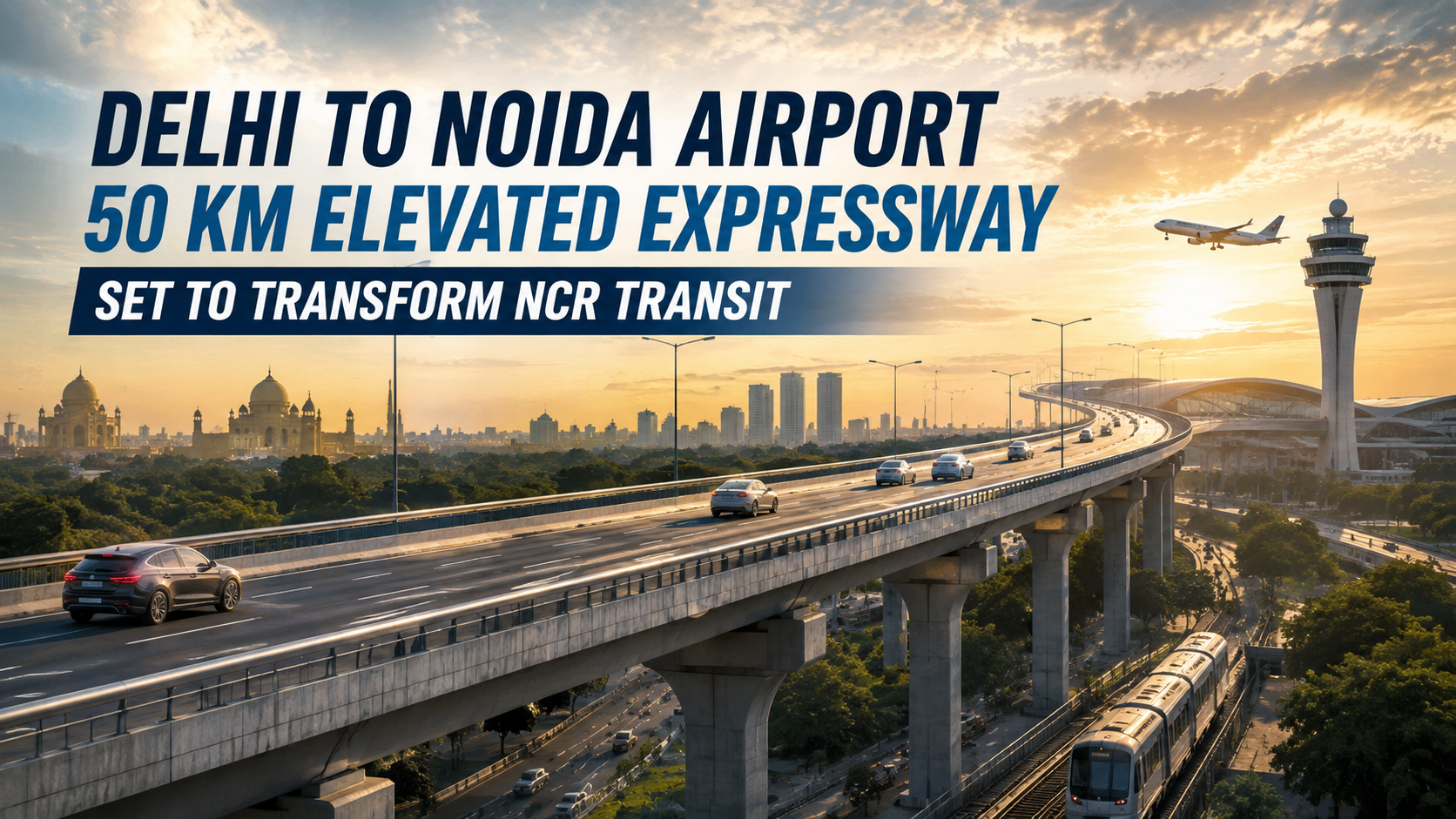
Anyone who has navigated the sprawling expanse of the National Capital Region knows that while the distances might seem manageable on a map, the actual commute is often dictated by notorious traffic bottlenecks. As the Noida International Airport at Jewar inches closer to operational reality, the biggest question on the minds of residents, investors, and daily commuters has been simple: how will we actually get there without spending half the day in traffic?
The answer has finally arrived in the form of a massive infrastructure blueprint. Authorities have recently given the green light to the alignment of a 50-kilometre, fully elevated expressway that will directly connect the Akshardham Temple in East Delhi to the upcoming Noida International Airport. This ambitious corridor is not just another road project; it is a structural paradigm shift designed to drastically cut travel times, relieve the heavily burdened existing expressways, and seamlessly integrate multiple cities within the NCR.
For real estate investors, homebuyers, and daily commuters, this development rewrites the rules of regional connectivity. Here is a comprehensive breakdown of what this mega-project entails, the engineering hurdles it overcame, and how it is already reshaping the property landscape from East Delhi to the Yamuna Expressway.
Building a dedicated high-speed corridor through one of the most densely populated urban agglomerations in the world is a monumental task. The proposed Delhi to Noida Airport expressway is envisioned as a 50-kilometre structural marvel, heavily relying on elevated sections to bypass the chaotic local traffic below.
The starting point is strategically placed near the Akshardham Temple in Delhi, seamlessly linking with the existing Delhi-Meerut Expressway infrastructure. From there, it will carve its way toward Jewar, culminating at the Noida International Airport. Out of the total 50-kilometre stretch, approximately 27 kilometres will fall entirely within Noida’s territorial limits. The route is meticulously planned to traverse through the land of 25 villages, comprising 22 villages in Noida and three in Greater Noida, eventually extending to Sector 21A along the Yamuna Expressway.
The financial scale of this undertaking is equally impressive, with project estimates hovering around Rs 4,000 crore. The National Highways Authority of India (NHAI) has been tasked with both the construction and the long-term maintenance of the corridor. To handle the anticipated surge in airport-bound traffic, the main elevated stretch will feature a robust six-lane configuration, which will widen into an eight-lane expanse at critical entry and exit stretches to prevent choke points.
Currently, the project is moving swiftly through its administrative phases. With the route alignment officially approved by the Noida Authority, the drafting of the Detailed Project Report is in its final stages. Once the final draft is submitted to the government in the coming weeks, the next immediate step will involve rigorous soil testing to assess bearing capacity, clearing the runway for actual groundwork to commence.
Infrastructure projects of this magnitude rarely proceed without encountering significant administrative and environmental hurdles, and this elevated expressway was no exception. The original blueprint looked flawless on paper, proposing that the elevated corridor be built directly on the Yamuna river embankment. However, this hit a massive roadblock when the state’s irrigation department withheld operational clearance. Their primary concerns revolved around flood plain management and the long-term structural safety of building heavy pillars directly on the embankment.
A bureaucratic stalemate over environmental and structural clearances can stall a project for years. However, the engineering teams and project consultants devised a remarkably simple yet highly effective workaround. They tweaked the master plan, shifting the entire alignment by a mere five metres toward the Noida side.
This minor geographical adjustment was the masterstroke needed to bypass the flood plain regulations, satisfying the safety protocols of the irrigation department without compromising the route's efficiency. With the revised alignment cleared, the design integrates a 120-metre wide road starting from Noida Sector 94. Running parallel to the embankment, this massive feeder road will smoothly funnel traffic directly onto the elevated stretch, ensuring that the transition from ground-level driving to the elevated expressway is completely frictionless.
The most immediate and tangible benefit of the Delhi to Noida Airport elevated expressway is the massive reduction in travel time. Currently, navigating from East Delhi to the Jewar region is an unpredictable gamble. On a relatively clear day, the journey might take 90 minutes. However, during peak hours or bad weather, travelers routinely find themselves stuck in transit for well over two and a half hours, battling through the bottlenecks of Kalindi Kunj, the DND Flyway, and the Noida-Greater Noida Expressway.
Once this elevated corridor is operational, those agonizing commute times will be a thing of the past. Traffic modeling suggests that the 50-kilometre journey from Akshardham to the Noida International Airport will settle into a predictable, signal-free run of just 60 to 70 minutes.
This time-saving dynamic is particularly revolutionary for residents of East and South East Delhi. Neighborhoods like Mayur Vihar, Patparganj, IP Extension, Kalindi Kunj, and Sarita Vihar will benefit from direct entry points to the new expressway. Instead of navigating inner-city traffic to merge onto the traditional Noida expressway, commuters from these areas will simply ascend onto the elevated corridor and cruise directly to the airport terminals.
Furthermore, the connectivity net is cast wider than just Delhi and Noida. The expressway alignment incorporates a strategic link to the Manjhawali bridge, which opens up a direct, high-speed route for residents of Faridabad in Haryana. For many Faridabad commuters, this eliminates the need to travel north toward the DND Flyway, offering a much shorter, diagonal trajectory straight into the airport corridor.
Beyond facilitating airport transit, this project is a critical rescue mission for the existing Noida-Greater Noida Expressway. Serving as the primary arterial lifeline for the region, the current expressway is suffocating under its own success. It currently handles an overwhelming volume of over 5 lakh vehicles every single day. The mix of daily office commuters, heavy commercial trucks, and interstate travelers creates notorious rush-hour paralysis.
By providing a dedicated, elevated alternative, the new Akshardham to Jewar corridor is expected to siphon off a massive chunk of this traffic. Urban planners project that even if just 25 to 30 percent of the airport-bound and long-distance traffic shifts to the new elevated road, the peak hour pressure on the old expressway will drop dramatically.
This decongestion strategy is part of a much larger, interconnected regional master plan. The ultimate goal of the infrastructure bodies is to knit together five major expressways into a seamless web of high-speed transit. Once complete, the network will effortlessly link the Delhi-Meerut Expressway, the Delhi-Dehradun Expressway, the Noida-Greater Noida Expressway, the DND-Faridabad route, and the Yamuna Expressway. This macro-level integration ensures that whether a commercial truck is heading to Uttarakhand or a family is catching an international flight, they can bypass local city roads entirely.
In the world of real estate, capital moves long before the concrete is poured. The mere approval of the 50-km elevated expressway has already sent ripples across the residential and commercial property markets in the National Capital Region. Developers and brokers are actively incorporating the new route map into their sales pitches, and buyers are recalibrating their investment strategies based on the promise of hyper-connectivity.
The impact, however, is beautifully varied depending on the micro-market.
At the starting point of the corridor in East Delhi, areas like Mayur Vihar and Patparganj are witnessing a noticeable uptick in buyer inquiries. For families and professionals rooted in these older, established neighborhoods, the prospect of having an international airport just an hour away without having to relocate to Greater Noida is a massive lifestyle upgrade.
Moving into Noida, the entry points of the new expressway are creating localized real estate hotspots. Sectors 94, 100, and 150 are seeing intense interest from end-users. Because these sectors will serve as crucial access nodes to the elevated road, residents here will enjoy the dual benefits of established city infrastructure and immediate, high-speed regional connectivity. Consequently, rental demand and premium apartment valuations in these sectors are expected to see a sharp upward trajectory.
The most dramatic financial appreciation, however, is playing out along the Yamuna Expressway and the immediate vicinity of the Jewar airport. The plot belt governed by the Yamuna Expressway Industrial Development Authority (YEIDA) has transformed into an investor's goldmine. To put things into perspective, land rates in this specific belt hovered around a modest Rs 1,100 per square foot back in 2020. Today, driven by the dual engines of the airport's progress and the new expressway connectivity, those same plots command anywhere from Rs 3,000 to an astonishing Rs 10,500 per square foot.
Specific YEIDA zones, particularly Sectors 18, 20, and 22D, are currently the most active hubs for investors who are projecting another 20 to 30 percent capital appreciation over the next two years.
Meanwhile, regions like Greater Noida West, Knowledge Park, Zeta, and Omega are experiencing steady, job-led growth. For these areas, the elevated expressway is less about direct airport access and more about the broader regional link it provides, making these sectors highly attractive for corporate offices, warehousing, and logistics hubs that require seamless movement of goods and personnel.
Even across the state border in Faridabad, the confirmation of the Manjhawali bridge link has renewed interest in the local real estate market, as investors realize the city is no longer geographically isolated from the booming Yamuna Expressway economy.
While the enthusiasm surrounding the Akshardham to Noida Airport elevated expressway is palpable, seasoned real estate veterans understand that true price realization and economic impact will materialize only when heavy machinery hits the ground. The immediate focus is strictly on the Detailed Project Report and the subsequent soil testing phases.
The involvement of the National Highways Authority of India is a massive confidence booster for the project's timeline. Known for executing complex, large-scale infrastructure corridors with relative efficiency, NHAI's dual mandate of constructing and maintaining the road ensures that the project will meet the highest standards of safety and durability. The target is to align the operational readiness of this expressway as closely as possible with the opening phases of the Noida International Airport, creating a synchronized launch of regional infrastructure.
For decades, the expansion of the National Capital Region was somewhat disjointed, with residential hubs often outpacing the road networks required to support them. The Delhi to Noida Airport 50-km elevated expressway represents a mature, proactive approach to urban planning. By building the arteries before the heart of the new airport starts pumping at full capacity, authorities are ensuring that the entire NCR ecosystem thrives.
When completed, this corridor will be much more than a convenience for frequent flyers. It will stand as the definitive physical link unifying the economic potential of East Delhi, Noida, Greater Noida, and Faridabad, cementing the region's status as a premier global hub for business, logistics, and modern urban living.
