Published On:
April 27, 2026
Updated On:
April 27, 2026
The Delhi to Faridabad metro route has completely transformed the National Capital Region's transit landscape, drastically cutting commute times and triggering a massive, ongoing real estate and commercial boom across Greater Faridabad in 2026.
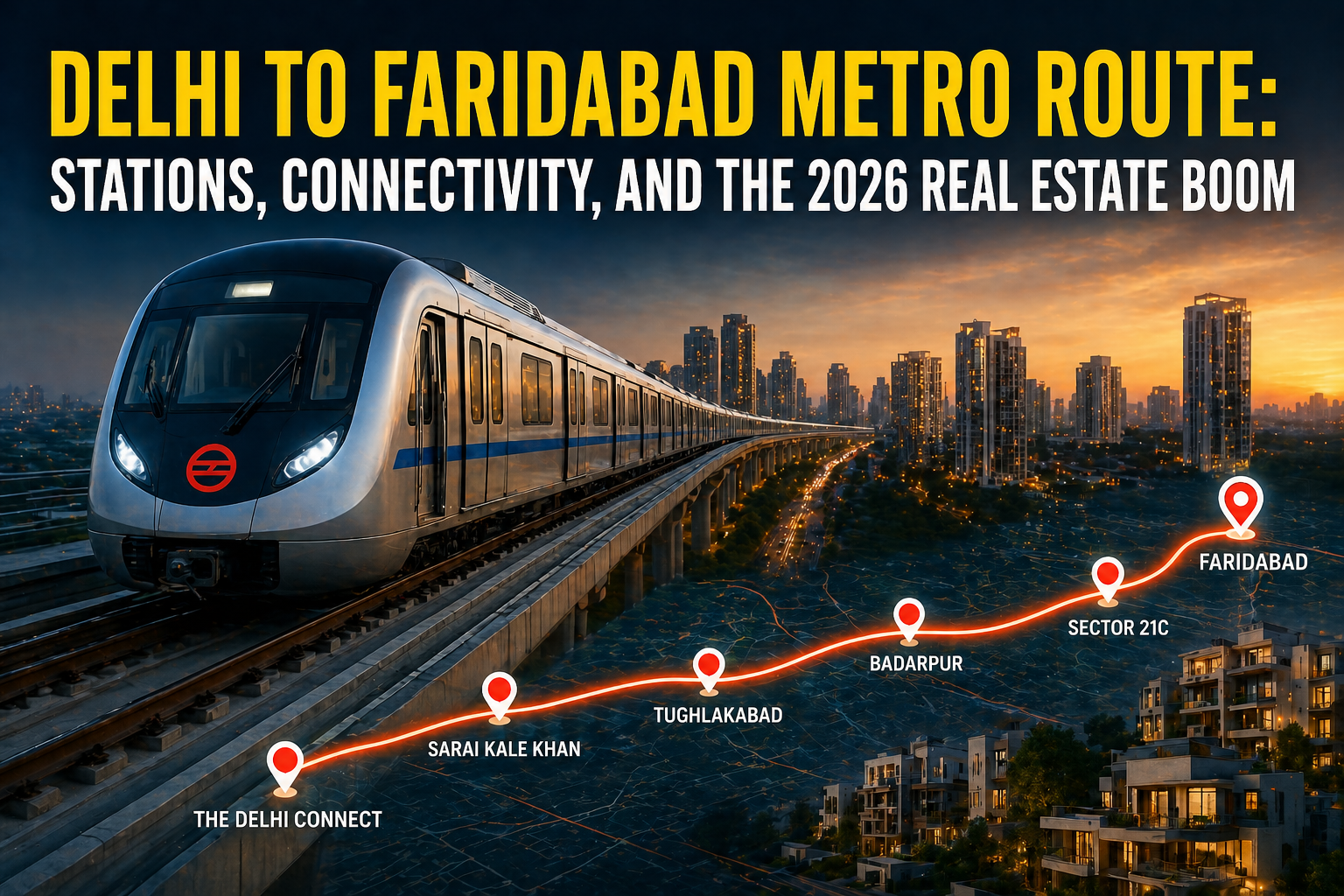
Anyone who has ever navigated the treacherous daily traffic on the Delhi-Mathura Road understands the sheer exhaustion of that specific commute. For years, the journey between the national capital and the industrial heartland of Haryana was defined by endless gridlock, blaring horns, and a significant loss of productive time. The introduction and subsequent expansion of the Delhi to Faridabad metro route changed that narrative entirely. Operating as a critical extension of the bustling Violet Line, this transit network now functions as the primary artery for thousands of daily commuters.
What was once an agonizing two-hour journey trapped in bumper-to-bumper highway traffic has been streamlined into a comfortable, air-conditioned ride taking barely thirty minutes. In 2026, this infrastructure project is operating at its absolute prime, doing much more than just moving people from point A to point B. It is reshaping the entire urban fabric, turning the city from an overlooked industrial suburb into one of the most highly sought-after real estate and commercial destinations in the National Capital Region.
One of the most appealing aspects of this transit corridor is its straightforward, user-friendly layout. The route is essentially a straight shot that meticulously follows the main highway, making navigation incredibly intuitive even for first-time riders. Beginning right at the Badarpur border, the line plunges deep into the city, systematically connecting all the major residential and industrial hubs without forcing passengers to navigate confusing interchanges.
The strategic placement of the stations ensures that the maximum population density is served. Passengers can board and alight at key junctions starting from Sarai and NHPC Chowk, moving seamlessly through Mewala Maharajpur, Sector 28, and Badkal Mor. As the train ventures further into the city's commercial core, it services Old Faridabad, Neelam Chowk Ajronda, and Bata Chowk, before reaching Escorts Mujesar and finally culminating at Raja Nahar Singh in Ballabhgarh.
Each of these stops was deliberately chosen to alleviate the specific pressure points along the highway. By mirroring the road route, the transit authority successfully coaxed daily drivers out of their private vehicles and into the mass transit system. The seamless integration of these stations with local transport hubs has created a unified transit ecosystem, allowing residents from the deepest, most remote pockets of the city to access the capital with unprecedented ease and predictability.
This transit corridor represents a significant leap forward in modern urban engineering. It is a clear indicator of domestic manufacturing capabilities, with approximately ninety-five percent of the system's components being entirely homegrown. This heavy reliance on the Make in India initiative not only reduced overall capital expenditure but also fostered a deep sense of local pride in the region's ability to execute world-class infrastructure.
From a structural standpoint, the decision to make every single station on this stretch elevated was a masterstroke in urban planning. Constructing a sprawling underground network would have required massive excavation, leading to years of surface-level road closures, dust pollution, and unbearable traffic diversions for the local residents. The elevated design minimized surface disruption during the building phase and now provides daily riders with a spectacular vantage point to witness the city's rapidly evolving skyline.
Beyond its physical architecture, the network is deeply committed to environmental sustainability. Many of the station roofs have been outfitted with expansive solar panel arrays. This green energy initiative significantly offsets the massive power requirements of running a high-frequency train system, actively reducing the region's overall carbon footprint.
Furthermore, passenger safety and accessibility remain a top priority. The entire stretch features comprehensive closed-circuit television coverage and highly responsive emergency communication systems that are monitored round the clock. The architectural layout of the stations ensures that they are completely barrier-free, offering wide elevators, tactile paving, and dedicated ramps, making the daily commute completely hassle-free for the elderly and differently-abled passengers.
The realization of this massive infrastructure project was a long, complex journey. The initial blueprint was drafted when transport authorities recognized that the vehicular volume between Delhi and Haryana was rapidly approaching a critical breaking point, threatening to choke the region's economic output. The construction was meticulously rolled out in highly coordinated stages to manage the sheer scale of the engineering required. The primary section was completed and opened to the public back in late 2015, bringing immediate, highly publicized relief to the border areas. The momentum continued, and the critical extension deeper into the heavy industrial zones, concluding at Ballabhgarh, was successfully wrapped up in late 2018.
Executing a project of this magnitude requires immense financial backing. The total cost to connect the Badarpur border to the deep industrial sectors hovered around the twenty-five hundred crore rupee mark. Because the economic and social benefits of this corridor are shared across state lines, the financial burden was distributed collaboratively. The state government of Haryana absorbed the largest portion of the expense, contributing roughly fifteen hundred and fifty-seven crore rupees. The central government provided an additional five hundred and thirty-seven crore rupees to ensure the project did not stall, while the central transit authority covered the remaining balance through a mix of internal revenues and structured institutional loans.
Even in 2026, the network refuses to remain static. Transport authorities are constantly tweaking the ecosystem to enhance the daily passenger experience. Current initiatives are heavily focused on solving the frustrating last-mile connectivity puzzle. There is aggressive ongoing development to construct dedicated, weather-proof skywalks linking stations directly to massive commercial buildings and retail centers. Additionally, local authorities are deploying expansive fleets of electric feeder buses and strictly regulated e-rickshaws, ensuring that passengers can travel from their front doors to the station concourse without ever needing to rely on their private vehicles.
If you analyze the property trends across the National Capital Region today, the impact of this rail network is nothing short of revolutionary. Historically, the area was perceived primarily as the dusty, strictly industrial cousin of the much glossier Gurugram and Noida markets. It was widely considered a place for heavy factories and warehouses, not luxury living or premium residential investments. The arrival of the high-speed transit line completely shattered that outdated perception.
The most dramatic transformation is currently unfolding in the residential sector, particularly in the sprawling, master-planned sectors of Greater Faridabad, commonly referred to as Neharpar. Properties situated within a close radius of the newly established transit hubs have experienced a massive surge in valuation. Market data clearly shows property appreciations ranging from thirty to fifty percent over the last few real estate cycles, vastly outperforming many traditional investment hotspots in the region.
This housing boom is driven by a massive, highly visible demographic shift. For years, middle-class and upper-middle-class corporate professionals were steadily priced out of the premium neighborhoods in South Delhi and the central business districts of Gurugram. The transit line offered a golden, highly practical alternative. Homebuyers quickly realized that they could liquidate a cramped, aging apartment in the capital and use the exact same budget to purchase a sprawling, luxury three-bedroom condominium in Greater Faridabad. Thanks to the highly reliable train schedule, living further away no longer meant sacrificing hours to a stressful, unpredictable commute. The region is now characterized by premium gated communities featuring world-class sporting amenities, massive green spaces, and a quality of life that easily rivals the most expensive postal codes in the national capital.
Infrastructure rarely operates in a vacuum, and the true economic multiplier for this region is the phenomenal, highly lucrative synergy between the rail network and the newly developed road systems. While the train handles the daily human capital and office commuters, the massive Delhi-Mumbai Expressway, which also carves its way directly through the district, handles the heavy commercial logistics and long-distance travel.
When you combine a high-frequency, reliable metropolitan train system with a world-class, high-speed national highway, the corporate world takes immediate notice. This dual-connectivity advantage has triggered a massive influx of commercial and institutional investments. The landscape alongside the transit corridor is rapidly changing, with expansive retail malls, advanced multi-specialty hospitals, and towering corporate office complexes rapidly replacing old, obsolete warehouses and vacant agricultural plots.
The local economy is undergoing a profound, highly visible diversification. It is no longer just a pure manufacturing and heavy industry hub reliant on blue-collar labor. Because companies can now easily draw on the massive, highly educated talent pool residing in Delhi without forcing their employees into grueling road commutes, corporate behavior is shifting dramatically. Multinational corporations and large domestic financial firms are aggressively relocating their back-office operations, massive data centers, and sophisticated logistics headquarters to the area. This influx of white-collar jobs is creating a vibrant local economy, directly driving up demand for high-end retail, fine dining, and premium entertainment venues, further enhancing the city's overall livability index.
The success of this transit route serves as a perfect, highly replicable case study for how developing economies should manage rapid urban sprawl. The National Capital Region is expanding at a dizzying pace, and relying solely on widening existing highways is an unsustainable strategy that only invites more cars, heavier gridlock, and worse air pollution. By laying down heavy rail infrastructure that seamlessly crosses state borders, urban planners have managed to effectively decentralize the population density.
People no longer feel compelled to cram into the hyper-expensive center of the capital to maintain their corporate careers. The reliable thirty-minute train ride has effectively flattened the economic geography of the region. It proves that when governments invest heavily in high-quality, dependable, and clean public transportation, the real estate market and the corporate sector respond incredibly positively. The rapid, highly organized urbanization of the surrounding sectors demonstrates that transit-oriented development is the only viable path forward to prevent mega-cities from collapsing under the weight of their own population growth.
Ultimately, this sprawling transit corridor is about much more than just pouring concrete, erecting pillars, and laying steel tracks; it is fundamentally about giving people their valuable time and their sanity back. By completely eliminating the daily two-hour highway struggle, the network has dramatically improved the work-life balance for thousands of families across two distinct states. It has successfully closed the psychological and physical distance between the national capital and its southern neighbor, making daily life in the metropolitan region significantly more manageable and enjoyable. As new businesses continue to flock to the area and the luxury housing market maintains its robust upward trajectory, it is entirely evident that this rail line remains the undisputed engine driving the city's modern economic renaissance.
