Published On:
September 6, 2026
Updated On:
September 6, 2026
The Delhi Public Works Department is set to transform the capital's infrastructure with a strategic Rs 93.2 crore micro-surfacing project covering 240 kilometres of roads across the North, East, and South zones to enhance safety and extend pavement lifespan during the 2026-27 financial year.
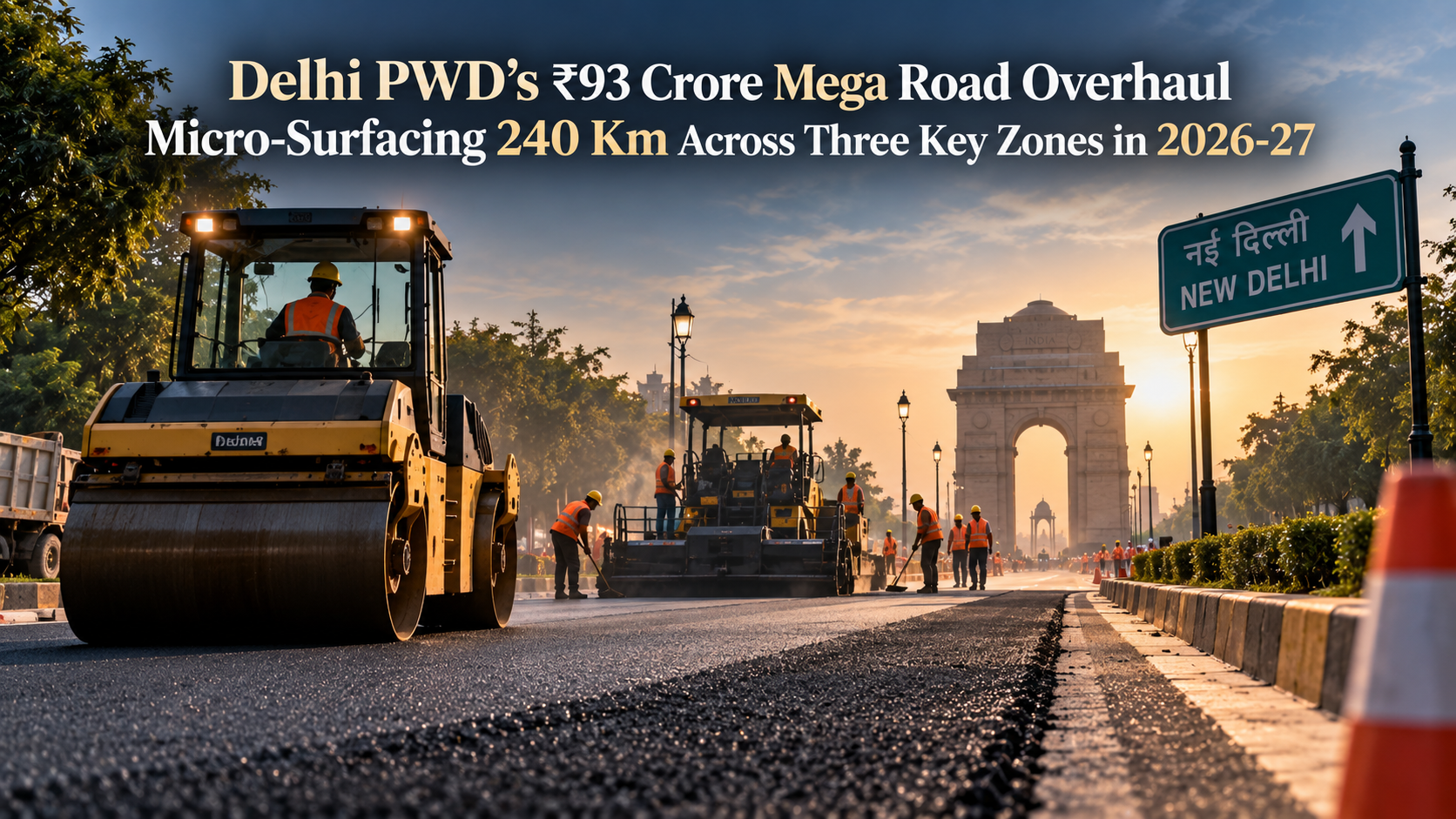
The road network of the national capital is arguably one of the most heavily burdened infrastructural assets in the country. Serving a rapidly expanding population and millions of registered vehicles, the arterial and sub-arterial stretches experience relentless daily friction, heavy load-bearing stress, and severe seasonal weather impacts. Recognizing the urgent need for proactive infrastructure preservation, the Delhi Public Works Department has officially sanctioned a massive preventive road maintenance programme for the 2026-27 financial year. The ambitious initiative involves the micro-surfacing of nearly 240 kilometres of crucial roadways distributed across the North, East, and South maintenance zones, backed by a dedicated financial approval of Rs 93.2 crore.
This development signals a major shift in how urban civic bodies are approaching asset management. Instead of waiting for thoroughfares to completely degrade into pothole-ridden nightmares that require highly expensive and time-consuming total reconstruction, the authorities are adopting modern preventive treatments. By intervening early in the pavement lifecycle, the city aims to significantly extend the longevity of its existing infrastructure while ensuring a smoother, safer commute for millions of daily travelers.
To truly appreciate the scale and impact of this initiative, it is essential to understand what micro-surfacing actually entails. Unlike conventional road relaying, which involves heavy machinery scraping off the top layers of damaged asphalt and laying down thick, fresh coats of hot mix bitumen, micro-surfacing is a highly specialized, minimally invasive preventive technique. It involves the precise application of a thin, tough protective layer directly over the existing pavement surface.
This specialized mixture is typically composed of precisely graded crushed mineral aggregates, polymer-modified asphalt emulsion, water, and specialized mineral fillers. Applied at ambient temperatures using custom-designed paving equipment, this slurry-like mixture bonds instantly to the existing asphalt. The primary objective here is not to add structural strength or thickness to the road, but rather to seal the surface completely.
The treatment works by penetrating and filling tiny surface cracks and minor imperfections that naturally develop as bitumen oxidizes under the harsh Delhi sun. By sealing these micro-fissures, the new layer effectively waterproofs the road. Water ingress is the single biggest enemy of asphalt; once moisture seeps into the foundational layers of a road, the heavy weight of passing traffic causes the sub-base to fail, leading to the rapid formation of deep potholes. Micro-surfacing halts this destructive cycle in its tracks. Additionally, the fresh aggregate provides a high-friction surface, instantly restoring lost skid resistance and making the stretches significantly safer for motorists, especially during the monsoon season.
The decision to utilize micro-surfacing over traditional road relaying is rooted in both economic and logistical efficiency. Traditional road reconstruction is an incredibly disruptive process. It requires massive diversions, generates significant noise and dust pollution, and can leave neighborhoods dealing with traffic bottlenecks for weeks on end. In a city with the traffic density of Delhi, shutting down major neighborhood corridors for extended periods creates a cascading gridlock effect across adjacent zones.
Micro-surfacing completely bypasses these logistical nightmares. The mixture cures exceptionally fast. Depending on the weather conditions, a newly treated stretch can usually be opened to heavy traffic within a matter of hours, rather than days. This rapid turnaround time means work can be executed efficiently during off-peak hours or night shifts with minimal disruption to the daily lives of residents.
Furthermore, this method is highly environmentally friendly. Because it requires a fraction of the raw materials compared to a full overlay, the carbon footprint associated with mining, transporting, and heating aggregate and bitumen is drastically reduced. From a fiscal standpoint, treating a road before it structurally fails costs only a fraction of what a complete rebuild would demand. By spending Rs 93.2 crore now, the exchequer is potentially saving hundreds of crores in deferred reconstruction costs over the next five to seven years.
A granular breakdown of the sanctioned project reveals that the North Zone will be the primary beneficiary of this maintenance drive, accounting for the absolute largest share of the overall programme. The Public Works Department has meticulously mapped out 152.4 kilometres of roads in this specific region to undergo the treatment, backed by a substantial budget allocation of Rs 48 crore.
The North Zone encompasses a highly complex mix of dense residential neighborhoods and sprawling industrial belts. The approved works will provide extensive coverage to critical areas including Model Town, Shalimar Bagh, Rohini, Narela, and Bawana. The inclusion of Narela and Bawana is particularly significant. These regions host massive industrial estates and logistics hubs, which means the local road network is subjected to continuous pounding from heavy commercial vehicles, freight trucks, and goods carriers.
Such extreme weight loads accelerate surface degradation, making preventive care absolutely vital. By micro-surfacing these specific industrial corridors, the authorities are ensuring that the movement of commercial freight remains unhindered, which directly supports the local economy. Simultaneously, upgrading the internal and peripheral roads of densely populated residential strongholds like Rohini and Shalimar Bagh will vastly improve the daily commuting experience for hundreds of thousands of families, reducing vehicle wear and tear and significantly enhancing neighborhood safety.
The eastern part of the capital, historically characterized by its exceptionally high population density and heavy localized traffic, is also slated for a major infrastructure upgrade. In the East Zone, the department has formally approved the micro-surfacing of 59.3 kilometres of roads, dedicating a budget of Rs 32.8 crore to the task.
The project blueprint covers several high-traffic areas, with a specific focus on Patparganj, Vishwas Nagar, and Shahdara. The Trans-Yamuna region serves as a critical transit point for a massive volume of traffic moving between central Delhi and the neighboring districts of Uttar Pradesh. The roads here endure an intense volume of two-wheelers, auto-rickshaws, and private cars, leading to rapid surface polishing and the loss of essential skid resistance.
Restoring the texture and grip of these specific stretches is a critical road safety intervention. In busy commercial hubs like Vishwas Nagar and Shahdara, where pedestrian movement heavily intersects with vehicular traffic, having a well-maintained, high-friction road surface drastically reduces the braking distance for vehicles, directly preventing localized accidents. The smooth, sealed surfaces will also help mitigate the chronic issue of localized water stagnation during heavy rains, a problem that frequently plagues the older, highly congested neighborhoods of East Delhi.
The strategy applied to the South Maintenance Zone highlights a highly targeted approach to urban infrastructure management. While the overall length of the project here is smaller, the impact will be deeply felt by the local communities. The department has sanctioned Rs 12.3 crore to meticulously micro-surface 28.1 kilometres of roads in this specific division.
What makes the South Zone project distinct is its focus on roads that possess a right-of-way of less than 30 metres. This specific parameter means the work will largely concentrate on the crucial secondary and tertiary connector roads rather than the massive multi-lane arterial highways. The approved works will cover heavily populated and historically rich areas such as Malviya Nagar, Mehrauli, Chhatarpur, and Deoli.
These neighborhoods present their own unique infrastructural challenges. Areas like Mehrauli and Chhatarpur are characterized by narrower corridors, organic urban growth, and a mix of historic precincts adjoining high-density residential settlements. The traffic flow on these less-than-30-metre roads is constant and highly localized. By upgrading these specific neighborhood arteries, the authorities are directly addressing the immediate daily concerns of the residents, ensuring that the last-mile connectivity from the main highways to the residential colonies is smooth, resilient, and safe.
Beyond the technical and geographical scope of the massive project, the administrative directives attached to this Rs 93.2 crore sanction highlight a refreshing commitment to financial discipline and contractor accountability. The Public Works Department is taking stringent measures to ensure that public funds are utilized with maximum efficiency and zero wastage.
Before a single machine is deployed or a single drop of emulsion is laid down, the department has issued a firm directive to all field divisions to meticulously audit the legal status of the targeted roads. Specifically, engineers must verify whether any of the designated stretches are still operating under an active Defect Liability Period.
The Defect Liability Period is a standard contractual clause mandating that the original contractor who built or last repaired the road remains financially and operationally responsible for maintaining its quality for a specified number of years. If the field inspection reveals that a road has suffered premature damage, rutting, or cracking due to substandard workmanship, poor execution, or the use of defective materials by the original builder, the government will absolutely not step in to bail them out. In such scenarios, the micro-surfacing or necessary repairs will not be carried out at the government's expense. Instead, the original contractors will be forced to rectify their failures at their own cost. This strict enforcement prevents the double-spending of taxpayer money and sends a clear message regarding quality control and long-term accountability in public infrastructure projects.
To further safeguard the financial integrity of the 2026-27 preventive maintenance programme, the civic authorities have laid down inflexible ground rules regarding project execution. The department has explicitly stipulated that all associated projects across the three zones must be completed strictly within the approved cost framework and the specified timeline.
In the realm of large-scale public works, cost overruns and endless deadline extensions have historically been a major drain on municipal resources. By formally eliminating any provision for cost escalation right at the sanctioning stage, the department is forcing contractors to plan their logistics, material procurement, and labor deployment with absolute precision.
Furthermore, the tendering process for these extensive works will be conducted with total transparency, strictly adhering to all applicable procurement rules and aligned with the official Delhi Schedule of Rates. This ensures a level playing field for civil engineering firms bidding for the contracts and guarantees that the government is securing the best possible technical execution at a fair, standardized market price.
While the primary goal of this initiative is civic maintenance, the extensive upgrading of 240 kilometres of roads carries significant secondary benefits, most notably for the local real estate sector. The correlation between robust infrastructure and property valuation is undeniable. A neighborhood's desirability is intrinsically linked to how easily and comfortably it can be accessed.
In the North Zone, the targeted improvements in Narela and Bawana are likely to boost the commercial leasing appeal of these industrial sectors. Logistics companies and warehousing operators highly prioritize locations with impeccable road networks to minimize fleet maintenance costs and ensure rapid turnaround times. For residential strongholds like Rohini, Malviya Nagar, and Patparganj, the elimination of bumpy, degraded neighborhood roads directly enhances the livability index of the area. Prospective homebuyers and tenants are far more likely to invest in localities that demonstrate active municipal upkeep. Consequently, this Rs 93.2 crore public investment will inadvertently act as a catalyst for maintaining and potentially boosting real estate capital values and rental yields across the affected zones.
The decision to aggressively micro-surface 240 kilometres of the capital's road network is a testament to mature urban planning. It reflects a deep understanding that maintaining a world-class city is not just about constantly building new flyovers and expressways, but equally about fiercely protecting and preserving the infrastructure that already exists.
By strategically allocating Rs 93.2 crore across the North, East, and South zones, the authorities are addressing the specific, localized needs of diverse neighborhoods—from the heavy freight corridors of Bawana to the historic lanes of Mehrauli and the dense commercial centers of Shahdara. Through the implementation of advanced preventive technology, strict financial accountability, and rigid project timelines, the upcoming 2026-27 road maintenance programme is set to deliver immense value. It promises to shield the city’s vital arteries from the ravages of weather and extreme traffic, ensuring that the daily commute for millions remains safe, seamless, and efficient for years to come.
