Published On:
May 21, 2026
Updated On:
May 21, 2026
The upcoming 742-km Shamli-Gorakhpur Expressway is set to revolutionize connectivity across northern India, cutting travel time between the Delhi-NCR region and the Nepal border to just eight hours. As Uttar Pradesh's longest greenfield corridor, it promises to trigger massive economic growth, provide strategic defense advantages, and significantly boost real estate markets across 22 districts.
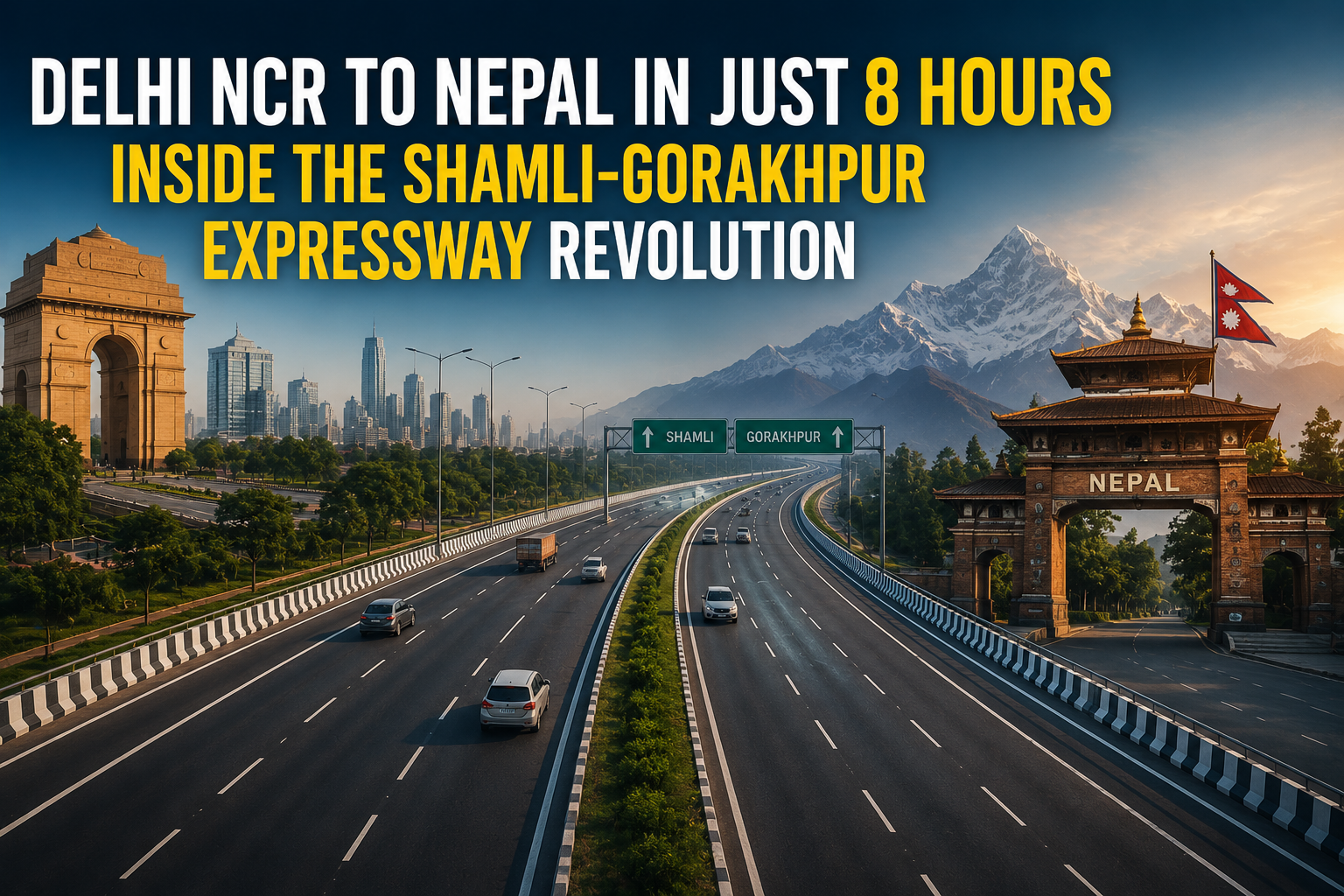
Traversing the vast expanse of Uttar Pradesh has traditionally been a test of endurance. For decades, moving goods or traveling from the bustling, highly industrialized western borders near the National Capital Region to the culturally rich, agrarian eastern belts near Gorakhpur and the Nepal border required navigating a labyrinth of congested highways and fragmented state roads. A typical road trip between these two extremities easily consumes upwards of 15 hours, making seamless trade and travel an logistical nightmare. However, the geographic and economic narrative of northern India is on the verge of a historic transformation.
The catalyst for this change is the ambitious Shamli-Gorakhpur Expressway, a massive infrastructure project that is currently transitioning from blueprints to reality. Designed as a high-speed greenfield corridor, this expressway is engineered to bridge the massive gap between eastern and western Uttar Pradesh, essentially shrinking the state and bringing the international borders of Nepal within a comfortable eight-hour drive from Delhi-NCR. This project is not merely another road; it is a meticulously planned economic artery that will reshape logistics, real estate, and strategic mobility across the entire region.
When it comes to highway infrastructure, Uttar Pradesh has rapidly established itself as the expressway capital of the country. The state already boasts an impressive network of access-controlled corridors, including the Purvanchal Expressway and the Agra-Lucknow Expressway. Yet, the Shamli-Gorakhpur Expressway is designed to dwarf them all.
Spanning an incredible length of approximately 742 kilometers, this new corridor will officially take the crown as the longest expressway in the state once completed. The project, spearheaded by the National Highways Authority of India, comes with a colossal estimated budget ranging between ₹35,000 crore and ₹40,000 crore. Built entirely as a greenfield project—meaning it is being constructed from scratch on completely new alignments rather than upgrading existing roads—it features a state-of-the-art six-lane configuration.
The engineering parameters of the highway are built for the future. It boasts a fully access-controlled design, eliminating random intersections and localized traffic disruptions, which allows for a sanctioned speed limit of 120 kilometers per hour. To achieve this, the corridor will be flanked by thousands of newly planted trees, creating an environmentally conscious green corridor that mitigates carbon emissions while offering a visually stunning drive.
The true brilliance of the Shamli-Gorakhpur Expressway lies in its unique route alignment. Unlike other highways that cut through the center of the state, this corridor takes a distinct northern trajectory, running near parallel to the Indo-Nepal border.
Initially conceptualized to start from Shamli, the project's scope was recently extended westward to originate in Panipat, Haryana. This was a masterstroke in urban planning. By starting in Panipat, the expressway provides eastern Uttar Pradesh with a direct, high-speed link to the massive industrial and manufacturing hubs of Haryana and the wider Delhi-NCR region, completely bypassing the notorious traffic bottlenecks of central Delhi. From the western terminus, the road cuts a near-straight east-west line, terminating near Kushinagar, right at the Bihar and Nepal borders.
Along its 742-kilometer journey, the asphalt will slice through 22 districts and 37 tehsils. The route touches prominent cities and rural heartlands alike, including Shamli, Muzaffarnagar, Saharanpur, Haridwar, Bijnor, Moradabad, Rampur, Bareilly, Pilibhit, Shahjahanpur, Lakhimpur Kheri, Sitapur, Bahraich, Shravasti, Balrampur, Sant Kabir Nagar, Gorakhpur, and Kushinagar.
This specific alignment is incredibly deliberate. For decades, the districts along the northern rim of Uttar Pradesh and the Nepal border, such as Bahraich and Shravasti, have remained economically isolated due to poor connectivity. By running a world-class, six-lane highway straight through their backyards, the government is effectively integrating these remote areas into the mainstream economic engine of the National Capital Region.
For frequent travelers, logistics companies, and supply chain managers, time is the ultimate currency. Currently, reaching the Nepal border or Gorakhpur from western Uttar Pradesh requires a tedious journey south toward Delhi, onto the Agra-Lucknow Expressway, and then further east, covering a massive, convoluted detour.
The Shamli-Gorakhpur Expressway eliminates this massive curve. By providing a straight-line alternative, it shaves off nearly 200 kilometers of unnecessary driving distance. The impact on travel time is nothing short of revolutionary. A grueling 15-hour expedition will be condensed into a smooth, predictable eight-hour drive.
This drastic reduction in travel time has massive implications for international tourism and trade. Pilgrims and tourists looking to travel from the international airports in Delhi to the Buddhist circuits in Kushinagar and Lumbini in Nepal will find the journey exponentially more comfortable. Similarly, the export-import trade between India and Nepal, which relies heavily on road transport for daily essentials, manufacturing components, and agricultural products, will experience a massive boost in efficiency. Freight trucks that previously lost days navigating local traffic and broken state roads will now zip across the state in a single operational shift.
The days of isolated highway projects are over. The modern approach to Indian infrastructure is the creation of interconnected grids, where major expressways seamlessly merge into one another to allow uninterrupted cross-country travel. The Shamli-Gorakhpur Expressway is engineered to serve as the ultimate backbone for this northern grid.
Throughout its sprawling alignment, the highway will strategically intersect with several other major road networks. It will connect with the Ambala-Shamli Expressway, extending the reach of eastern goods straight into the agricultural and industrial belts of Punjab and Chandigarh. It will also cross paths with the Delhi-Dehradun Expressway, providing a quick detour into Uttarakhand.
Perhaps most importantly, it will intersect with the massive 594-kilometer Ganga Expressway, which runs vertically down the state. This crossing of the horizontal Shamli-Gorakhpur corridor and the vertical Ganga Expressway will create a massive cross-hair of high-speed connectivity, allowing a driver to switch directions and reach virtually any corner of Uttar Pradesh without ever hitting a local city road.
While the economic and civilian benefits of the corridor are undeniable, the strategic and national security importance of the Shamli-Gorakhpur Expressway cannot be overstated. Geopolitics plays a massive role in modern infrastructure planning, and this highway is heavily influenced by its proximity to international borders.
Running parallel to the Nepal border, the highway provides the Indian armed forces with a rapid deployment corridor. In the event of a geopolitical crisis or security requirement, military convoys, heavy artillery, and essential supplies can be moved from the western commands directly to the eastern frontlines in a fraction of the time it previously took.
Taking the security aspect a step further, the engineering blueprints include the construction of a dedicated emergency airstrip right on the expressway. Heavy-duty concrete sections of the highway will be structurally reinforced and designed perfectly flat, lacking any road dividers, to allow for the emergency landing and takeoff of Indian Air Force fighter jets and military transport aircraft. This transforms the civilian highway into an active tactical asset, ensuring that the country maintains a robust, highly mobile defense posture in the region.
Whenever a multi-billion dollar highway cuts through a region, a real estate boom inevitably follows. The Shamli-Gorakhpur Expressway is already sending ripples through the property markets of the 22 districts it touches. Investors, commercial developers, and large-scale logistics firms are aggressively scouting for land parcels along the proposed alignment, eager to secure a first-mover advantage.
Historically, real estate growth in Uttar Pradesh was heavily concentrated around the immediate National Capital Region—places like Noida, Greater Noida, and Ghaziabad. However, the new expressway is democratizing this growth, pushing real estate demand deep into the hinterlands. Cities like Bareilly, Moradabad, and Gorakhpur are witnessing a sudden surge in interest from national real estate developers who are planning large-scale residential townships, commercial complexes, and gated communities.
Market analysts project that property prices in the immediate vicinity of the expressway, particularly in major nodes like Gorakhpur, Shamli, and Bareilly, will appreciate by a staggering 10 to 30 percent in the near term. This isn't just limited to urban centers. The rural areas and agricultural zones flanking the highway are experiencing unprecedented land valuations. The National Highways Authority of India is actively acquiring thousands of hectares of land, offering substantial financial compensation to local farmers, which in turn is injecting massive liquidity into the rural economy.
Beyond residential properties, the commercial real estate sector is preparing for a windfall. The dramatic reduction in travel times makes the expressway corridor an ideal location for massive warehousing facilities, cold storage chains, and e-commerce fulfillment centers. As freight movement becomes more predictable, companies will establish localized distribution hubs along the route to serve the massive consumer markets of central and eastern Uttar Pradesh.
A project of this staggering magnitude requires meticulous planning and a phased approach to execution. To ensure that construction progresses smoothly and does not get bogged down by bureaucratic delays, the 742-kilometer stretch has been divided into 11 distinct development packages. These packages will be awarded to multiple different infrastructure developers simultaneously, allowing work to happen concurrently across the state.
Broadly, the massive project has been split into two primary phases. The first phase covers the 450-kilometer stretch from Panipat to Shahjahanpur, while the second phase will cover the remaining 300-kilometer stretch from Shahjahanpur directly into Gorakhpur.
As of early 2026, the administrative groundwork is moving at a blistering pace. The detailed project reports have been finalized, and comprehensive drone and ground-level surveys to lock in the exact alignment are largely complete. The most critical hurdle of any major infrastructure project—land acquisition—is currently in full swing. Authorities have initiated the process of identifying and acquiring land across 17 districts. In critical nodes like Bareilly, dozens of villages have already been marked, and the compensation processes are actively materializing.
Physical construction and heavy earth-moving are slated to begin in full force within the current financial year. Given the massive deployment of resources and the parallel construction of the 11 distinct packages, the government has set an aggressive target to have the expressway fully operational by the 2028-2029 timeframe.
The Shamli-Gorakhpur Expressway is far more than a stretch of high-speed tarmac; it is a vital lifeline that will permanently alter the socioeconomic fabric of northern India. For the everyday commuter, it promises an end to agonizing 15-hour journeys, offering instead a smooth, scenic, and rapid eight-hour drive from the heart of the capital region right to the borders of Nepal.
For the economy, it acts as a massive stimulus package. By unlocking the latent potential of historically overlooked districts, fostering a massive real estate boom, and creating an ultra-efficient logistics corridor, the highway will generate thousands of direct and indirect jobs. The integration of this route with existing expressways creates an unparalleled logistical web that will undoubtedly attract massive domestic and foreign manufacturing investments to the state.
As land acquisition transitions into active construction, the anticipation is palpable. When the first vehicles finally roll onto the finished concrete of the Shamli-Gorakhpur Expressway, they won't just be driving on Uttar Pradesh's longest road—they will be driving directly into a faster, more connected, and highly prosperous future for the entire region.
