Published On:
February 11, 2026
Updated On:
February 11, 2026
The full completion of the Delhi-Mumbai Expressway (NE4) has been officially pushed to late 2027 due to pending construction in key Gujarat sectors. While major stretches like Sohna-Dausa and Vadodara-Bharuch are already operational, the final link to Mumbai awaits the resolution of critical bottlenecks.
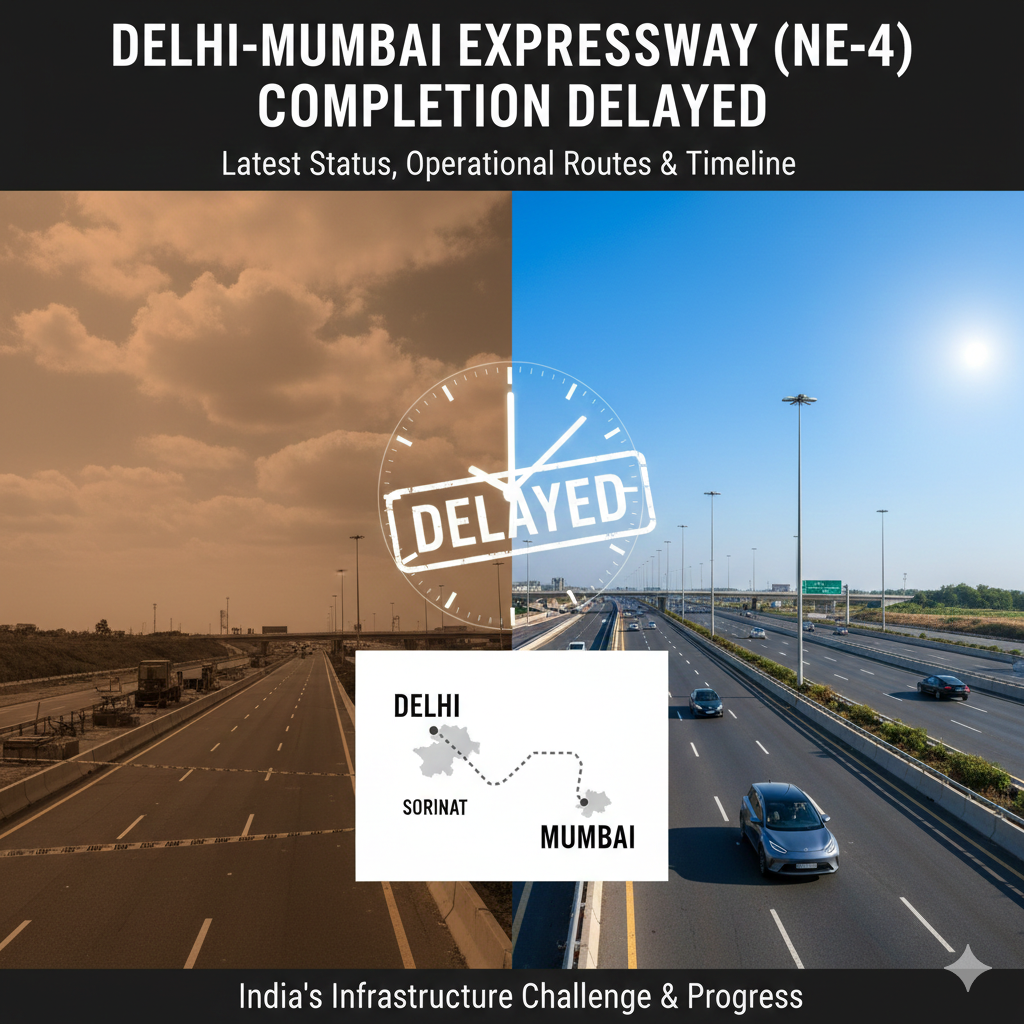
The dream of driving from India’s political capital to its financial capital in just 12 hours is inching closer to reality, but the finish line has moved slightly further away. The Delhi-Mumbai Expressway, often referred to in segments as NE4 (specifically the Vadodara-Mumbai arm), has seen a revision in its completion deadline. Originally slated for an earlier finish, the full 1,350 km corridor is now expected to be fully operational by late 2027 or early 2028.
For real estate investors, logistics companies, and road trip enthusiasts, this update is crucial. While significant portions of the expressway are already live and transforming travel, critical bottlenecks in Gujarat and Maharashtra have necessitated this new timeline. Here is a comprehensive deep dive into where the project stands today.
The Ministry of Road Transport and Highways (MoRTH) and the National Highways Authority of India (NHAI) have been working at a breakneck pace, but infrastructure projects of this magnitude rarely escape hurdles. The primary reason for the shift to a 2027 deadline lies in a specific 87-kilometer stretch in southern Gujarat.
This section, which falls under the Vadodara-Virar leg (NE4), has faced complications related to land acquisition and contractor performance. Specifically, construction packages 8, 9, and 10 have seen slower progress compared to the rest of the corridor. To ensure quality and speed, the NHAI has had to re-evaluate and, in some cases, re-tender these packages. This administrative and on-ground reset means that while the rest of the highway might be ready sooner, the "continuous" drive from Delhi to Mumbai will only be unlocked once these final links are forged in 2027.
It is not all about delays. A massive chunk of the expressway is already live, actively reducing travel time and boosting local economies. If you are planning a trip, here are the sections you can use right now:
This 246-km stretch was the first to open and has been a game-changer for travelers between Delhi NCR and Jaipur. It has successfully diverted traffic from the congested NH-48, offering a smooth, high-speed alternative that cuts travel time to Jaipur significantly.
Part of the crucial NE4 segment, this 86-km section is fully operational. It serves as a vital artery for industrial traffic moving between these two major Gujarat hubs, showcasing the high-quality infrastructure—spanning 8 lanes—that the rest of the project promises.
Opened recently in late 2024, this section has improved connectivity within Rajasthan, making the drive through the Hadoti region smoother and faster.
A significant portion running through Madhya Pradesh is also functional, connecting the tribal belts of Jhabua with the industrial towns of Rajasthan.
When we talk about "NE4," we are specifically looking at the Vadodara-Mumbai Expressway component. This is perhaps the most complex leg of the journey due to the high density of population and industrial zones it traverses.
Despite the delay, the Delhi-Mumbai Expressway remains one of the most advanced engineering feats in India’s history.
The delay to 2027 gives smart investors a slightly longer window to capitalize on the "expressway effect." Real estate markets in Sohna, Dausa, Vadodara, and Palghar are already witnessing price appreciation.
While the push to 2027 might be a dampener for those hoping to drive the full length this year, the progress on the ground is undeniable. The Delhi-Mumbai Expressway is not a "paper project"—it is a living, breathing corridor that is 80% complete. The operational sections are already proving the concept's viability.
For now, the focus shifts to the NHAI’s ability to fast-track the remaining Gujarat packages. As we move through 2026, we can expect more short stretches to open up, gradually stitching the two cities together until the final ribbon is cut in 2027. The wait is longer, but the destination promises to be transformative.
