Published On:
May 26, 2026
Updated On:
May 26, 2026
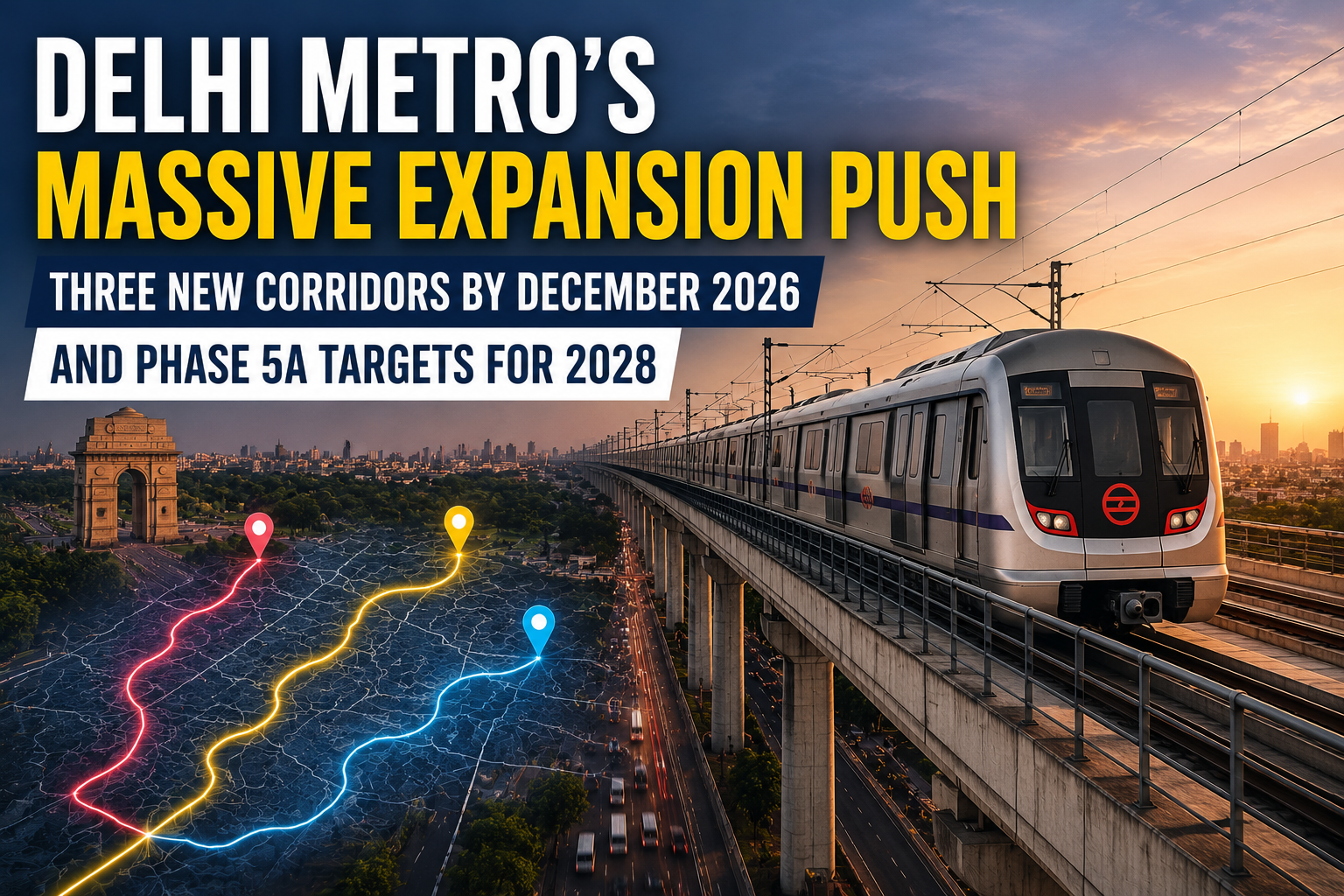
The Delhi Metro is aggressively expanding its network with three major Phase 4 corridors slated to open by December 2026 and a Rs 12,014 crore Phase 5A project targeting completion in 2028. This comprehensive infrastructure upgrade promises to significantly decongest roads, connect underserved neighborhoods, and ignite a major real estate boom across the National Capital Region.
Navigating the sprawling expanse of the National Capital Region has always been a complex daily challenge for millions of commuters. As the population swells and business hubs spread further into the peripheries, relying solely on road transport has become increasingly unsustainable. Recognizing this critical need for seamless, rapid transit, the authorities overseeing the capital's mobility network have set in motion an unprecedented wave of infrastructural growth.
This ambitious expansion push is not just about laying down new tracks; it is about fundamentally redrawing the map of urban connectivity. With multiple project phases running concurrently, the city is bracing for a transport revolution. By the end of this year, commuters will experience immediate relief with the launch of key corridors, while the newly sanctioned blueprints for the coming years promise to interlink the most isolated pockets of the city. For daily travelers, business owners, and real estate investors alike, these developments signal a transformative era for the region's economy and lifestyle.
The immediate focus of the transport authorities is the rapid completion and commissioning of three vital corridors under the ongoing Phase 4 project. Targeted for a grand opening by December 2026, these stretches are meticulously designed to plug existing gaps in the network and provide much-needed cross-city linkages.
The first significant addition is the Janakpuri West to RK Ashram Marg stretch, which serves as a crucial extension of the already operational Magenta Line. Historically, residents of deep West Delhi and North West Delhi had to rely on circuitous routes and multiple interchanges to reach central commercial districts. This new extension cuts straight through densely populated neighborhoods, offering a direct, high-speed alternative that will dramatically reduce travel time. By bypassing heavily congested surface roads, this corridor is expected to become an instant lifeline for lakhs of daily office-goers and students.
Equally transformative is the upcoming Aerocity to Tughlakabad corridor, officially designated as the Golden Line. Southern parts of the capital have long required a dedicated east-west link that directly accesses the airport ecosystem. The Golden Line addresses this exact need. It weaves through prominent residential and commercial zones in South Delhi, seamlessly connecting them to the massive hospitality and business hubs situated around Aerocity. For frequent flyers, hotel staff, and corporate executives, this corridor eliminates the unpredictable traffic jams of the Outer Ring Road, guaranteeing a timely arrival at the airport terminals.
The third critical piece of this year's expansion puzzle is the Majlis Park to Maujpur extension of the Pink Line. The northern and northeastern frontiers of the capital have witnessed rapid residential growth but have often lagged in terms of premium public transport access. This extension bridges that gap, looping around the city to create a comprehensive ring network. By strengthening connectivity in these high-density areas, the extension ensures that residents have smoother access to the broader transit grid, making cross-city commutes significantly less daunting.
While the December openings will provide immediate relief, the transport planning committees are already laying the groundwork for the next wave of Phase 4 deliverables. Recently, official approvals were granted for three additional corridors, further cementing the commitment to a comprehensive transit web. These newly greenlit routes are tentatively projected to become operational around the year 2029, subject to land acquisition and construction milestones.
Among these is the Inderlok to Indraprastha corridor. This specific route is highly strategic as it aims to traverse through the heart of the city, potentially acting as a major pressure relief valve for the heavily burdened central interchange stations. By offering an alternative path through the inner city, it will distribute passenger loads more evenly across the network.
Another eagerly anticipated addition is the Lajpat Nagar to Saket G Block corridor. South Delhi’s internal mobility has often been hampered by narrow arterial roads and heavy local traffic. This short but impactful metro link will bridge prominent retail, medical, and residential districts, allowing residents to bypass surface congestion entirely.
Furthermore, the Rithala to Narela and Nathupur extension represents a massive push towards the outer suburban frontiers. Narela has long been earmarked as a major growth center, yet its isolation from the rapid transit network has stunted its potential. This upcoming extension will finally integrate this sprawling sub-city with the central grid, paving the way for large-scale residential and commercial development in the northern outskirts.
While Phase 4 is actively under construction, the government has already cast its vision further into the future by formally approving the Phase 5A expansion project. With an estimated financial outlay exceeding Rs 12,014 crore, this phase is designed to add over 16 kilometers of critical new lines to the network. Authorities have set a firm target to complete these highly strategic routes by 2028.
The centerpiece of Phase 5A is the RK Ashram Marg to Indraprastha corridor, spanning nearly 10 kilometers. This underground route is set to be an engineering marvel, passing beneath some of the most historically and politically significant areas of the capital. It is specifically aligned to provide direct, doorstep connectivity to the newly redeveloped Central Vista area. Once operational, it will serve tens of thousands of government employees and millions of tourists who visit India Gate, the War Memorial, and various administrative buildings annually. By offering a clean, efficient alternative to private vehicles, this corridor will play a pivotal role in reducing the carbon footprint around the city's most iconic landmarks.
Phase 5A also doubles down on airport connectivity. A new, specialized corridor linking Aerocity directly to the Indira Gandhi International Airport Terminal 1 has been approved. Although relatively short in distance, this link is a logistical masterstroke. It ensures that passengers arriving via the Golden Line or the Airport Express Line can seamlessly transition to domestic departure terminals without ever stepping out onto the crowded surface roads.
Completing the Phase 5A triad is the Tughlakabad to Kalindi Kunj section. This route acts as a vital bridge between the southern reaches of the capital and the rapidly expanding borders of Noida. By strengthening this cross-border linkage, the transport network facilitates a smoother flow of the workforce between the residential complexes of Faridabad and South Delhi, and the booming corporate parks situated across the river in Uttar Pradesh.
The master plan for the region's mobility does not stop at Phase 5A. A massive, comprehensive blueprint for Phase 5B is currently under review by the central authorities. This proposed expansion is staggering in its scale, encompassing seven distinct corridors that collectively cover over 97 kilometers.
The core philosophy behind Phase 5B is to push the boundaries of the transit network into territories that have historically remained untouched by the metro revolution. Proposed routes like the Dhansa Bus Stand to Nangloi line and the Samaypur Badli to Narela DDA Sports Complex corridor are specifically designed to uplift deep suburban and rural-urban fringe areas. By bringing rapid transit to these doorsteps, the authorities aim to decentralize urban growth, encouraging populations to settle in affordable outer zones without sacrificing accessibility to the city center.
Other proposed alignments, such as the Central Secretariat to Kishangarh route and the Kirti Nagar to Palam corridor, focus on creating multiple alternative pathways and new interchange hubs within the existing city limits. This dense layering of transit lines ensures that commuters have a variety of route options, drastically reducing the bottlenecks that currently plague older, single-line interchange stations during peak rush hours.
Infrastructure and real estate share a deeply symbiotic relationship, and an expansion of this magnitude is already sending ripples through the property markets across the National Capital Region. The announcement and active construction of these new corridors serve as a powerful catalyst for property appreciation, drawing intense interest from homebuyers, retail investors, and commercial developers.
Areas slated to receive new stations under the impending December deadlines are already witnessing a surge in demand. Janakpuri and its surrounding neighborhoods in West Delhi are becoming increasingly attractive for families seeking upgraded living standards coupled with top-tier connectivity. The extension of the Magenta Line has significantly boosted the appeal of properties in this belt, with capital values reflecting the anticipated ease of commute.
However, the most profound real estate transformations are expected along the Golden Line and the Phase 5A corridors. Aerocity is rapidly cementing its status as the premier commercial and hospitality hub of northern India. The introduction of dedicated metro links to Terminal 1 and Tughlakabad will only amplify its dominance. Corporate entities are aggressively vying for office spaces in this precinct, knowing that seamless airport access is a massive logistical advantage.
Similarly, the proposed expansions toward Narela, Rohini, and Maujpur are unlocking vast tracts of affordable real estate. These areas present lucrative opportunities for long-term investors. As the tracks are laid and stations take shape, these currently undervalued micro-markets are poised for substantial price corrections. Retail avenues, shopping malls, and integrated residential townships inevitably follow the metro lines, fundamentally upgrading the civic infrastructure and lifestyle quotient of these suburban pockets.
Beyond the immediate conveniences of faster travel and real estate appreciation, this massive infrastructure push represents a vital step toward sustainable urban living. The capital has long grappled with severe vehicular pollution and deteriorating air quality, particularly during the winter months. A robust, expansive public transit system is the most effective weapon against this environmental crisis.
By adding over a hundred kilometers of new lines and dozens of new stations over the next few years, the authorities are providing a compelling, comfortable alternative to private car ownership. Every new corridor launched translates to thousands of fossil-fuel-burning vehicles taken off the streets daily. The shift toward a fully electrified, mass transit grid aligns perfectly with broader national goals of reducing carbon emissions and fostering green, smart cities.
Furthermore, the emphasis on creating multi-modal integration points—where metro stations seamlessly connect with bus terminals, railway stations, and airport terminals—ensures that the entire public transport ecosystem functions as a cohesive unit. This holistic approach to mobility guarantees that a commuter can navigate the entire breadth of the region using a single, unified transit system, truly enhancing the overall ease of living.
The ongoing and future expansions of the rapid transit network represent one of the most ambitious urban infrastructure undertakings in the world today. From the imminent opening of the Phase 4 corridors this December to the visionary blueprints of Phase 5A and 5B extending into the next decade, the capital is undergoing a profound metamorphosis.
This relentless push for connectivity is dismantling geographical barriers, bridging the gap between central commercial districts and affordable suburban housing. It promises to breathe new life into localized economies, decongest surface infrastructure, and provide millions of citizens with a safer, faster, and more sustainable way to travel. As the city continues to grow and evolve, these expanding steel tracks will undoubtedly serve as the strong, reliable backbone of its future prosperity.
