Published On:
January 29, 2026
Updated On:
January 30, 2026
The Delhi Metro Rail Corporation (DMRC) has installed 20 km of LED-lit barricades for its Phase 4 construction, enhancing safety and signaling a major infrastructure push. This visual marker of progress has triggered a real estate surge, with property prices in key corridors like the Golden Line and Magenta Extension expected to rise by 12-20% by 2027.
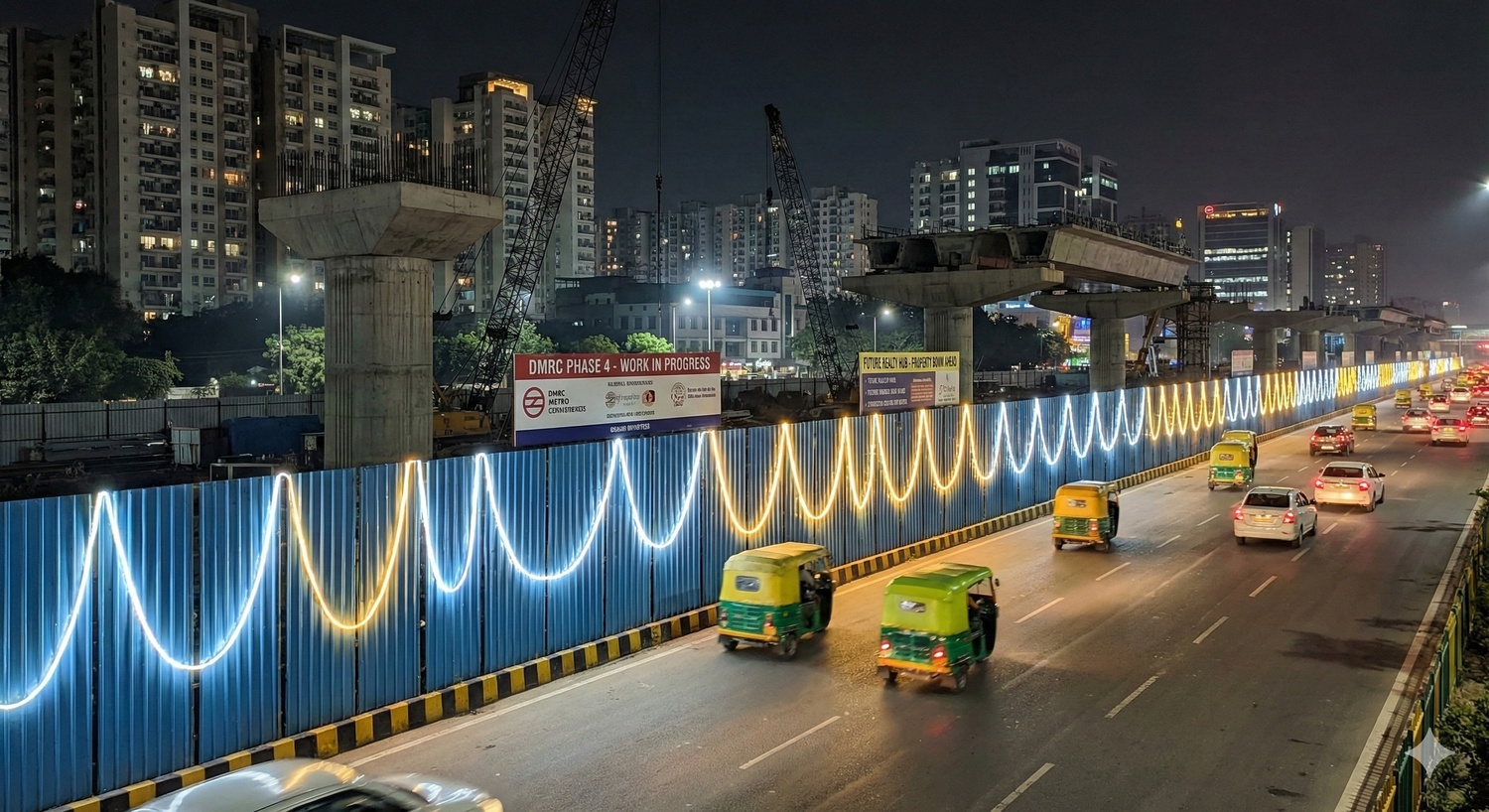
If you have driven through the arterial roads of South or West Delhi recently, particularly during the late evening hours, you might have noticed a distinct change in the urban landscape. The usual drab, dust-coated construction barriers have been replaced—or rather, upgraded—to something far more unmissable. Miles of heavy-duty barricades, outlined with vibrant LED rope lights and blinkers, are cutting through the city's fog and traffic.
At first glance, this is a safety initiative, and a very welcome one. But for the seasoned real estate observer, these 20 kilometers of illuminated barricades represent something far more valuable than just traffic management. They are a literal and metaphorical "green light" for the property market. They signify that the Delhi Metro Phase 4 is no longer a distant plan on a government file; it is on the ground, it is aggressive, and it is racing toward its 2026 operational targets.
In the world of real estate investment, visible infrastructure progress is the primary driver of market sentiment. The sheer scale of this safety deployment—covering nearly 20 kilometers of construction zones—has inadvertently highlighted the massive footprint of the upcoming metro lines. For homebuyers and investors sitting on the fence, these glowing perimeters are a signal that the window for "pre-launch" pricing is rapidly closing.
The Delhi Metro Rail Corporation (DMRC) has always been a benchmark for construction standards in India, but the recent protocols adopted for Phase 4 have taken this to a new level. The decision to install approximately 17 kilometers of LED rope lights and blinkers along the barricades was primarily driven by the need to combat Delhi’s notorious winter fog and ensure the safety of commuters navigating near these sites.
Alongside the lights, the DMRC has deployed over 270 traffic marshals who work round-the-clock to manage the flow of heavy machinery and civilian traffic. They have even introduced "Impact Protection Vehicles" to shield workers and drivers from collisions.
However, from an economic perspective, this level of organization signals "velocity." Stalled projects rarely have well-lit, meticulously managed perimeters. Active, fast-tracked projects do. The visual impact of these LED barricades instills confidence. It tells the resident of Khanpur or the shop owner in Pitampura that the dust and disruption are temporary, and the metro is undeniably coming. In a market often plagued by project delays, this visible commitment to pace and safety is restoring investor trust, directly influencing property inquiries in the affected zones.
While the barricades are visible across various corridors, their impact is perhaps most profound along the route of the upcoming Golden Line (formerly known as the Silver Line). This corridor, connecting Aerocity to Tughlakabad, is arguably the most economically significant stretch of Phase 4.
For decades, vast swathes of South Delhi—specifically areas like Tughlakabad, Khanpur, Tigri, and Sangam Vihar—have existed in a strange paradox. They are geographically located in South Delhi, bordering premium zones like Saket, yet they have suffered from poor connectivity and a "budget" reputation. The Golden Line is the key that unlocks their potential.
The new line will directly connect these densely populated residential pockets to the Aerocity–IGIA hub. Imagine the rental potential of a floor in Tughlakabad when the airport is a 15-minute reliable metro ride away. The thousands of employees working in the hospitality, aviation, and corporate sectors at Aerocity currently face expensive rents in Vasant Kunj or long commutes from other parts of NCR. The Golden Line opens up a massive new rental catchment area.
The construction activity is particularly intense around future interchange hubs. Tughlakabad is set to become a major interchange, linking the Violet Line (Faridabad-Kashmere Gate) with the new Golden Line. Similarly, the Saket G-Block station will offer connectivity to the Brown Line.
Real estate data suggests that properties within a 500-meter radius of an interchange station command a "convenience premium" of 15-20% over standard metro-connected properties. The LED barricades currently lining the Mehrauli-Badarpur Road are essentially outlining the future "high-yield" zones. Investors who are spotting these illuminated sites are already moving to acquire older builder floors and plots, anticipating the inevitable price correction that will happen once the stations go live in 2026-27.
Another critical area where the "LED effect" is visible is along the Majlis Park to Maujpur corridor. This extension of the Pink Line is the final piece of the puzzle that will create India's first "Ring Metro."
For years, areas like Burari, Jagatpur Village, and Bhajanpura have been on the periphery of Delhi’s real estate conversation. They were affordable but isolated. The completion of this loop changes the geometry of the city's transit. A resident in Burari will soon be able to access South Delhi, West Delhi, or East Delhi without ever changing trains, simply by riding the loop.
The barricades here mark the spots where connectivity gaps are being bridged. The impact on affordable housing is expected to be significant. As prices in core Delhi become unattainable, the middle class is looking for "connected suburbs." The Ring Metro turns these northern pockets into viable options for daily commuters working in commercial hubs like Netaji Subhash Place or South Extension. Consequently, local dealers are reporting a surge in inquiries for plots and inventory that had been stagnant for years.
On the western front, the Janakpuri West to RK Ashram Marg corridor (an extension of the Magenta Line) is weaving through some of the most established neighborhoods of the capital, including Paschim Vihar, Pitampura, and Ashok Vihar.
The real estate story here is less about "new discovery" and more about "intensification." These are already premium areas, but the new line acts as a commercial booster. The line creates a direct artery connecting West Delhi to Central Delhi.
Of particular interest to commercial real estate investors is the transformation of Azadpur and Pitampura. With the new lines, these stations are evolving into triple-interchange hubs. The footfall in these zones is projected to skyrocket. We are already seeing a trend where commercial properties—shops, office spaces, and showrooms—facing the main roads (where the barricades currently stand) are seeing rental asks increase. Brands are vying for visibility in what will soon be the busiest transit nodes of North-West Delhi.
Why is the sight of these barricades so important for a buyer today? It comes down to the classic investment philosophy of "buying the rumor and selling the news."
In the lifecycle of infrastructure-driven real estate appreciation, there are three distinct phases:
The 20 kilometers of lit-up barricades are a visual confirmation that we are deep in Phase 2. The DMRC’s aggressive timeline means Phase 3 is just around the corner. Buying property behind these barricades now is essentially locking in the price before the "convenience spike" occurs.
While the outlook is bullish, navigating a market under heavy construction requires a strategic approach. The very barricades that signal growth also signal temporary inconvenience.
For an end-user looking to move in immediately, the areas flanking the Phase 4 sites might currently face congestion. The DMRC’s efforts with marshals and road studs mitigate this, but the dust is a reality. Smart buyers use this to their advantage during negotiations. A seller might be motivated to close a deal quickly to move away from the construction zone, offering a price advantage to a buyer willing to wait out the next 12-18 months.
The properties that will appreciate the most are those that will have safe, walkable access to the new stations. When scouting locations near the Golden Line or the Pink Line extension, look at the pedestrian infrastructure. The DMRC is likely to upgrade sidewalks and access roads near the station entry/exit points (often where the barricades are widest). Properties on these direct feeder routes will command a higher premium than those deep inside the colonies which require a rickshaw ride to reach the metro.
The DMRC’s initiative to light up its construction sites with 17 kilometers of LED blinkers is a commendable step towards urban safety. It reflects a sensitivity to the city's residents and a commitment to operational excellence. But for the astute observer, these lights serve a dual purpose. They illuminate the path of Delhi's future growth.
Every lit-up barricade represents a future station, a future connection, and a future spike in local economic activity. The Phase 4 expansion is not just adding kilometers to a map; it is integrating the fragmented markets of the NCR into a cohesive economic unit. From the affordable lanes of Burari to the aspirational floors of Tughlakabad, the metro is the great equalizer.
As 2026 progresses, these barricades will eventually come down. When they do, they will reveal a transformed city with shorter commutes and higher property valuations. For those watching the lights today, the message is clear: the machinery is moving, the tracks are being laid, and the real estate boom is not coming—it is already here, hidden in plain sight behind the glow of the safety lights. The time to position oneself in the market is not when the ribbons are cut, but now, while the work is still in progress.
