Published On:
June 29, 2026
Updated On:
June 29, 2026
The upcoming Delhi Metro extension from Bahadurgarh to Asauda in Jhajjar district will transform regional connectivity, directly benefiting 50,000 residents across 15 villages. This major infrastructure project includes six new stations and is set to trigger a significant real estate boom in the surrounding areas.
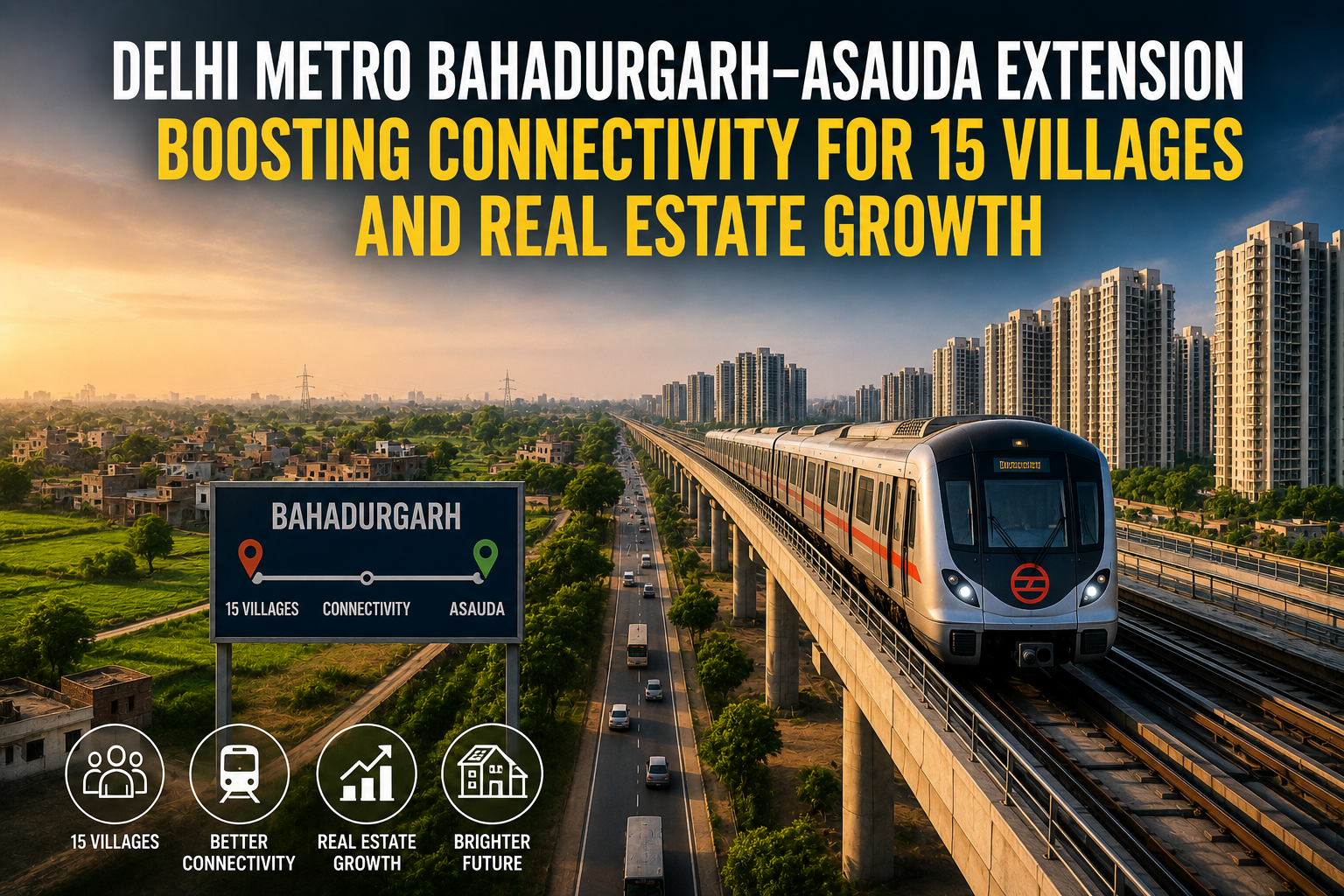
The National Capital Region is expanding at an unprecedented pace, and robust public transportation is the central pillar supporting this massive demographic and economic shift. For years, the Delhi Metro has served as the circulatory system of the capital and its immediate satellite cities. Now, there is highly anticipated news for the residents of Haryana. The mass transit network is preparing to take another massive leap deeper into the state. A major extension of the Delhi Metro has been proposed to connect Bahadurgarh to Asauda in the Jhajjar district.
This is not just another minor route addition; it is a transformative infrastructure initiative actively pursued by the Haryana Government to strengthen the overall transport framework of the region. By bridging the gap between rapidly industrialising zones and established urban centres, this upcoming metro corridor is designed to alter the daily commuting reality for thousands of people. It is projected to directly benefit a population of 50,000 residents and dramatically improve the accessibility of over 15 villages spanning across the Bahadurgarh and Jhajjar regions. For homebuyers, daily commuters, and real estate investors, this development signals a golden era of connectivity and regional appreciation.
The success of any mass transit system lies in its strategic alignment and its ability to penetrate areas with high residential density and commercial potential. The proposed extension from Bahadurgarh to Asauda is meticulously planned to capture both. The alignment is set to introduce six entirely new metro stations along its corridor, effectively weaving the suburban and rural fringes into the main urban fabric.
The proposed stations are Sankhol, Udyog Nagar, HSIIDC, Jakhoda, HPCL, and Asauda. Each of these nodes has been chosen with a specific purpose. Sankhol and Jakhoda will primarily serve the dense residential communities, offering them a direct, air-conditioned, and rapid link to the heart of Delhi. Udyog Nagar and HSIIDC are vital industrial hubs. By bringing a metro station directly to these zones, the government is solving a massive logistical challenge for the industrial workforce. Thousands of factory workers, managers, and business owners travel to these industrial estates daily. A direct metro link will reduce their dependence on private vehicles, ease highway congestion, and lower the carbon footprint of the entire industrial belt.
Furthermore, the HPCL station will cater to specific commercial and strategic setups, while the terminal station at Asauda will act as a major transit point for passengers coming from the deeper interiors of the Jhajjar district. The land requirements for both the tracks and the station locations have already been identified during the initial survey processes, ensuring that the project can move forward without major land acquisition hurdles that typically delay large-scale infrastructure projects.
Infrastructure is ultimately about people, and the human impact of this metro extension is profound. For decades, the residents of the villages situated on the periphery of Bahadurgarh and Jhajjar have relied on erratic state transport buses, shared auto-rickshaws, and private two-wheelers to navigate their way toward the city. These commutes are often long, tiring, and highly susceptible to unpredictable weather and heavy highway traffic.
The extension will seamlessly connect 15 villages to the broader National Capital Region grid. This means that a student living in Asauda can now realistically enroll in a university in Delhi and commute daily without spending hours on the road. A patient requiring specialised medical care in the capital's top hospitals can access them swiftly and comfortably. For the working professional, it opens up a much wider job market. When travel time is cut in half and reliability is guaranteed, the geographical barriers to employment disappear.
The estimated 50,000 residents who will directly benefit from this project will experience a substantial upgrade in their quality of life. Reliable public transport reduces the physical and mental stress of daily travel. It also translates to significant financial savings, as the cost of a metro ride is marginally lower than the fuel and maintenance costs of a private vehicle or the daily fares of private cabs. By integrating these 15 villages into the metro map, the government is effectively bringing the city to their doorstep, fostering inclusive growth and bridging the rural-urban divide.
A project of this magnitude requires rigorous planning and extensive ground-level evaluation. Fortunately, the bureaucratic and technical wheels are already turning at a rapid pace. The Haryana Mass Rapid Transport Corporation (HMRTC) is the nodal agency spearheading this initiative. Demonstrating a strong commitment to the project, the HMRTC has already completed a comprehensive physical survey of the proposed route through a specialized private agency.
This physical survey is a critical milestone. It assesses the topographical challenges, the soil conditions, the existing public utilities that need relocation, and the exact alignment of the tracks. Based on the findings of this survey, coupled with previous ridership assessments that justify the economic viability of the route, the corporation is actively preparing the Detailed Project Report (DPR). The DPR is the foundational blueprint of any mega-infrastructure project, detailing the engineering specifications, the financial outlay, the environmental impact, and the exact timeline for execution.
The DPR is expected to be finalized and submitted within the next month. Once this critical document receives the green light from the relevant authorities, the state government will swiftly move towards the next phases: budget allocation and the initiation of the tendering process. The construction work will commence immediately after the final approvals are secured and the necessary relocation of public utilities along the alignment is completed. The swift pace at which the HMRTC is moving indicates that this extension is a high-priority project for the state.
Modern urban planning dictates that transit systems should not operate in isolation; they must interact and integrate with other modes of transport to create a seamless mobility web. One of the most significant advantages of the Bahadurgarh-Asauda Metro extension is its planned integration with the massive Haryana Orbital Rail Corridor (HORC).
The Haryana Orbital Rail Corridor is a game-changing railway project designed to bypass Delhi, connecting Palwal to Sonipat via Sohna, Manesar, and Kharkhoda. Its primary objective is to divert heavy freight traffic away from the congested core of the national capital while simultaneously boosting passenger movement across the periphery of the NCR.
By creating an interchange or a close connection between the new metro corridor and the HORC, planners are establishing a master transit grid. A passenger could potentially take the metro from Delhi to Asauda and easily switch to the Orbital Rail to travel towards Manesar or Palwal without ever having to enter the gridlocked streets of the capital. This multi-modal integration will exponentially increase the utility of both transit systems, making the entire region highly accessible for both logistics and passenger travel.
Wherever the metro goes, a real estate boom inevitably follows. The proposed corridor is poised to become a massive growth driver for the property markets in Bahadurgarh, Jhajjar, and the surrounding rural-urban fringes. Historically across the NCR, the announcement and subsequent construction of a metro line have acted as the strongest catalysts for land appreciation and housing demand.
Currently, the property prices in Bahadurgarh are relatively affordable, ranging from ₹3,100 to ₹7,082 per square foot. This makes it an incredibly attractive market for middle-income homebuyers who have been priced out of the exorbitant real estate markets of Gurugram, Noida, and central Delhi. The promise of the upcoming metro extension changes the investment calculus entirely. Areas located in close proximity to the proposed stations—specifically Sankhol, Jakhoda, Asauda, and Udyog Nagar—are expected to witness a gradual but highly lucrative appreciation in land and property prices.
For real estate developers, this corridor represents a fresh canvas. We can expect to see an influx of new residential projects, affordable housing complexes, and integrated townships along this route. Investors who enter the market at this early stage, right around the finalization of the DPR, stand to gain maximum returns. As the project transitions from paper to physical construction, property values will experience sharp upward revisions.
Moreover, the commercial real estate sector will also receive a massive boost. The areas around the new metro stations will naturally develop into micro-commercial hubs, featuring retail outlets, shopping complexes, and essential services catering to the daily commuters. The presence of the Udyog Nagar and HSIIDC stations will also drive up the demand for warehousing and industrial plots, as businesses will want to capitalize on the improved logistics and easy access to the workforce.
While the immediate focus is firmly locked on the execution of the Bahadurgarh to Asauda stretch, the long-term vision of the transport authorities is far more expansive. High-level discussions have already taken place regarding the future expansion of the metro line further towards Rohtak.
Rohtak is one of the most prominent educational and political hubs in Haryana. Connecting it directly to Delhi via a high-speed metro link would be a monumental achievement in regional integration. If these long-term plans materialize, it would mark another massive leap for Haryana's infrastructure, firmly cementing the state's position as the most well-connected region in North India. It would seamlessly link the agricultural and educational heartlands of the state directly to the global economic engine of the national capital.
The proposed Delhi Metro extension connecting Bahadurgarh to Asauda is much more than a transit project; it is an economic lifeline for the Jhajjar district. By bringing 15 villages and over 50,000 residents into the fold of modern, rapid public transportation, the Haryana Government is setting the stage for unprecedented regional development. With six strategic stations, brilliant integration with the Haryana Orbital Rail Corridor, and a massive impending real estate boom, this corridor is destined to reshape the socio-economic landscape of the region. As the Detailed Project Report nears finalization, the residents and investors of Bahadurgarh and Asauda stand on the threshold of a highly connected, prosperous future.
