Published On:
February 23, 2026
Updated On:
February 23, 2026
The fully operational 82-kilometer Delhi-Meerut RRTS Namo Bharat corridor reduces travel time to under an hour, integrating seamlessly with the new Meerut Metro and dramatically boosting regional real estate investments across the National Capital Region.
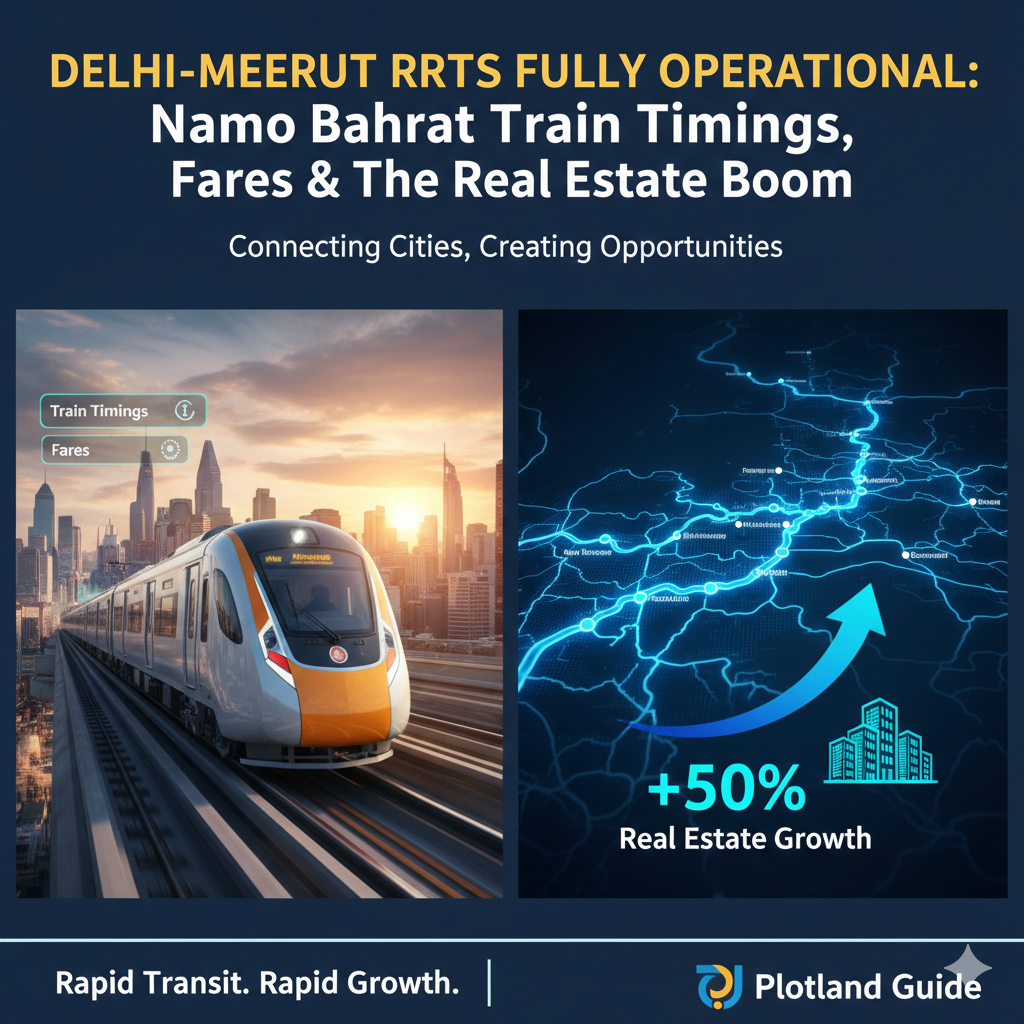
In the relentless, fast-paced rhythm of modern urban life, a peculiar paradox has emerged: many professionals possess the financial resources for private luxury vehicles, yet they are entirely stripped of the time required to enjoy the commute. The daily migration between the National Capital and its surrounding satellite cities has long been defined by unpredictable traffic bottlenecks, weather-induced delays, and the sheer mental exhaustion of navigating congested highways. However, the paradigm of regional travel experienced a monumental shift with the complete operationalization of the Delhi-Meerut Regional Rapid Transit System (RRTS).
With the official inauguration of the final stretches on February 22, 2026, the entire 82-kilometer Namo Bharat corridor is now open to the public. This semi-high-speed rail network does far more than merely bridge the geographical gap between Delhi and western Uttar Pradesh. It offers a highly reliable, meticulously scheduled, and exceptionally comfortable alternative that allows commuters to reclaim their lost time. By drastically cutting down travel duration and eliminating the stress of driving, the Namo Bharat service is fundamentally altering how people live, work, and invest across the National Capital Region (NCR).
For decades, traveling from the heart of Delhi to the urban centers of Meerut meant enduring a grueling road trip that could easily consume two to three hours of the day, heavily contingent on highway traffic. The fully active Namo Bharat corridor completely obliterates this massive time sink. Commuters can now board a train at the centrally located Sarai Kale Khan station in Delhi and disembark at Modipuram in Meerut in an astonishing 55 to 58 minutes.
This incredible efficiency is driven by world-class rail engineering. The Namo Bharat trainsets boast a design speed of 180 kilometers per hour, maintaining a maximum operational speed of 160 kilometers per hour and an impressive average speed of roughly 90 kilometers per hour across the route. With the entire 82-kilometer network now online, the frequency of these rapid trains is set to improve significantly, dropping from a 15-minute wait time to a train arriving every 10 minutes.
The extensive corridor is strategically dotted with 16 stations designed to capture maximum commuter footfall across key urban nodes. The route includes stops at Sarai Kale Khan, New Ashok Nagar, Anand Vihar, Sahibabad, Ghaziabad, Guldhar, Duhai, Duhai Depot Station, Murad Nagar, Modi Nagar South, Modi Nagar North, Meerut South, Shatabdi Nagar, Begumpul, Modipuram, and Modipuram Depot. Architecturally, the network is a mix of elevated and underground engineering, comprising 14 kilometers within Delhi's borders (9 kilometers elevated and 5 kilometers underground) and 68 kilometers traversing Uttar Pradesh (61 kilometers elevated and 7 kilometers underground).
When evaluating the true cost of a daily commute, urban planners and transport analysts look beyond just the price of a ticket; they calculate the holistic expenditure of time, fuel, and mental well-being. A straightforward mathematical comparison vividly highlights why private driving is rapidly losing its appeal on this specific route.
Consider a standard petrol-driven private car that offers an average fuel efficiency of 16 kilometers per liter. With petrol prices hovering around Rs 95 per liter, a single 82-kilometer journey from Delhi to Meerut consumes roughly 5.12 liters of fuel, costing approximately Rs 486 just in direct petrol expenses. When factoring in the return trip, highway toll taxes, inevitable vehicle wear and tear, and the potential costs of parking, the financial burden of driving becomes overwhelmingly steep. Even vehicles running on compressed natural gas (CNG), while slightly cheaper, still demand the driver's absolute focus and physical energy in heavy traffic.
In stark contrast, the Namo Bharat transit system offers an incredibly economical alternative. The fare structure is distance-based, with standard class tickets for the entire length of the corridor capped at a highly affordable Rs 150. For commuters desiring a more luxurious experience, the premium class fare is set at just Rs 225 for the complete journey.
Beyond the immediate financial savings, the most valuable currency the RRTS offers is time. Daily commuters stand to save between 30 to 40 minutes each way, accumulating hundreds of recovered hours over the course of a year. Furthermore, the train environment allows passengers to completely detach from the stress of the road. Instead of white-knuckling a steering wheel through a traffic jam, commuters can safely utilize their travel time to work on laptops, browse their mobile devices, or simply rest in a climate-controlled environment, entirely insulated from unpredictable weather conditions and road accidents.
The February 2026 launch did not just complete the regional rapid transit line; it also introduced a groundbreaking innovation in Indian urban mobility with the commencement of the Meerut Metro. For the very first time in the country's transportation history, a local city metro system is operating on the exact same track infrastructure as a semi-high-speed regional train.
This integrated transport model allows the Namo Bharat trains to handle the high-speed, long-distance regional leaps between cities, while the Meerut Metro acts as the localized capillary network, distributing passengers deeply within the city limits. The Meerut Metro is currently recognized as the fastest metro system in India, boasting a design speed of 135 kilometers per hour and a maximum operational speed of 120 kilometers per hour.
Covering a 21-kilometer local stretch, the Meerut Metro traverses 12 dedicated stations: Meerut South, Partapur, Rithani, Shatabdi Nagar, Brahmpuri, Meerut Central, Bhaisali, Begumpul, MES Colony, Daurli, Meerut North, and Modipuram. The incredibly fast local trains can cover this entire intra-city distance, including all scheduled stops, in approximately 30 minutes. Because both systems share the same stations at key junctions like Meerut South, Shatabdi Nagar, Begumpul, and Modipuram, passengers can seamlessly transition from a regional journey from Delhi right into a localized commute without ever leaving the transit ecosystem.
At the southern terminus of the corridor lies the Sarai Kale Khan station, a structural marvel that serves as the primary anchor for this massive transit network. This station has been meticulously engineered to function as one of the largest and most efficient multimodal transportation hubs in the National Capital.
The true power of the Sarai Kale Khan hub is its unparalleled connectivity. It physically bridges multiple disparate modes of public transport, allowing commuters to switch networks with absolute ease. The RRTS station directly interfaces with the Hazrat Nizamuddin Railway Station (facilitating long-distance national train travel), the Veer Haqeeqat Rai Inter-State Bus Terminal (ISBT), and the Delhi Metro's expansive Pink Line. To manage the immense daily footfall and ensure frictionless movement between these transport modes, a massive 280-meter-long foot overbridge has been constructed, fully equipped with six travelators.
Looking toward the future, Sarai Kale Khan is positioned to become even more critical. It is designed with six elevated platforms and four tracks specifically because it will serve as the central convergence point for two upcoming rapid rail corridors. Once approved and constructed, the planned corridors heading toward Panipat and Karnal in Haryana, as well as Alwar and Neemrana in Rajasthan, will all originate from this mega-hub, creating an unprecedented, interconnected web of high-speed transit across northern India.
The introduction of a reliable, sub-60-minute transit link between a major metropolis and its surrounding tier-2 cities rarely acts just as a transportation upgrade; it acts as a massive catalyst for real estate expansion. The operationalization of the full Delhi-Meerut RRTS is aggressively reshaping the property market dynamics across the entire corridor.
Historically, professionals working in Delhi were forced to reside within the city's borders or immediately adjacent suburbs like Noida and Gurugram to avoid exhausting commutes, leading to skyrocketing residential rents and severe property market saturation. Now, the high-speed connectivity has effectively expanded the viable residential catchment area of the National Capital. Areas like Ghaziabad, Muradnagar, Modinagar, and Meerut are suddenly highly attractive to end-users and long-term investors alike.
Market data already reflects this dramatic geographical shift. Real estate industry analysis reveals that property prices have witnessed a staggering appreciation over the last four years, rising by 131% in Ghaziabad and 54% in Meerut. Land rates in Meerut, which previously hovered between Rs 8,000 and Rs 12,000 per square yard, have surged to between Rs 12,000 and Rs 20,000 per square yard. Micro-markets situated near major transit nodes like Modipuram and Shatabdi Nagar have reported price jumps of 30% to 60%.
This boom is largely driven by a renewed focus on Transit-Oriented Development (TOD). Urban planners and large-scale developers are actively acquiring land banks along the corridor to build high-density, mixed-use communities right within the influence zones of the RRTS stations. These developments prioritize walkable neighborhoods that integrate premium residential apartments, retail spaces, and office complexes. Furthermore, premium plotted developments are emerging near highway bypasses that offer immediate access to both the expressways and the rapid rail stations. For young professionals and families, the proposition is incredibly compelling: invest in larger, significantly more affordable real estate in a developing tier-2 city, while retaining seamless, stress-free access to the employment hubs of Delhi.
To attract commuters away from the privacy of their personal cars, the Namo Bharat trains have been outfitted with amenities that rival modern aviation standards. The rolling stock is designed with a sleek, aerodynamic profile reminiscent of bullet trains, featuring fully air-conditioned interiors and a 2x2 transverse seating arrangement.
Every trainset includes a dedicated premium coach, accessible via an exclusive lounge on the station platform. This upscale coach is designed for maximum comfort, offering wider, deeply cushioned reclining seats, ample legroom, and sun-protection blinds. Recognizing the needs of the modern working professional, the trains are equipped with mobile and laptop charging ports at every seat, alongside onboard Wi-Fi, allowing the transit time to be fully utilized for business or entertainment. Additionally, to ensure safety and comfort, one coach in every train is strictly reserved for women commuters.
The infrastructure also prioritizes passenger safety and accessibility at the station level. All platforms are secured with automated screen doors that seamlessly integrate and open synchronously with the train doors, entirely eliminating the risk of track-related accidents.
Beyond individual comfort, the broader impact of the RRTS is profoundly environmental. By providing a highly efficient alternative to road travel, the network aims to shift tens of thousands of daily trips away from fossil-fuel-dependent private vehicles. This modal shift will drastically reduce the volume of vehicular emissions released into the atmosphere, helping to combat the severe air quality issues that perpetually plague the National Capital Region during peak seasons.
Ultimately, the fully realized Delhi-Meerut RRTS and the integrated Meerut Metro represent far more than a triumph of civil engineering. They stand as a blueprint for the future of Indian urban development—a future where distance no longer dictates opportunity, where economic growth is distributed evenly across regions, and where the daily commute is transformed from an exhausting chore into a fast, peaceful, and highly productive journey.
