Published On:
May 8, 2026
Updated On:
May 8, 2026
The Delhi Development Authority is radically overhauling the capital’s real estate landscape through the ambitious Master Plan 2041, the activation of the long-stalled Land Pooling Policy, and a highly strategic pivot toward premium luxury housing to foster sustainable, high-density urban growth.
For over six decades, the skyline and suburban sprawl of India’s capital have been meticulously shaped by a singular governing body. Since its inception in the late 1950s, the Delhi Development Authority was tasked with an unprecedented challenge: managing a massive influx of residents while laying down the foundational civic infrastructure for a rapidly expanding metropolis. Its historical approach was highly pragmatic, focusing almost entirely on land acquisition and the mass construction of standardized, affordable housing colonies to ensure that millions of citizens had a roof over their heads. This functional strategy successfully created vast residential zones and district commercial centers that serve as the backbone of the city today.
However, the urban dynamics of the National Capital Region have undergone a massive paradigm shift over the past two decades. Satellite cities like Gurugram and Noida emerged as aggressive competitors, driven by agile private developers who recognized the growing demand for premium, integrated townships. As a result, the capital experienced a demographic drain, losing high-net-worth investors, multinational corporate offices, and upwardly mobile homebuyers to these neighboring commercial hubs. Realizing that the traditional blueprint of basic shelter provision is no longer sufficient to sustain a modern global city, the primary development authority is undergoing a sweeping structural and philosophical transformation. Through the visionary guidelines of the upcoming Master Plan 2041, the breakthrough implementation of the Land Pooling Policy, and a surprising entry into the ultra-luxury real estate market, the narrative is dramatically shifting from mere housing management to the creation of a world-class, future-ready urban ecosystem.
The most visible indicator of this institutional evolution is the complete reimagining of public sector housing. Historically, the housing inventory released by the authority was categorized strictly by income—Lower Income Group, Middle Income Group, and High Income Group flats. While these projects successfully addressed the severe housing shortage, they were often characterized by utilitarian architecture, limited communal amenities, and recurring maintenance challenges. They were designed for utility, not aspiration.
Today, that approach has been entirely discarded in favor of competing directly with top-tier private real estate developers. The authority has officially entered the luxury segment, a move designed to recapture the affluent homebuyer demographic that had largely migrated to the expansive golf-course communities of neighboring states. The flagship representation of this massive shift is the development of ultra-luxury residential complexes, perfectly exemplified by the Golf View Condos located in Sector 19B of Dwarka.
Spread across a sprawling twenty-acre land parcel, this multi-tower project completely redefines the expectations of a government-backed residential community. Buyers are no longer settling for basic four-wall structures. These premium three and four-bedroom apartments are designed with expansive floor plans, maximizing natural light and ventilation while offering uninterrupted views of the surrounding green belts. More importantly, the community infrastructure mirrors the exclusivity of high-end private townships. Residents have access to state-of-the-art gymnasiums, dedicated community clubhouses, expansive swimming pools, and meticulously landscaped jogging tracks.
The structural integrity and environmental consciousness of these projects have also seen a massive upgrade. Modern complexes now natively integrate rainwater harvesting systems, solar-powered communal lighting, and advanced decentralized sewage treatment plants, ensuring that luxury living does not come at the cost of ecological balance. By releasing this premium inventory into the market through highly transparent e-auction platforms, the authority is successfully demonstrating that public developments can deliver unparalleled quality and exclusivity, triggering a massive resurgence of interest in the capital's high-end property market.
While luxury condominiums address a specific market segment, the most pressing issue facing the capital is the absolute scarcity of developable land within the core city limits. For years, the city’s peripheral villages and rural belts were trapped in a developmental vacuum. Strict zoning laws prevented organized construction, leading to a massive proliferation of unauthorized colonies, chaotic urban sprawl, and a complete lack of master-planned civic infrastructure. To combat this, urban planners introduced the highly anticipated Land Pooling Policy, a mechanism designed to replace forced land acquisitions with mutually beneficial partnerships between the government and local landowners.
The underlying mechanics of the policy are deeply innovative. Instead of the government buying land at set rates, groups of local landowners and farmers voluntarily pool their contiguous land parcels and hand them over to a unified consortium. The urban development authority then takes over the site to lay down the critical master infrastructure—constructing wide arterial roads, heavy-duty drainage systems, power grids, and water supply networks. Once the land is fully modernized and ready for development, a substantial percentage of the enhanced real estate is returned directly to the original owners or their partnered private developers. This returned land can then be utilized to construct high-density residential towers and commercial complexes, while the remaining portion is retained by the government for public parks, schools, and essential utilities.
After facing years of bureaucratic friction, complex legal hurdles, and immense hesitation from the landowning communities, the policy has finally achieved a monumental breakthrough. Recently, Sector 8b within the P-II zone became the very first sector to cross the mandatory landowner consent threshold, securing official approval to alter land use parameters across roughly forty hectares. This is a watershed moment for the city's real estate trajectory. The activation of Sector 8b serves as a live, operational blueprint that will drastically restore confidence among thousands of hesitant landowners across the capital. As heavy machinery moves in to develop this initial sector, it acts as the catalyst needed to unlock thousands of acres of peripheral land, paving the way for the organized, high-density expansion that the city desperately needs to accommodate its surging population.
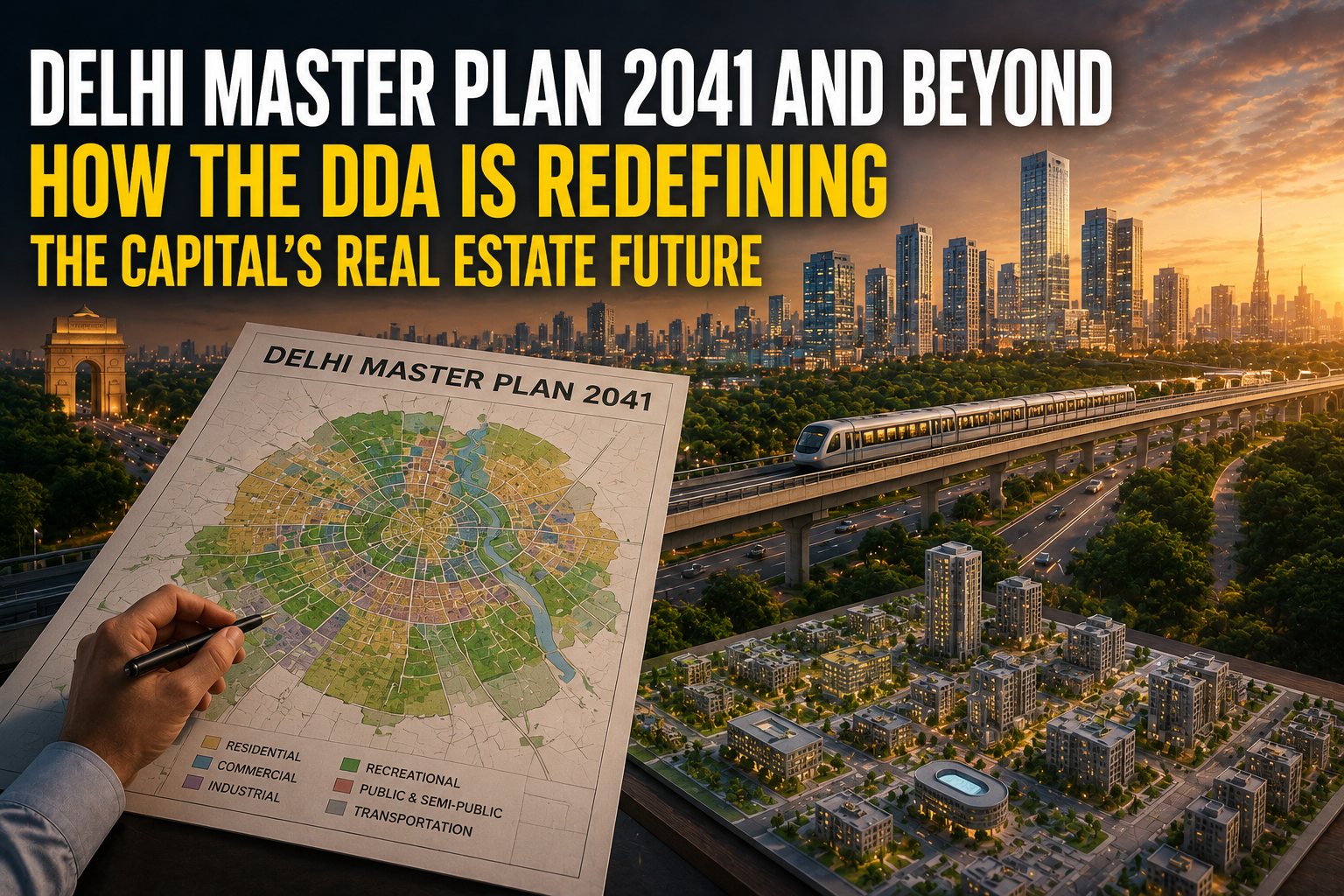
Guiding all these localized residential projects and peripheral expansions is the overarching Delhi Master Plan 2041. Currently in its final stages of statutory approval, this comprehensive twenty-year strategic document represents a radical departure from the city's previous urban planning doctrines. Older master plans were heavily focused on horizontal expansion, attempting to stretch the city's borders outward. However, the 2041 blueprint faces a harsh reality: land is finite, environmental degradation is severe, and the population density is reaching critical mass. Consequently, the new framework is aggressively focused on vertical integration, environmental regeneration, and economic vibrancy.
Absolute environmental sustainability forms the non-negotiable core of the new master plan. Recognizing the city's ongoing battles with severe seasonal air pollution and a rapidly depleting water table, the regulations aggressively target resource management. The blueprint mandates a massive push toward renewable energy, requiring new large-scale developments to incorporate solar infrastructure and strict green building certifications. To tackle water scarcity, the plan heavily promotes a circular water economy, enforcing mandatory wastewater recycling protocols and zero-liquid-discharge systems for large commercial and residential complexes. The preservation of the city's natural ecology is also heavily prioritized, with strict development buffers placed around the Yamuna riverfront and the sensitive Aravalli ridge areas.
From a structural standpoint, the 2041 vision recognizes that the city sits within a highly active seismic zone. The new planning parameters enforce incredibly stringent engineering and safety codes to protect future high-rises against earthquakes, localized urban flooding, and fire hazards.
Economically, the master plan is designed to transform the capital into a vibrant, round-the-clock global metropolis. It introduces specific zoning provisions to cultivate a thriving night-time economy, allowing commercial and entertainment districts to operate continuously. This move is expected to generate massive employment opportunities and drastically improve the city's cultural and recreational appeal. Furthermore, to untangle the daily gridlock that plagues the capital's roads, the master plan heavily incentivizes Transit-Oriented Development. By encouraging high-density, mixed-use real estate projects immediately adjacent to major metro stations and regional rapid transit hubs, the strategy encourages citizens to live, work, and socialize within a highly walkable radius, significantly reducing the reliance on private vehicles and lowering the city's overall carbon footprint.
Even as the development authority aggressively pursues high-net-worth investments and high-tech urban planning, it remains deeply committed to its foundational social responsibilities. Millions of the city's residents continue to live in informal settlements and densely packed slum clusters, completely devoid of legal land rights and basic civic amenities. In previous decades, the standard approach to clearing these settlements involved relocating the residents to the distant, under-developed outskirts of the city. This strategy was highly disruptive, stripping vulnerable communities of their established livelihoods and severing deep-rooted social networks. The current urban strategy, however, heavily favors in-situ rehabilitation—rebuilding the community exactly where it stands.
The flagship representation of this inclusive, community-first approach is the Pragati Apartments project, located in West Delhi. Formerly known as the Kathputli Colony, this massive undertaking involved temporarily relocating the original residents—a vibrant community of traditional street performers, artisans, and puppeteers—clearing the dilapidated structures, and constructing modern, multi-story apartment towers on the exact same plot of land.
Once the construction phase concludes, the original families are seamlessly integrated back into their historical neighborhood. However, they return to secure, legally recognized, and well-ventilated homes equipped with uninterrupted clean water, proper sanitation networks, and reliable electricity. This highly successful in-situ model is now being rapidly scaled and deployed across other major informal settlements throughout the capital.
Simultaneously, the authority has launched massive affordable housing drives, such as the Karamyogi Awaas Yojana and the Janatha Awaas schemes. These initiatives release thousands of newly constructed, highly subsidized flats in emerging zones like Narela and Siraspur. By utilizing highly transparent, computer-based draw systems and offering massive financial discounts under a first-come, first-served model, the authority is aggressively democratizing homeownership. These programs ensure that the city's transition into a high-tech metropolis does not alienate or displace its most vulnerable demographic, maintaining a crucial balance between premium real estate growth and essential social welfare.
The comprehensive rebranding of the capital's primary development authority is undeniable. The aggressive launch of ultra-luxury housing, the strategic activation of the land pooling mechanism, and the sweeping, forward-thinking reforms embedded within the 2041 master plan signal a fundamental institutional shift. The governing body is actively shedding its historical reputation as a slow-moving, rigid bureaucracy and is actively repositioning itself as an agile, highly competitive urban facilitator. It clearly understands that to maintain the capital's economic supremacy, it must deliver the same ease of doing business, transparency, and world-class infrastructure that global investors have come to expect from modern private developers.
However, the road ahead is incredibly complex. Translating these grand, multi-billion-rupee visions from paper blueprints to physical reality requires flawless execution and seamless coordination across multiple state and central government agencies—a bureaucratic hurdle that has historically stalled dozens of critical mega-projects in the region.
The Land Pooling Policy, while brilliant in its design, faces a massive capital expenditure challenge. The authority must secure and deploy billions of rupees to construct the promised master infrastructure before private developers can even begin to break ground on their residential towers. Furthermore, the city's aging and heavily burdened water and electrical grids will require massive, highly disruptive overhauls to support the intense vertical growth mandated by the new transit-oriented development norms.
The upcoming decade will serve as the ultimate testing ground for the capital's real estate sector. If the development authority can successfully navigate the intricate web of rapid land acquisition, strict environmental compliance, and massive infrastructure financing, it will permanently alter the urban trajectory of northern India. The long-awaited transition from a horizontally sprawling city of disjointed residential colonies into a vertically integrated, highly sustainable, and economically vibrant global metropolis is currently underway. The foundational pillars are being laid today, and the successful execution of these sweeping policies will dictate the livability, prestige, and economic vitality of the capital for generations to come.
