Published On:
June 29, 2026
Updated On:
June 29, 2026
The proposed extension of the Delhi Airport Express Metro Line to Rajiv Chowk in Gurugram is set to revolutionize daily commuting by bypassing NH-48 traffic, while simultaneously boosting real estate demand and regional connectivity across the National Capital Region.
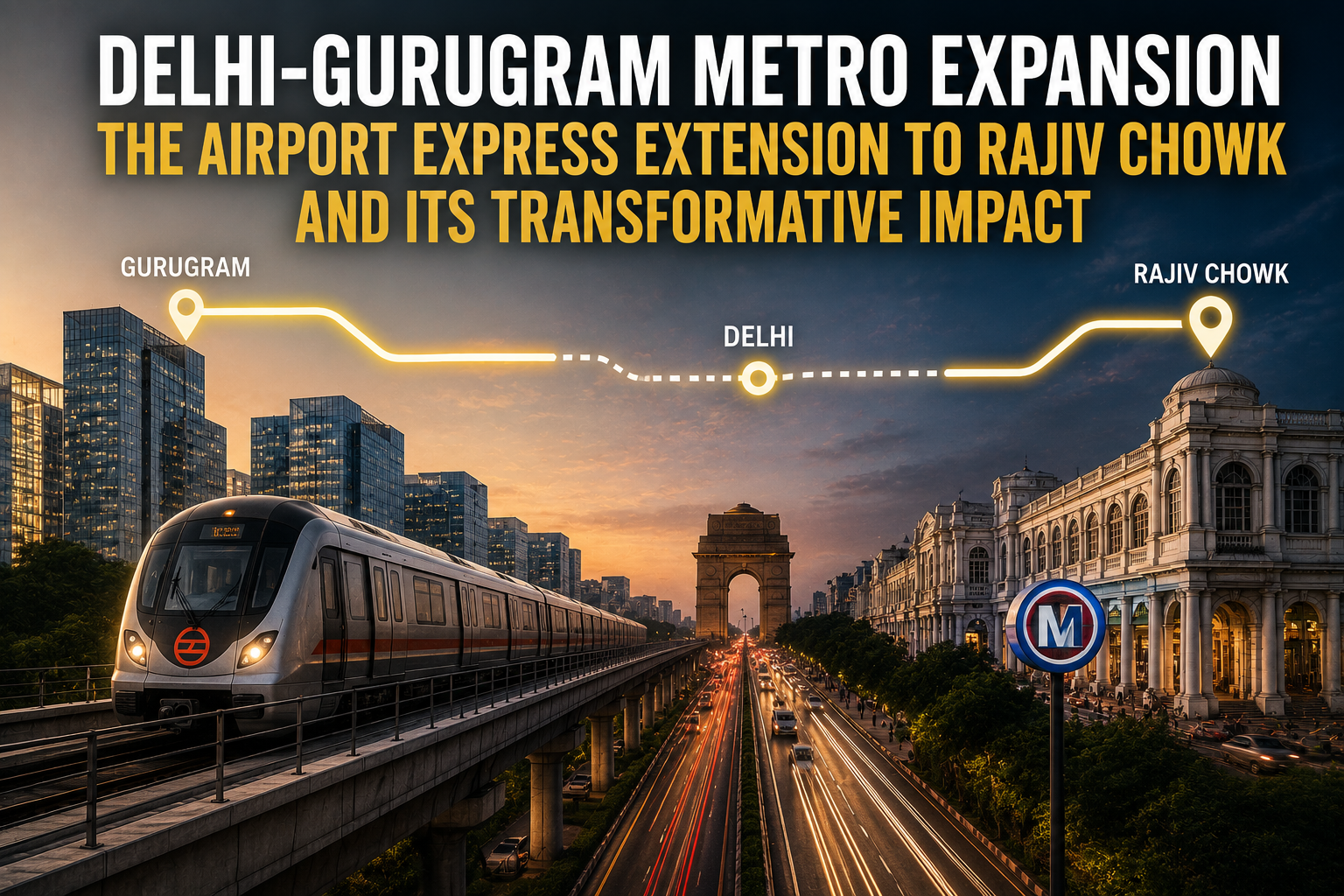
For thousands of professionals living in Delhi and working in the corporate hubs of Gurugram, the daily commute is often the most unpredictable part of the day. The journey along the Delhi-Gurgaon Expressway, specifically National Highway 48, is notorious for heavy traffic congestion, sudden bottlenecks at the border, and long delays during peak hours. The drive can be smooth one morning and painfully slow the next, forcing commuters to constantly monitor traffic updates before stepping out. However, a massive infrastructure upgrade is on the horizon that promises to fundamentally alter how the National Capital Region moves.
The proposal to expand the high-speed Airport Express Line directly into the heart of Gurugram is gaining serious momentum. By extending the metro network from its current terminus at Yashobhoomi Dwarka Sector 25 all the way to Rajiv Chowk, urban planners are looking to provide a rapid, reliable, and stress-free alternative to road travel. This Delhi-Gurugram metro expansion is not merely a transit project; it is a vital economic catalyst that will reshape real estate, enhance corporate connectivity, and bring immense relief to daily commuters.
The effort to seamlessly connect the Indira Gandhi International Airport with the commercial nerve center of Gurugram has been in the works for several years, evolving through multiple iterations. Currently, the planning authorities, including the Delhi Metro Rail Corporation and the Haryana Mass Rapid Transport Corporation, are evaluating three distinct proposals to achieve this goal. These proposals aim to close the existing transit gaps and create a comprehensive rail network across the state borders.
The most prominent of these proposals is the direct extension of the Airport Express Line from the newly operational Yashobhoomi station directly to Rajiv Chowk on NH-48. This alignment is highly strategic, as Rajiv Chowk serves as a central nodal point for Gurugram, dispersing traffic toward major commercial and residential hubs. Planners have highly recommended that this entire stretch be constructed underground. An underground corridor, while capital-intensive, avoids the complex and time-consuming process of surface land acquisition in highly densely populated urban areas and prevents further disruption to the already congested highway above.
The second proposal focuses on extending the Airport Express Line from Dwarka Sector 21 to Gurugram Sector 21. This route aims to create a crucial circular loop that would smoothly integrate the older, established metro lines with the newer tracks being laid down. Such a connection would allow passengers to interchange effortlessly, creating a unified grid.
The third proposal on the table originates from the Haryana authorities, suggesting a dedicated metro corridor between Rezangla Chowk and Dwarka Sector 21. This alignment has a history dating back to 2011 and has seen several revisions to align with the current demographic demands of the region.
To optimize resources and maximize passenger convenience, senior officials at the Union Housing Ministry have suggested combining elements of these alignments. A prominent recommendation involves merging the routes to include vital stations at Bijwasan and Kapashera. These two areas lie squarely on the border and have large populations that currently lack robust mass transit options. By integrating them into the high-speed network, the expansion will serve a dual purpose: facilitating rapid airport transit for business travelers while serving the daily transit needs of local residents.
The immediate and most visible impact of this metro expansion will be the drastic reduction in travel times. The Airport Express Line is the fastest metro corridor in the country, boasting an operational speed of 120 kilometers per hour. Bringing this level of transit speed into Gurugram will be revolutionary. Once the Rajiv Chowk extension is operational, commuters can easily bypass the crowded highway, potentially saving up to thirty minutes every single day during peak morning and evening hours.
For frequent flyers and business executives, the benefits are even more pronounced. Gurugram is home to numerous multinational corporations and sprawling IT parks. A significant portion of the city's workforce travels domestically and internationally on a regular basis. Currently, reaching the Delhi Airport from central Gurugram requires navigating unpredictable road traffic, often forcing travelers to leave hours in advance. A direct, high-speed underground metro link means that a passenger can board a train at Rajiv Chowk and reach the airport terminals in a matter of minutes, in a fully climate-controlled, disabled-friendly environment.
Furthermore, shifting thousands of commuters from private vehicles and cabs to a mass transit rail system will have a profound environmental impact. Reducing the number of vehicles idling in traffic jams on NH-48 will significantly lower carbon emissions and improve the overall air quality of the National Capital Region, aligning with broader sustainability goals.
While the Rajiv Chowk extension is a headline-grabbing project, it is part of a much larger, coordinated effort to overhaul the transportation infrastructure across Delhi and Haryana. Urban planners recognize that a piecemeal approach is insufficient for a megacity of this scale. Therefore, several other critical metro corridors are being fast-tracked simultaneously.
Within Gurugram, a massive 35-kilometer elevated metro route has been finalized to connect Sector 56 to Panchgaon. Featuring 28 stations, this corridor is designed to penetrate the newer, rapidly developing residential and commercial sectors of the city, bringing reliable public transport to areas that have historically relied entirely on private transport.
The expansion vision extends deep into the surrounding industrial zones as well. Extensive plans have been reviewed to extend metro services from Ballabhgarh to Palwal, covering over 30 kilometers and incorporating 18 stations. This will provide a vital lifeline to the industrial workforce in South Haryana. Similarly, extensions from Bahadurgarh to Asoda and Narela to Kundli are moving through the approval stages, aiming to bridge the transit divide between Delhi and the western and northern borders of Haryana.
Concurrently, the national capital itself is preparing for a massive internal upgrade under Delhi Metro Phase 5. This ambitious phase aims to add nearly 97 kilometers of new tracks and 65 new stations across the city. Crucial routes are being drawn up to connect rural and outer areas, such as the line from Dhansa Bus Stand to Nangloi, which will bring the Najafgarh region onto the main grid. Other strategic links include a corridor from Central Secretariat to Kishangarh—serving institutional areas like JNU and Vasant Kunj—and a route connecting Kirti Nagar to Palam. This comprehensive web of transit lines ensures that the benefits of the Airport Express extension are amplified, as passengers from any corner of the NCR can seamlessly navigate their way to Gurugram or the airport.
Infrastructure development is the most potent driver of real estate growth, and the proposed Delhi-Gurugram metro expansion is already sending ripples through the property market. Historically, areas adjacent to high-speed transit hubs witness substantial capital appreciation and robust demand, and the corridors along this new route will be no exception.
The areas surrounding Rajiv Chowk, which are already established commercial zones, will see a surge in demand for premium office spaces and retail outlets. Businesses highly value connectivity, and having a high-speed link to the international airport makes these locations incredibly attractive for corporate headquarters and regional offices.
Similarly, the residential sectors situated along the Dwarka Expressway and near the proposed stations at Bijwasan and Kapashera are poised for significant value upgrades. For years, the Dwarka Expressway has been marketed as the next big real estate destination, but the lack of integrated public transport has been a sticking point for end-users. The introduction of a direct metro line will instantly solve this connectivity puzzle. Homebuyers and investors are heavily factoring in these upcoming metro links, anticipating that property values will climb sharply once construction officially commences.
The rental market is also expected to heat up. Young professionals and expatriates who work in Gurugram often seek housing that offers quick access to the airport and the cultural hubs of South and Central Delhi. Properties located within walking distance of the new Airport Express stations will command premium rental yields, making them highly lucrative assets for real estate investors.
Executing an infrastructure project of this magnitude requires cutting-edge engineering, particularly because the proposed alignments heavily feature underground construction. Building tunnels beneath active highways and densely populated neighborhoods requires precision tunneling technology to ensure zero disruption to the surface infrastructure.
The Airport Express Line is already considered the premium tier of the Delhi Metro network, and the extension will uphold these world-class standards. The tracks utilize advanced ballast-less technology and specialized signaling systems that allow for high-speed travel while maintaining a remarkably smooth and quiet ride. The stations are designed to be expansive, featuring state-of-the-art automated fare collection systems, advanced security protocols, and comprehensive accessibility features. Ramps, specialized elevators capable of accommodating stretchers, and tactile pathways ensure that the transit system is fully inclusive and disabled-friendly.
When the extension reaches Rajiv Chowk, the station is expected to be an architectural landmark, equipped with seamless interchange facilities, retail zones, and extensive parking infrastructure to encourage park-and-ride behavior among commuters.
The realization of this transformative project currently rests on the final regulatory approvals and detailed administrative evaluations. The draft Detailed Project Reports have been rigorously prepared, integrating ridership studies, financial viability models, and technical feasibility assessments. These documents are presently under the careful review of the Ministry of Housing and Urban Affairs, which serves as the ultimate decision-making authority for combining the proposed routes and finalizing the exact alignment.
Once the final nod is given, the region will witness a flurry of construction activity. While large-scale underground metro projects inherently require several years to complete, the long-term payoff is undeniable. The authorities are working with a sense of urgency, acutely aware that the current road infrastructure cannot sustain the exponential growth in population and vehicle ownership.
The extension of the Airport Express Line to Rajiv Chowk represents a forward-thinking approach to urban planning. It acknowledges that the economic destinies of Delhi and Gurugram are inextricably linked and that physical boundaries must be bridged by seamless, high-speed mass transit. As the project moves from the drawing board to the construction phase, it brings with it the promise of a more connected, efficient, and dynamic National Capital Region, setting a new benchmark for urban mobility in India.
