Published On:
September 12, 2026
Updated On:
September 12, 2026
The NHAI has proposed a new 2-kilometre, 3-lane elevated corridor from Shiv Murti to Ambience Mall to segregate Dwarka Expressway traffic from the main NH-48 flow. This critical infrastructure project promises to permanently eliminate the notorious daily traffic jams at the Delhi-Gurugram border, ensuring faster, smoother commutes.
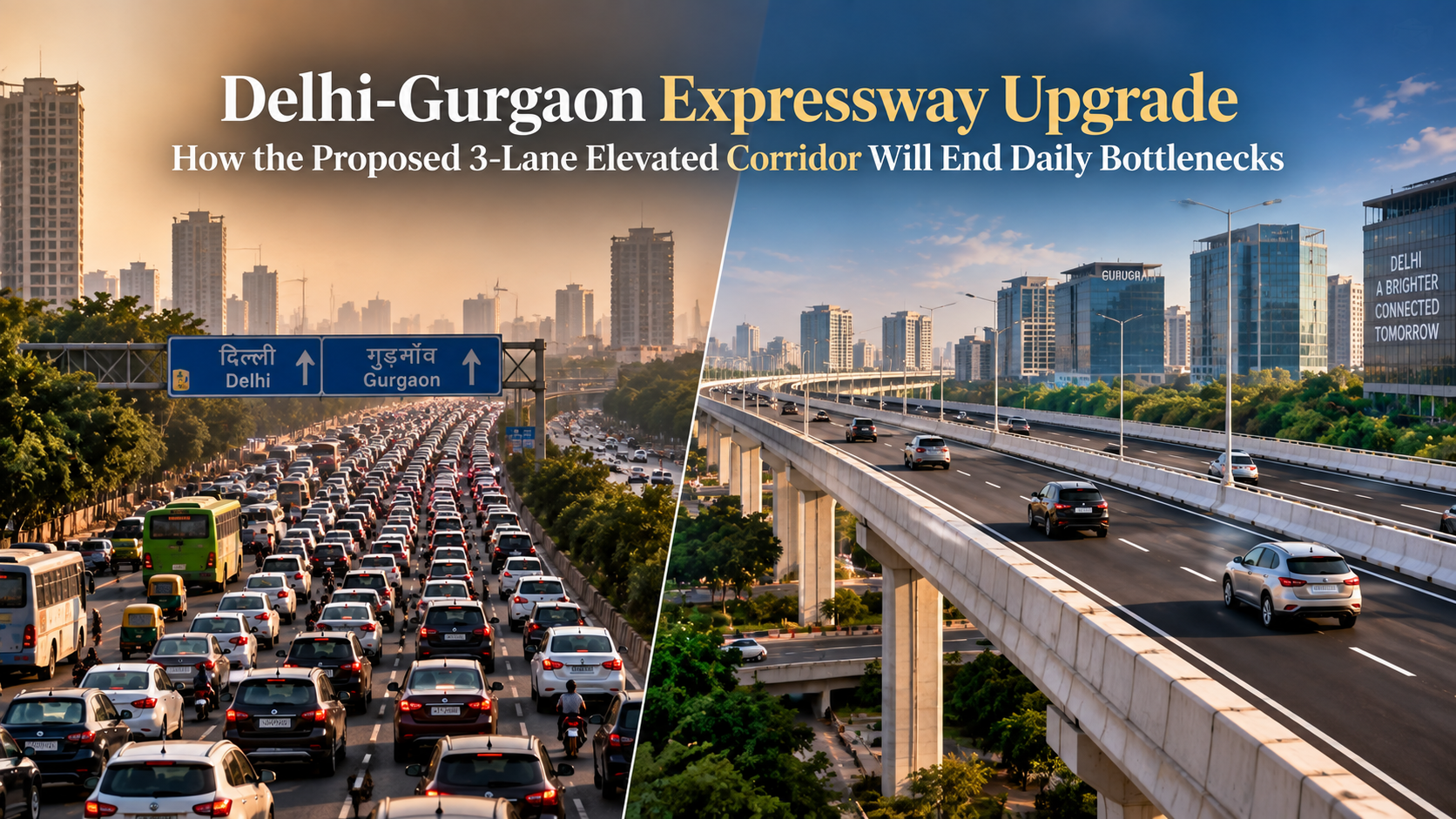
Every morning, thousands of commuters brace themselves for a familiar ordeal. The drive between the national capital and the millennium city is an integral part of life in the National Capital Region, but the stretch near the Delhi-Gurugram border has historically tested the patience of even the most seasoned drivers. The creeping pace of vehicles, endless tailbacks, and the frustration of idling engines have defined the commute for years. However, a major infrastructural intervention is currently on the drawing board, promising to untangle this daily chaos. The National Highways Authority of India is actively evaluating a proposal to construct a brand new 3-lane elevated corridor on the Delhi-Gurgaon Expressway.
This proposed two-kilometre flyover, planned between Shiv Murti in Delhi and Ambience Mall in Gurugram, is specifically designed to alleviate the massive pressure points that bring the highway to a grinding halt. By strategically segregating incoming traffic streams and providing dedicated routes for high-volume corridors, this project aims to permanently resolve one of the most severe traffic traps in the entire region. Let us dive deep into the intricacies of this plan, the engineering approach, and how it is expected to transform the daily commute.
To appreciate the scale and necessity of the proposed elevated corridor, it is crucial to understand why the existing infrastructure routinely collapses under pressure. The section of the Delhi-Gurgaon Expressway between Mahipalpur, Shiv Murti, and the Haryana border is not just a standard highway segment; it is a massive convergence zone. Traffic from South Delhi, West Delhi, Sonipat, Noida, Greater Noida, and Ghaziabad all funnels into this specific corridor before crossing over into Gurugram.
Recently, the integration of major new road networks, particularly the Dwarka Expressway and the Urban Extension Road, has exponentially increased the vehicular load at the Shiv Murti junction. During the morning and evening peak hours, the sheer volume of vehicles is overwhelming. Traffic assessments have starkly categorised this stretch as operating at a Level of Service F. In traffic engineering terms, this means the roadway is functioning well beyond its designed capacity, resulting in forced, stop-and-go movement where the road is essentially choked.
The problem is most visible as vehicles approach the Gurugram border. A substantial portion of the traffic travelling on the main carriageway intends to exit towards the service roads to access major commercial and retail destinations, primarily Ambience Mall, Cyber City, and Udyog Vihar. However, the existing two-lane service road on the Gurugram side lacks the capacity to absorb this sudden influx. Consequently, vehicles queue up to exit, and this queue spills rapidly onto the main high-speed lanes of National Highway 48. This creates a severe knock-on effect, with congestion extending backward into Delhi, frequently reaching the Mahipalpur flyover.
Recognising that simply widening the road at ground level is no longer feasible due to space constraints, the highway authority has engineered a vertical solution. The proposal outlines a unidirectional, three-lane elevated corridor designed entirely to bypass the existing ground-level friction.
Starting from the right-turn tunnel of the newly constructed Dwarka Expressway interchange near Rangpuri and Shiv Murti, the elevated road will stretch for approximately two kilometres. Built on a single-pier configuration, the structure will be accommodated within the existing drain section of the highway, sitting snugly between the main carriageway and the service road on the left side as one travels from Delhi towards Jaipur.
The genius of this design lies in its focus on traffic segregation. Currently, vehicles exiting the Dwarka Expressway underpass are forced to merge directly into the already saturated lanes of the Delhi-Gurgaon Expressway. This merging of two massive, high-speed traffic streams is the primary catalyst for the daily gridlock. The new plan completely eliminates this conflict.
Under the new proposal, vehicles emerging from the Dwarka Expressway tunnel will be mandatorily routed onto the new elevated corridor. They will travel above the existing highway, bypassing the chaotic convergence zones at the border. Meanwhile, the regular traffic originating from Delhi that is already travelling on the standard four-lane main carriageway of NH-48 will continue its journey at the surface level. This traffic will not have access to the new elevated road. By keeping these two heavy streams completely separated over the critical two-kilometre bottleneck, the pressure on the ground-level highway will drop dramatically.
An elevated highway is only as effective as its exit strategy. If vehicles cannot seamlessly descend to their destinations, the congestion is merely shifted from one point to another. The blueprint for this 3-lane elevated corridor meticulously maps out the exit points to ensure fluid movement into Gurugram’s interior road network.
As the elevated corridor runs parallel to the existing Rajokri flyover and crosses the Haryana border, a strategically placed down ramp is proposed. This ramp will allow vehicles to exit the elevated structure and gracefully merge onto the approach of the Gurugram-bound service road. From here, commuters will have direct, unimpeded access to prominent destinations like Ambience Mall, the corporate hubs of Cyber City, and the industrial sectors of Udyog Vihar.
For those whose destinations lie deeper within Gurugram or further towards Manesar and Jaipur, the elevated corridor will continue past the mall area. It will eventually terminate and merge safely back into the main carriageway of the Delhi-Gurgaon Expressway, well beyond the traditional congestion zones.
This smart routing also offers a secondary benefit. Because a massive chunk of the Dwarka Expressway traffic is physically removed from the ground level, the vehicles that are already travelling on the surface lanes of NH-48 will find it much easier to manoeuvre. Commuters trying to access the service road opposite the mall from the main highway will face significantly less resistance and shorter queues.
While the NHAI’s proposed elevated corridor is a monumental step forward, completely decongesting the border requires a multi-pronged approach. The elevated road expertly handles the traffic arriving from Delhi, but the dispersal of that traffic within Gurugram needs equally robust infrastructure.
Recognising this, there is an understanding that the bottleneck near the mall cannot be solved by the highway authority alone. To complement the elevated corridor, a separate infrastructural upgrade is being actively considered by the Haryana state government. A private developer has proposed the construction of an additional flyover along the city-bound service road, stretching from Ambience Mall straight into Cyber City.
When you combine the NHAI’s 3-lane elevated corridor with this proposed inner-city flyover, a seamless, continuous transit system emerges. Traffic from the Dwarka Expressway gets a dedicated, elevated bypass; vehicles bound for the commercial districts exit smoothly via the new ramps; and the local service road itself receives a massive capacity upgrade to handle the final mile of the journey. This holistic approach ensures that the traffic flows continuously from the border deep into the heart of Gurugram’s business districts without confronting a single traffic light or choke point.
The implications of this infrastructural overhaul extend far beyond just saving a few minutes on the morning commute. In the National Capital Region, improved road connectivity is a proven catalyst for real estate appreciation and broader economic growth.
For the daily commuter, the benefits are immediate and tangible. Less time spent idling in traffic translates directly to lower fuel consumption, reduced wear and tear on vehicles, and a smaller carbon footprint. The sheer reduction in daily stress for thousands of professionals travelling between the two cities cannot be quantified, but its impact on productivity and quality of life is profound.
From a real estate perspective, the Delhi-Gurgaon Expressway corridor has always been a premium micro-market. However, the chronic traffic issues have often acted as a deterrent for prospective homebuyers and commercial tenants. By definitively solving the border bottleneck, the appeal of properties along this stretch will skyrocket.
Residential developments near the Dwarka Expressway and the Delhi border will become incredibly attractive as the friction of commuting into Gurugram vanishes. Similarly, the commercial real estate in Cyber City and Udyog Vihar will solidify its position as the premier corporate destination in northern India. When businesses know their employees and clients can travel from the capital to their offices smoothly and predictably, the demand for premium office space in these sectors naturally intensifies. The new corridor is not just a traffic solution; it is an economic multiplier.
For the millions of frustrated drivers who endure the daily crawl, the most pressing question is regarding the timeline. Currently, the detailed project proposal for the 3-lane elevated corridor is under active and rigorous evaluation by the highway authorities. Given the critical nature of this junction and the overarching focus on eliminating national highway bottlenecks, the project is expected to be fast-tracked through the approval phases.
Once formal clearance is granted and the construction tenders are awarded, execution on the ground will begin. Typically, an elevated road project of this specific length and complexity, utilising single-pier configurations to minimise land acquisition delays, takes anywhere from eighteen to twenty-four months to complete. While the construction phase itself will undoubtedly require careful traffic management to prevent further chaos, the long-term payoff makes the temporary inconvenience entirely worthwhile.
The proposed 3-lane elevated corridor on the Delhi-Gurgaon Expressway represents a paradigm shift in urban traffic management. For too long, the approach to highway congestion was merely to add more lanes at the surface, a strategy that quickly met its physical limits at the Delhi-Gurugram border. By thinking vertically and focusing on intelligent traffic segregation, the authorities are addressing the root cause of the congestion rather than just its symptoms.
When realised, this project will permanently alter the daily rhythm of the National Capital Region. The harrowing tales of being stuck at Shiv Murti or crawling past the border will become a thing of the past. Drivers will experience a smooth, uninterrupted transition between the two cities, powered by smart engineering and a forward-looking vision for infrastructure. As the region continues to expand economically and demographically, clean, efficient, and high-capacity transit routes like this new elevated corridor will form the very backbone of its future success. The end of the daily traffic nightmare is finally visible on the horizon, promising a faster, cleaner, and vastly more efficient commute for everyone.
