Published On:
April 12, 2026
Updated On:
April 12, 2026
The Delhi government’s newly released Draft EV Policy 2026–2030 offers massive incentives, including a 100% road tax waiver for electric cars under Rs 30 lakh, up to Rs 1 lakh in scrappage benefits, and a phased ban on new petrol two-wheelers and three-wheelers. With a robust budget of nearly Rs 3,954 crore, the framework aims to rapidly accelerate the transition to clean mobility and drastically cut vehicular pollution in the national capital.
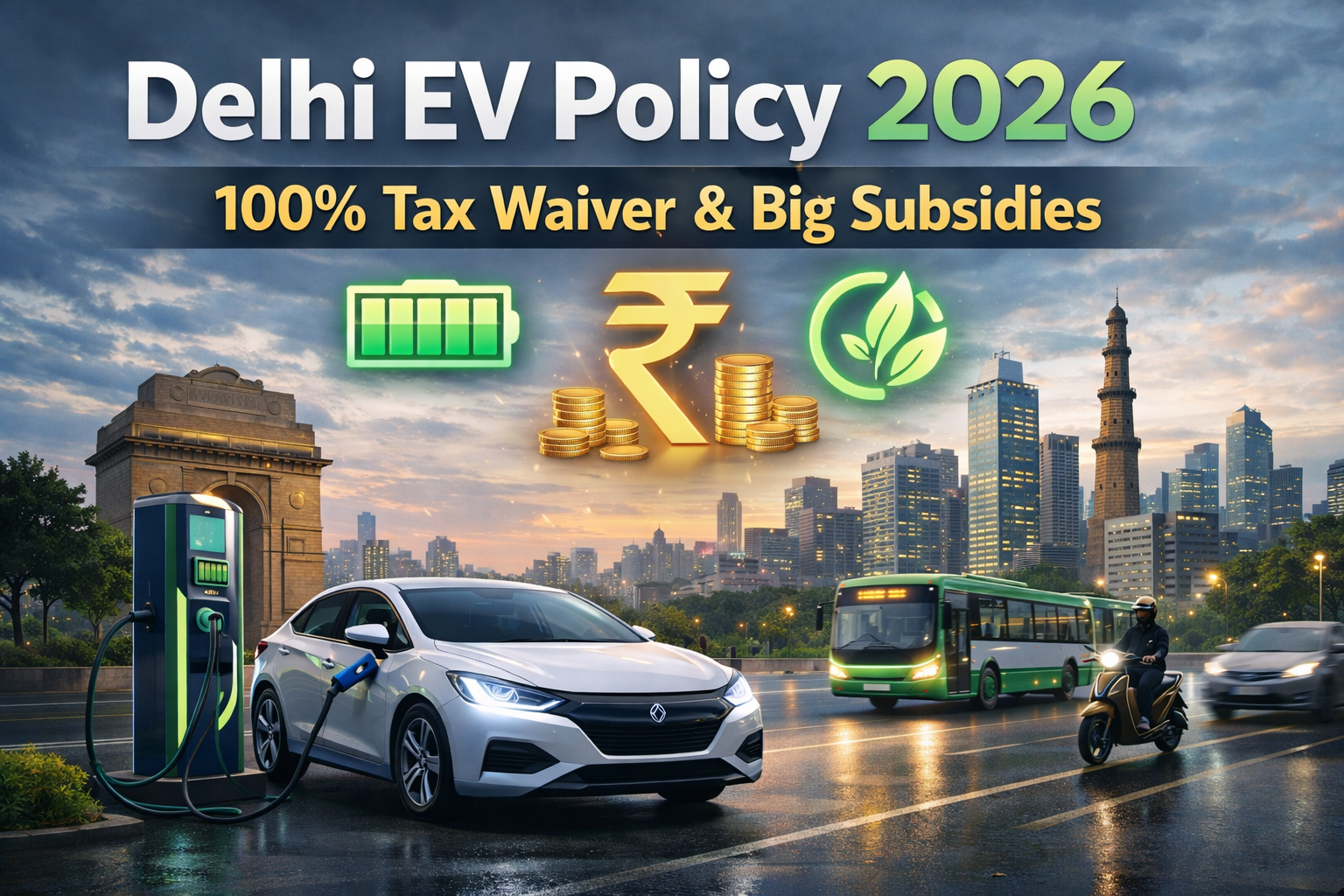
The national capital has long battled severe air quality issues, with vehicular emissions accounting for nearly a quarter of the city's daily pollution load. In a decisive move to tackle this persistent environmental challenge, the Delhi government has introduced the highly anticipated Draft Electric Vehicle Policy 2026–2030. Building on the foundational work of the previous 2020 framework, this newly unveiled blueprint is not just a gentle nudge toward green mobility; it is an aggressive, well-funded roadmap designed to fundamentally alter how residents commute, transport goods, and purchase vehicles.
With an overarching goal to rapidly phase out conventional internal combustion engine vehicles, the updated policy introduces a sprawling ecosystem of financial incentives, strict registration timelines, and massive infrastructure upgrades. From a complete road tax waiver for electric cars to heavily subsidising two-wheelers and commercial trucks, the administration is deploying a multi-pronged approach to make electric mobility the default choice for every household and business in the city. The policy combines a demand-side financial push with a supply-side infrastructural overhaul, backed by a massive budget outlay of over Rs 3,954 crore.
Whether you are a daily commuter looking to upgrade your scooter, a family planning to buy a new car, or a commercial fleet operator, the new regulations are set to impact your next vehicle purchase. Here is a comprehensive breakdown of everything proposed in the groundbreaking Delhi EV Policy 2026.
One of the most talked-about highlights of the new draft policy is the aggressive financial relief offered to private electric car buyers. To bridge the initial price gap between conventional petrol cars and their electric counterparts, the government has proposed a 100% exemption on road tax and registration fees for electric cars. This benefit will remain active until the end of the policy period on March 31, 2030, providing a long window for consumers to make the switch.
However, the administration is clear about its focus on mass adoption rather than subsidising luxury purchases. The full tax exemption is strictly capped for electric cars priced up to Rs 30 lakh ex-showroom. Any electric vehicle priced above this threshold will not be granted any waiver on road tax or registration fees. This strategic cap ensures that state funds are directed toward making affordable, everyday electric cars more accessible to middle-class families.
Interestingly, the policy also extends an olive branch to the strong hybrid vehicle segment. Recognising that the transition to pure electric might take time for some consumers due to range anxiety or infrastructure concerns, the draft proposes a 50% road tax exemption for strong hybrid vehicles priced under Rs 30 lakh. This inclusion is a significant shift, acknowledging the role of transitional technologies in reducing immediate tailpipe emissions while the city continues to build out its charging grid.
Two-wheelers form the backbone of Delhi’s transport network, making up over two-thirds of the city's total vehicle fleet. Because of their sheer volume, they are also a major contributor to daily urban emissions. The Draft EV Policy 2026 takes a firm stance on the future of two-wheelers, introducing both a generous subsidy structure and a strict phase-out timeline for conventional models.
The most sweeping regulatory measure in the draft is the proposal to completely ban the registration of new petrol two-wheelers starting April 1, 2028. By setting this hard deadline, the government is signalling to both consumers and manufacturers that the era of petrol scooters in the capital is rapidly drawing to a close.
To soften the blow and encourage immediate adoption, the policy outlines a highly attractive, descending subsidy model for electric two-wheelers priced up to Rs 2.25 lakh ex-factory. Buyers who switch early will reap the highest rewards. In the first year from the policy’s notification, purchasers will receive an incentive of Rs 10,000 per kWh of battery capacity, capped at a generous Rs 30,000. To create a sense of urgency, this benefit drops in the second year to Rs 6,600 per kWh with a maximum cap of Rs 20,000. By the third year, the subsidy further reduces to Rs 3,300 per kWh, capped at Rs 10,000. This sliding scale is designed to accelerate adoption right out of the gate, rewarding those who do not delay their transition to electric mobility.
Commercial vehicles, including auto-rickshaws, delivery vans, and light trucks, clock significantly higher daily mileage than private vehicles. Consequently, their contribution to the city's smog is disproportionately high. The administration has zeroed in on this segment with targeted financial support and rigid electrification mandates.
For three-wheelers, which are the lifeblood of last-mile connectivity in Delhi, the transition will happen even sooner than for two-wheelers. The draft mandates that from January 1, 2027, only electric three-wheelers will be allowed for new registrations. To support auto-rickshaw drivers in making this mandatory shift, the government is offering a flat incentive of Rs 50,000 in the first year. Similar to the two-wheeler scheme, this drops to Rs 40,000 in the second year and Rs 30,000 in the third year. These benefits apply whether an individual is registering a new auto or replacing an older CNG model operating with a Delhi permit.
The policy also targets the logistics and delivery sectors. Delivery service providers and ride-hailing fleet aggregators are strictly prohibited from inducting new petrol or diesel two-wheelers and light goods vehicles into their fleets. While there is a brief grace period allowing the induction of BS-VI emission standard two-wheelers until December 31, 2026, the sector must shift entirely to electric thereafter.
For the movement of heavier goods, electric four-wheeler e-trucks in the N1 category (light commercial motor vehicles up to 3.5 tonnes) are eligible for massive incentives. Businesses procuring these clean trucks will receive up to Rs 1 lakh in the first year, followed by Rs 75,000 in the second year and Rs 50,000 in the third year, easing the capital expenditure required to green the logistics supply chain.
Selling new electric vehicles is only half the battle; the other half is removing highly polluting, aging internal combustion engine vehicles from the city's congested roads. To address this, the EV policy allocates a staggering Rs 1,718 crore specifically for scrappage incentives, making it the single largest budget head within the entire framework.
Under this scheme, residents who scrap an old, highly polluting vehicle and replace it with a new electric one stand to gain substantial financial rewards. If a consumer scraps a Delhi-registered BS-IV or older car and purchases a new electric car priced under Rs 30 lakh within six months of receiving their Certificate of Deposit from an authorised facility, they will receive a flat Rs 1 lakh scrappage incentive. This is entirely separate from the road tax waiver, effectively making the switch to an EV financially irresistible for families holding onto older petrol or diesel cars. This benefit is capped at the first 1,00,000 claimants, again driving early adoption.
The scrappage benefits extend across all vehicle categories. Those trading in old two-wheelers will receive a Rs 10,000 bonus toward a new electric scooter or bike. Three-wheeler owners will get Rs 25,000 for scrapping their old autos, and buyers of N1 commercial trucks can claim a Rs 50,000 scrapping incentive when replacing older, polluting goods carriers.
The government is not just placing the burden of transition on private citizens and businesses; it is leading by example through the electrification of public and institutional transport.
According to the new guidelines, all hired or leased vehicles operating under the Delhi government must transition entirely to electric models immediately from the date the policy is notified. Any new vehicles procured by government departments or civic agencies will exclusively be electric. The public bus network is also set for a massive overhaul. All new buses inducted by the Transport Department and the Delhi Transport Corporation will run on electric power, with the policy remaining open to integrating cleaner future alternatives like hydrogen fuel cells if they become viable. Earlier this year, the administration already demonstrated its commitment to this goal by flagging off 300 new electric buses and initiating interstate electric bus services.
The education sector must also adapt. The draft proposes a phased electrification schedule for school bus fleets, regardless of whether the buses are owned, leased, or hired by the institutions. Schools are required to convert 10% of their fleets to electric within two years, 20% within three years, and reach a minimum of 30% fleet electrification by the end of the policy period in March 2030.
A frequent deterrent for potential EV buyers is range anxiety—the fear of running out of battery without a charging station nearby. To completely eliminate this hurdle, the Delhi government has earmarked Rs 1,000 crore specifically for the development of charging infrastructure.
The goal is to quadruple the current network, scaling up from roughly 9,000 charging points to an impressive 36,000 stations by 2030. To achieve this, land-owning agencies across the capital have been tasked with identifying optimal sites for public charging and battery swapping stations. Furthermore, urban planning regulations are being updated; all new commercial buildings, residential complexes, and public infrastructure projects must be designed to be "EV charging-ready" from day one. The Delhi Transco Limited will serve as the nodal agency responsible for the strategic planning, widespread deployment, and reliability of this expansive grid.
Beyond charging, the policy introduces strict environmental safeguards regarding battery lifecycle management. For the first time, a dedicated framework addresses the ecological impact of depleted EV batteries. Vehicle manufacturers and obligated entities are mandated to ensure strict compliance with Battery Waste Management Rules and Extended Producer Responsibility guidelines. The government plans to partner with private players to establish a vast network of battery collection and recycling centres across the city, ensuring that the shift to green transport does not create a new hazardous waste crisis down the line.
To ensure that the rollout of these sweeping reforms is smooth and corruption-free, the entire implementation system will be digital. All applications for subsidies, processing of approvals, fund disbursements, and grievance redressals will take place on a paperless platform. Subsidies will be routed directly to the bank accounts of eligible Delhi residents and local businesses through a Direct Benefit Transfer system, eliminating middlemen and bureaucratic delays.
Financing this ambitious vision requires a solid economic foundation. The government has created a dedicated EV Fund, which will pool resources from budgetary allocations, environmental cesses, grants, and other central and state schemes. The total policy outlay of Rs 3,954.25 crore has been meticulously distributed across the next four years, ensuring sustained financial backing until 2030.
A high-level apex committee, led by the state transport ministry, will oversee the implementation of the policy and the management of the EV Fund. Different departments have been assigned clear responsibilities: the Transport Department will act as the primary nodal agency, the Environment Department will monitor actual emission reductions, urban bodies will facilitate infrastructure rollout, and the Education Department will run awareness campaigns to educate the youth about clean mobility.
The Draft EV Policy 2026 is a monumental step forward in Delhi’s ongoing battle for clean air. By systematically phasing out internal combustion engines, providing heavy financial incentives to early adopters, aggressively targeting the highest-polluting vehicle segments, and building a robust charging and recycling ecosystem, the government is setting a gold standard for urban mobility in India.
The administration has made it clear that past hurdles, such as a lack of direct financial subsidies, are a thing of the past. The robust structure of the current draft reflects a deep understanding of market dynamics, balancing consumer affordability with environmental necessity. Currently, the draft policy is open for public consultation, with stakeholders and residents invited to share their feedback before the rules are officially notified and set into motion. As the national capital gears up for this massive transition, the message is clear: the future of Delhi's roads is definitively electric.
