Published On:
February 24, 2026
Updated On:
February 24, 2026
After an 11-year freeze, the Delhi government's 2026 circle rate revision proposes major hikes across Categories A to H and introduces a new ultra-premium A+ category, fundamentally altering stamp duty costs and real estate transparency in the capital.
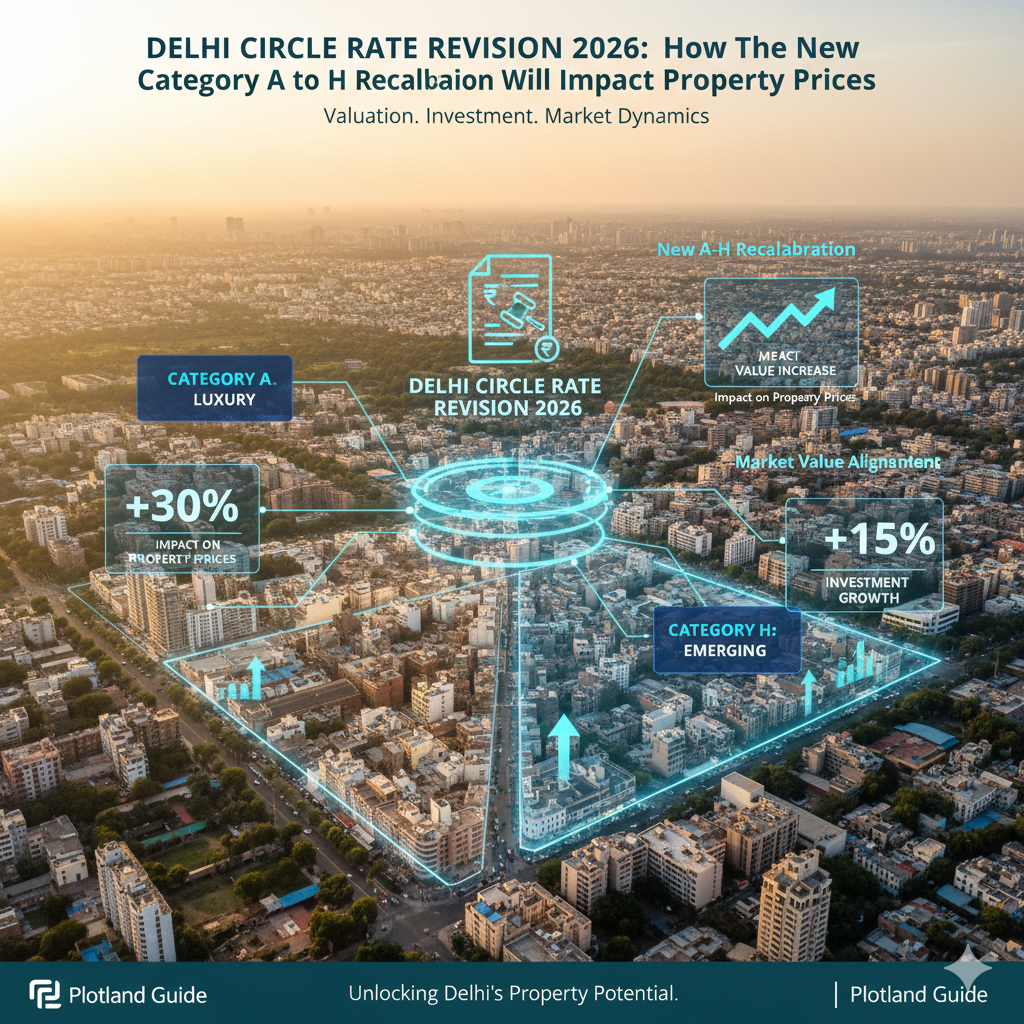
The real estate landscape of the National Capital is bracing for a monumental regulatory shift. For the first time in over a decade, the Delhi government is executing a comprehensive, structured revision of the city’s circle rates. Spanning across the entire real estate spectrum—from the ultra-luxurious avenues of Category A to the densely populated, lower-income neighborhoods of Category H—this recalibration promises to fundamentally alter the financial mechanics of buying and selling property in the city.
Led by Chief Minister Rekha Gupta and driven by a dedicated review committee constituted in June, the Delhi Circle Rate Revision 2026 is designed to bridge the massive, widening gap between government-notified property values and actual on-ground market realities. As the city has evolved structurally and economically since the last revision in 2014, the outdated valuation metrics have created severe market distortions. With the final proposal currently undergoing public review before heading to the Cabinet, homebuyers, sellers, and real estate investors must rapidly understand how these incoming changes will impact their financial planning, upfront transaction costs, and long-term property investments.
To fully grasp the magnitude of the upcoming 2026 revision, it is essential to understand the foundational mechanics of how property transactions are legally recorded in India. The circle rate, often referred to as the guidance value or ready reckoner rate in other states, is the absolute minimum property value mandated by the state government for a specific locality.
This officially notified rate serves as the baseline for calculating mandatory government levies, primarily stamp duty and property registration charges. The golden rule of real estate registration is that no property can be officially registered at a value lower than the area's designated circle rate, regardless of the actual agreement between the buyer and the seller. If a buyer manages to negotiate a distress sale and purchases a property at a price significantly below the circle rate, the stamp duty must still be paid based on the higher government-notified circle rate. Conversely, if the actual market transaction value is higher than the circle rate, the stamp duty is calculated on the higher market price.
Because the circle rates in Delhi have remained entirely frozen since 2014, they have lost their relevance. Over the last 11 years, the capital has witnessed massive infrastructure upgrades, the expansion of the Delhi Metro, and a surge in premium builder-floor redevelopments. Consequently, property prices in Delhi have skyrocketed, leaving the stagnant circle rates far behind in the rearview mirror.
The decision to aggressively revise the circle rates in 2026 is rooted in deep economic and administrative necessities. According to internal government reports and market analyses, the current notified rates have become dangerously outdated, creating a highly skewed real estate ecosystem.
In many of Delhi's prime residential and commercial areas, actual market prices are currently trading anywhere from 30 percent to 60 percent higher than the official circle rates. This massive valuation gap has inadvertently incentivized the flow of unaccounted cash in property deals. When the official registration value is artificially capped by an outdated circle rate, buyers and sellers often settle the remaining balance through undocumented cash transactions. This practice not only fuels the parallel economy but also results in massive revenue leakages for the state exchequer, as stamp duty is only collected on the artificially low paper valuation.
The 2026 revision aims to aggressively tackle these structural distortions. By increasing the circle rates to accurately reflect prevailing market dynamics, the government intends to drastically reduce the cash component in real estate transactions. This recalibration is designed to usher in a new era of absolute transparency, ensuring cleaner documentation, higher official valuations, and a robust increase in government revenue without inadvertently destabilizing the broader housing market.
One of the most highly anticipated and talked-about structural changes in the 2026 proposal is the potential introduction of an entirely new classification: the A+ Category.
Historically, Delhi’s real estate has been divided into eight alphabetical zones, with Category A representing the absolute pinnacle of luxury living. However, the real estate market at the very top end has splintered into extreme micro-markets. Ultra-premium neighborhoods such as Prithviraj Road, Jor Bagh, and Sundar Nagar are operating in a financial stratosphere of their own. Market transactions in these elite, heritage-rich zones are currently being executed at a staggering Rs 18 lakh to Rs 22 lakh per square meter.
Lumping these ultra-exclusive enclaves into the standard Category A no longer makes economic sense. Introducing an A+ category would allow the government to accurately index the immense wealth changing hands in Lutyens' Delhi and its immediate surroundings. If implemented by the Cabinet, this will mark a historic structural shift in how top-tier property rates are classified, ensuring that the city's most expensive real estate is taxed proportionately.
The proposed recalibration is not a blanket percentage increase across the board. The review committee has taken a highly localized, micro-market approach to adjust the rates based on actual ground realities, infrastructure developments, and civic conditions.
While a modest upward revision is expected for the standard Category A segment, this tier has witnessed a surprising pushback from current residents. In a fascinating turn of events, residents of several historically premium colonies are actively petitioning the government for a downgrade to Category B.
For instance, the residents of New Friends Colony have submitted nearly 70 official suggestions, alongside a massive petition signed by over 120 homeowners, demanding a downward reclassification. The core argument is that the actual on-ground property transactions in their neighborhood are occurring at 35 percent to 40 percent below the currently inflated circle rates. Residents point to severe civic congestion, decaying local infrastructure, and the immediate proximity to highly congested, lower-category areas like Taimoor Nagar and Zakir Nagar as primary reasons for their neighborhood's depreciating market value. Similar downgrade petitions have also been filed by residents of Kalindi Colony and Sukhdev Vihar, highlighting that historical prestige does not always align with current market valuations.
The upper-middle premium segment, classified under Category B, is slated for one of the most aggressive financial hikes in the entire 2026 revision. The government has proposed a minimum 32 percent increase in circle rates for this zone, pushing the baseline valuation from ₹2,45,520 per square meter up to a commanding ₹3,25,000 per square meter.
This category includes highly coveted, upscale neighborhoods such as Defence Colony, Greater Kailash I and II, Gulmohar Park, Niti Bagh, and Panchsheel Park. The justification for this steep hike lies in the massive architectural transformation these areas have undergone. Over the last decade, these neighborhoods have seen an explosive trend of builder-floor redevelopments, where older single-family bungalows are converted into multi-story luxury apartments. Coupled with enhanced Metro connectivity and relentless buyer demand, areas like Hauz Khas, Green Park, Punjabi Bagh, and Safdarjung Enclave have witnessed a 30 percent to 50 percent market appreciation well above the old circle rates. Interestingly, while Category A residents are seeking downgrades, some resident welfare associations in these booming Category B areas are actually demanding an upgrade to Category A, arguing that their modernized infrastructure and premium market rates surpass older, decaying Category A colonies.
Category C neighborhoods, which serve as the backbone for affluent professionals and business families, are also facing substantial upward revisions. Prominent areas within this tier include Janakpuri, Civil Lines, Vasant Kunj, Netaji Subhash Place, C R Park, and Malviya Nagar. Under the new draft proposal, the circle rates in these localities are expected to rise to a minimum of Rs 2.2 lakh per square meter. Government officials justify this hike by pointing out that actual, registered market transactions in these hubs are consistently clearing at 40 percent to 60 percent higher than the stagnant existing circle rates.
The mid-income housing markets, encompassing Categories D and E, are slated for what officials describe as an aggressive recalibration. While the exact, finalized percentage figures for these specific zones are currently awaiting official notification, industry insiders suggest that the hikes here will be steep. These areas have experienced massive population influxes and significant commercialization over the last 11 years, completely altering their baseline property valuations.
Even the most affordable real estate tiers in the capital are not exempt from the 2026 revision. Categories F, G, and H cover densely populated, lower-income areas such as Keshav Puram, Krishna Nagar, Laxmi Nagar, Bhalswa Dairy, Narela, and Burari. The proposed increase across these segments varies widely, ranging from an 8 percent bump to a more substantial 29 percent hike.
However, the government is adopting a highly nuanced approach in these zones. In certain specific, economically distressed localities where the current circle rates absurdly exceed the actual market value of the properties, the committee is actively considering downward revisions to provide relief to homeowners and stimulate stagnant local property markets.
The immediate consequence of the Delhi circle rate revision 2026 will be felt directly in the wallets of prospective homebuyers. Because stamp duty and registration fees are calculated as a percentage of the property's official valuation, a higher circle rate automatically translates into significantly higher upfront transaction costs. Buyers will need to allocate a much larger portion of their budget simply to cover the government taxes required to execute the sale deed. Furthermore, the aggressive alignment of circle rates with market prices drastically reduces the scope for property undervaluation, forcing buyers to secure larger home loans rather than relying on unrecorded cash reserves.
Despite the increased financial burden, the long-term benefits for buyers are substantial. Purchasing property under accurately indexed circle rates ensures completely clean legal documentation. It builds a highly transparent, fully recorded asset history that dramatically improves the property's future resale credibility and makes it significantly easier to secure institutional financing or mortgages down the line.
For sellers, the revised rates offer a mixed bag of consequences. On the positive side, a higher declared official value means that a much larger percentage of their sale proceeds will be received in official, bank-routed "white" money. This legitimate capital can be seamlessly reinvested into other assets, mutual funds, or commercial ventures without the fear of tax scrutiny. It essentially forces a cleaner, more transparent dealing environment. On the flip side, sellers holding properties in areas like New Friends Colony—where the market is currently refusing to meet the inflated circle rates—may face severe liquidity concerns. If buyers are unwilling to pay the high stamp duty associated with an artificially high circle rate, properties in those specific pockets may linger on the market for extended periods.
Furthermore, the revision heavily impacts Capital Gains reporting. Sellers will now have their capital gains calculated against a much higher baseline, which will require meticulous tax planning and a deep understanding of reinvestment exemptions to avoid massive tax liabilities.
From the perspective of the state exchequer, the 2026 revision is a massive financial victory. By correcting the structural distortion of artificially low paper valuations, the Delhi government stands to collect hundreds of crores in additional stamp duty revenue. Even a moderate 20 percent to 30 percent hike across mid-tier categories will significantly bolster the funds available for the city's future civic and infrastructural development.
Whenever a massive regulatory or taxation shift occurs, real estate markets tend to experience a period of extreme volatility followed by a temporary freeze. As the reality of the 2026 circle rate hikes sets in, we can fully expect a temporary slowdown in property transaction volumes across Delhi. Buyers will inevitably hit the pause button to aggressively reassess their budgets, recalculate their loan eligibility, and factor in the newly inflated stamp duty costs.
Simultaneously, we are likely to witness a frantic, short-term rush to the registrar's office. Buyers and sellers who are currently in the middle of negotiations or have recently signed agreements to sell will scramble to officially register their properties under the older, cheaper rates before the final government notification is officially gazetted and enforced.
However, once the initial shock wears off and the market fully absorbs the new pricing structure, the long-term outlook is overwhelmingly positive. By drastically reducing the gap between official paper rates and actual market realities, the Delhi government is actively institutionalizing the real estate sector. This newfound transparency will serve as a massive magnet for institutional investors, large-scale corporate developers, and foreign direct investment, all of whom typically shun markets plagued by rampant cash transactions. Ultimately, the 2026 revision will forge a healthier, highly regulated, and deeply credible real estate dynamic in the National Capital.
If you are actively scouting the market and planning to purchase a home in Delhi in the near future, the upcoming circle rate revision demands immediate tactical adjustments to your strategy.
First and foremost, you must diligently check the existing circle rates of your target locality and compare them against the proposed 2026 hikes. Ignorance of these incoming changes could completely derail your financial planning. You must actively monitor government notifications and news updates to perfectly time your deal closure before the new rates are officially implemented.
Secondly, strictly avoid any informal undervaluation practices or off-the-books cash agreements suggested by brokers or sellers. The tax department's scrutiny will be at an all-time high during this transition period, and participating in tax evasion can lead to severe legal and financial penalties.
Finally, do not navigate this transition alone. Before finalizing any property registration, consult with experienced legal counsel and financial advisors. Buyers looking at properties in Category B or other zones facing steep 30 percent hikes must plan their transactions highly strategically, ensuring that their home loan sanctions comfortably cover the aggressively inflated stamp duty requirements. The era of the undocumented real estate deal in Delhi is rapidly closing; strategic, fully compliant financial planning is the only way forward.
