Published On:
May 29, 2026
Updated On:
May 29, 2026
Delhi’s Indira Gandhi International Airport is embarking on a monumental infrastructure upgrade, featuring a massive expansion of Terminal 3 and the introduction of India's first driverless air train. This comprehensive master plan aims to smoothly phase out the ageing Terminal 2 by 2033, consolidating domestic flight operations into a single, high-tech hub to effortlessly manage a future capacity of 125 million annual passengers.
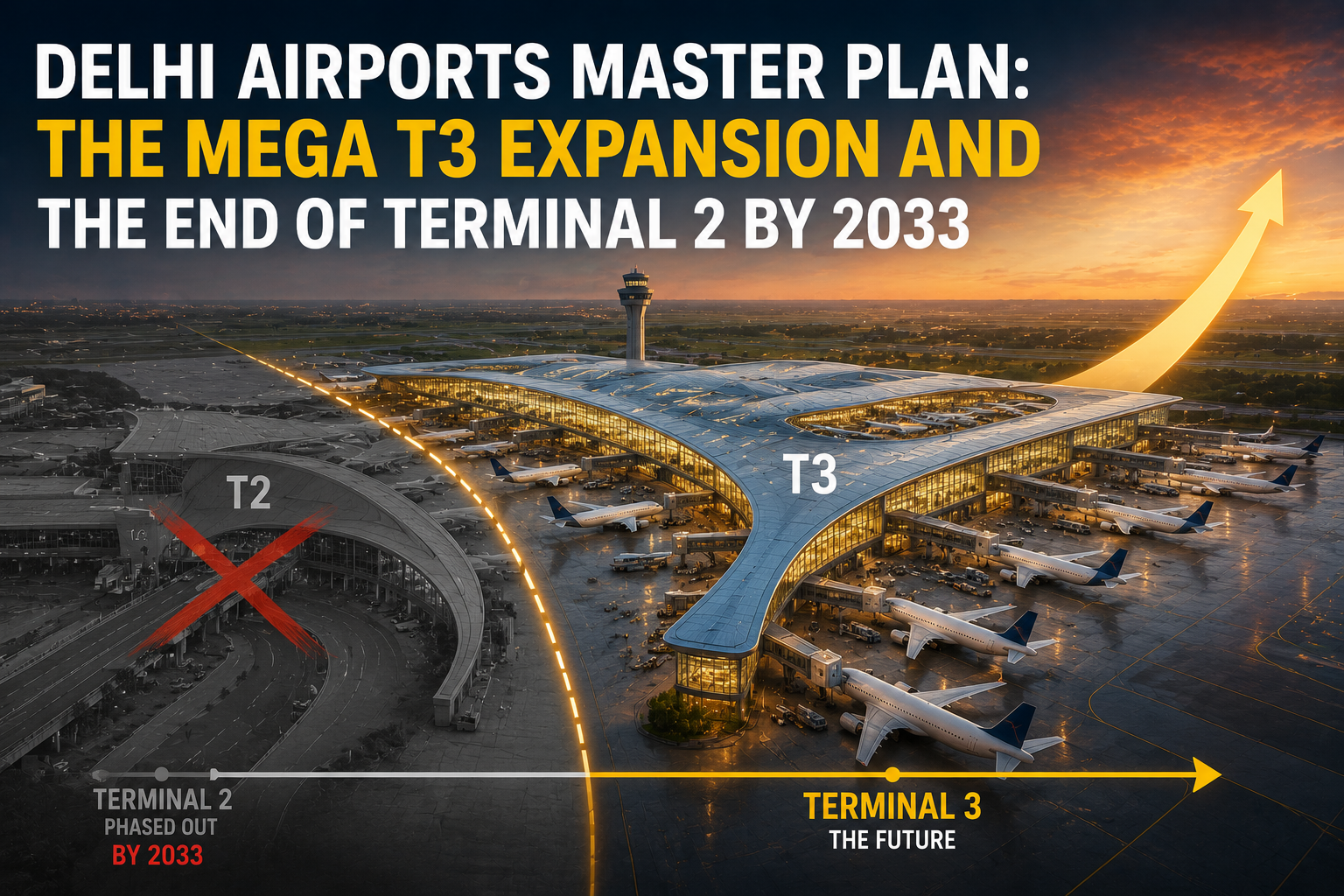
The Indira Gandhi International Airport has long served as the bustling primary gateway to the Indian subcontinent, constantly evolving to meet the skyrocketing demands of modern domestic and international air travel. For frequent flyers who regularly navigate the sprawling airport campus, the sheer volume of daily passenger traffic is a testament to India's booming aviation sector. However, the airport is now on the brink of its most ambitious structural transformation to date. The airport management has unveiled an aggressive, forward-looking master plan designed to completely redefine passenger transit, elevate operational efficiency, and massively boost terminal capacity.
At the very heart of this sweeping infrastructural overhaul is a significant expansion of Terminal 3, the carefully plotted closure of the decades-old Terminal 2 by the year 2033, and the highly anticipated launch of India's first fully automated, driverless air train. These interconnected megaprojects are meticulously designed to elevate the national capital's airport into a flawless, world-class transit hub. By streamlining domestic operations and entirely eradicating the friction of inter-terminal travel, the airport operator aims to deliver an unparalleled passenger experience while future-proofing the facility for decades to come.
Built back in 1986, Terminal 2 holds a deeply significant place in the historical timeline of Indian civil aviation. For nearly four decades, it has served as a crucial operational shock absorber during periods of explosive traffic growth. Over the years, it has continuously stepped in to handle heavy overflow traffic, keeping the airport functional while newer, more advanced terminals were under construction. However, the ageing infrastructure is finally reaching its physical and architectural limits. Despite several recent refurbishments and maintenance upgrades aimed at extending its operational lifespan, the long-term vision for the airport simply cannot rely on a facility that was fundamentally designed for a bygone era of air travel.
Airport management authorities have made it explicitly clear that Terminal 2 will not be shuttered overnight. It will remain highly functional for the foreseeable future, likely serving millions of passengers for a maximum of six to seven more years. The facility must stay open in the short term to seamlessly handle the current, unprecedented surge in domestic travellers. However, once the calendar hits 2033, the terminal will be completely decommissioned, phased out, and abandoned.
The future use of the prime real estate currently occupied by Terminal 2 remains a topic of strategic evaluation. Its ultimate fate will be decided in the coming years, largely depending on how regional passenger traffic growth shapes up over the next decade. The core objective driving this phase-out is strict consolidation. The management is actively shifting away from fragmented, separated domestic facilities into highly integrated, supersized, and technologically advanced modern terminal spaces.
The permanent closure of an entire terminal naturally requires a massive infusion of passenger handling capacity elsewhere on the campus. That is exactly what is planned for the sprawling Terminal 3. Currently recognized as the crown jewel of the airport, the mammoth T3 is set to undergo a colossal expansion. The revised master plan heavily centres around the construction of a brand-new, state-of-the-art fifth pier, officially designated as Pier E.
This upcoming architectural addition will be a massive facility in its own right, purposefully designed with the structural capacity to independently handle an additional 12 million passengers every single year. To put the sheer scale of this expansion into perspective, the new Pier E alone will effectively match the entire current operational capacity of Terminal 2. Once this new pier is fully constructed and goes live, all the domestic flight operations that currently scramble for limited space and boarding gates at Terminal 2 will be seamlessly shifted over to the newly expanded Terminal 3.
The integration of Pier E will provide the airport with unprecedented operational flexibility. While the final designation is still being fine-tuned based on rolling traffic trends, the new pier can be dynamically assigned for either domestic or international flight operations depending on future seasonal demand. Recently, the airport boosted its international handling capability by converting Pier C from domestic to international use. With the future addition of Pier E, Terminal 3 will effectively consolidate the vast majority of full-service domestic traffic under one massive roof, drastically streamlining the baggage handling, security checks, and boarding processes.
Perhaps the most highly anticipated and passenger-friendly aspect of the airport's extensive modernisation roadmap is the introduction of an Automated People Mover, commonly referred to as the air train. Navigating between distinctly separated terminals has historically been a major friction point for connecting flyers. Currently, passengers attempting to catch a connecting flight must rely on a fleet of diesel shuttle buses that battle their way through congested airport perimeter roads. The upcoming driverless air train system is meticulously designed to completely eradicate this logistical nightmare.
The dedicated transit corridor will span a total distance of 7.7 kilometres, featuring a strategic mix of elevated tracks gliding above the traffic and ground-level routes integrated into the terminal architecture. This high-speed loop is specifically planned to seamlessly link Terminal 1, the expanded Terminal 3 ecosystem, the bustling commercial and hospitality hotspot of Aerocity, and Cargo City. For the everyday passenger, this means stepping off a flight at one terminal, boarding an ultra-modern train carriage, and arriving at a connecting departure gate in a matter of minutes, completely bypassing the unpredictability of road traffic.
Building this air train is an incredibly capital-intensive endeavour. The transit network is estimated to cost between Rs 3,000 crore and Rs 4,000 crore, funded entirely through internal reserves by the operating authority. Groundwork and construction are projected to take roughly 30 months, meaning the automated transit system could be fully live and operational between 2027 and 2029. Crucially, the service is expected to be completely free for transit passengers moving between terminals, delivering a frictionless transfer experience that confidently rivals the finest aviation mega-hubs across Europe and East Asia.
While the architectural blueprint for the Delhi Airport expansion is incredibly aggressive, the exact execution timeline remains deliberately fluid. The airport operator is not building in a vacuum; they are actively aligning the master plan with the broader fleet expansion strategies of major domestic airlines.
The global aviation industry is currently navigating through severe headwinds that deeply complicate long-term operational forecasting. Prolonged supply chain disruptions and manufacturing bottlenecks have caused massive delivery delays for new commercial aircraft ordered from aerospace giants like Airbus and Boeing. Additionally, complex geopolitical conflicts in West Asia and fluctuating global oil prices have injected a heavy degree of uncertainty into long-term travel demand projections.
Because of these external macroeconomic pressures, the airport management is taking a highly calibrated approach to infrastructure development. Rather than blindly rushing to build new facilities, they are in constant consultation with airline partners to accurately gauge exactly when the carriers will physically require the additional capacity that the new Pier E will provide. The infrastructure rollout is being carefully synchronized to match the actual induction of new aircraft fleets. This ensures that the heavy capital expenditure delivers immediate operational value, preventing the creation of massive, underutilized terminal spaces.
The overarching, ambitious goal of the revised master plan is to raise the overall passenger handling capacity of the airport from its current operational threshold to a staggering 125 million flyers annually by the 2029-30 financial year. To successfully achieve this milestone, the immediate development focus is heavily skewed toward targeted, strategic upgrades at existing facilities rather than immediately tearing down and rebuilding a successor to Terminal 2.
Expanding the physical footprint of Terminal 1 to ease the severe congestion associated with low-cost carriers, alongside heavily upgrading Terminal 3 with new aircraft parking stands and the massive Pier E, are the primary drivers of this immediate capacity boost. The airport operator strictly adheres to the standard industry principle that the next major phase of structural expansion should only be triggered when roughly 80 percent of the current operational capacity is actively being utilized.
With annual passenger footfall already climbing past the 80 million mark, the race is on to ensure the physical infrastructure stays comfortably ahead of the demand curve. To manage the current volumes while construction takes place, the airport has deployed advanced data-driven systems, including predictive operations centres. These digital hubs track hourly passenger footfall in real-time, allowing security personnel and immigration officials to deploy resources efficiently and prevent severe bottlenecks at terminal entry points.
The radical transformation of the airport into a globally integrated, hyper-connected aviation city is naturally sending powerful economic ripples through the local real estate markets. Large-scale infrastructure announcements of this magnitude consistently drive capital appreciation, and the promise of seamless internal connectivity via the new air train makes the immediate vicinity incredibly lucrative for corporate investors.
Aerocity, already recognized as a thriving commercial and premium hospitality district, is heavily poised for explosive growth. The driverless transit system promises to link the district directly to the heavy, continuous passenger flows of the main terminals. Long-term commercial investors are actively seeking opportunities to build high-end corporate complexes, luxury hotels, and retail centres, fully anticipating a major spike in daily footfall and consumer spending.
Property values in the surrounding transit corridors and adjacent residential neighbourhoods are experiencing a sustained upward trajectory. Frequent flyers, corporate professionals, and multinational firms are aggressively seeking real estate that offers frictionless access to a world-class aviation facility. The multi-billion-rupee investments pouring into the terminal expansions and the automated train network are not just upgrading an airport; they are fundamentally cementing the entire South-West Delhi region as a premier commercial and residential goldmine.
Beyond the immediate, highly visible benefits of expanded passenger capacity and high-tech convenience, the entire master plan is deeply rooted in modern environmental sustainability. The deliberate shift towards a fully automated, electric air train system will entirely replace the sprawling fleet of heavy, fuel-combusting shuttle buses currently operating on the campus.
This critical transition will drastically cut down on internal road congestion, significantly lowering the overall carbon emissions and localised noise pollution generated by the airport's daily operations. As the facility scales up to handle unprecedented, record-breaking passenger volumes, maintaining a strict eco-friendly footprint becomes an absolute necessity.
The planned upgrades to the mechanical and electrical systems within the terminals, the seamless integration of advanced smart technologies, and an unwavering commitment to modern fire safety and automated air quality controls ensure that the expanded airport will be vastly more efficient.
The massive structural overhaul currently underway at Delhi Airport marks a definitive turning point for the future of Indian aviation infrastructure. The calculated, gradual phasing out of the historic Terminal 2 by 2033 is an entirely necessary step towards a consolidated, highly functional future. By super-sizing Terminal 3 with the advanced capabilities of Pier E and linking the entire sprawling campus with a futuristic, driverless air train, the airport operator is setting a magnificent new benchmark for global transit infrastructure.
While the exact timeline of construction will naturally adapt to the unpredictable realities of global aviation supply chains, the ultimate destination remains absolutely clear. Within the next decade, travellers navigating the national capital can expect a seamless, highly integrated, and exceptionally comfortable transit experience, firmly establishing Delhi as one of the most advanced and efficient aviation mega-hubs on the global stage.
