Published On:
May 29, 2026
Updated On:
May 29, 2026
Delhi Airport is set to transform passenger mobility with India’s first driverless Automated People Mover, a massive infrastructure project linking Terminal 1, Terminal 2, Terminal 3, Aerocity, and Cargo City. Expected to be operational by 2029, this high-tech, eco-friendly transit upgrade will replace traditional diesel shuttle buses, providing seamless and free inter-terminal transfers for connecting flyers.
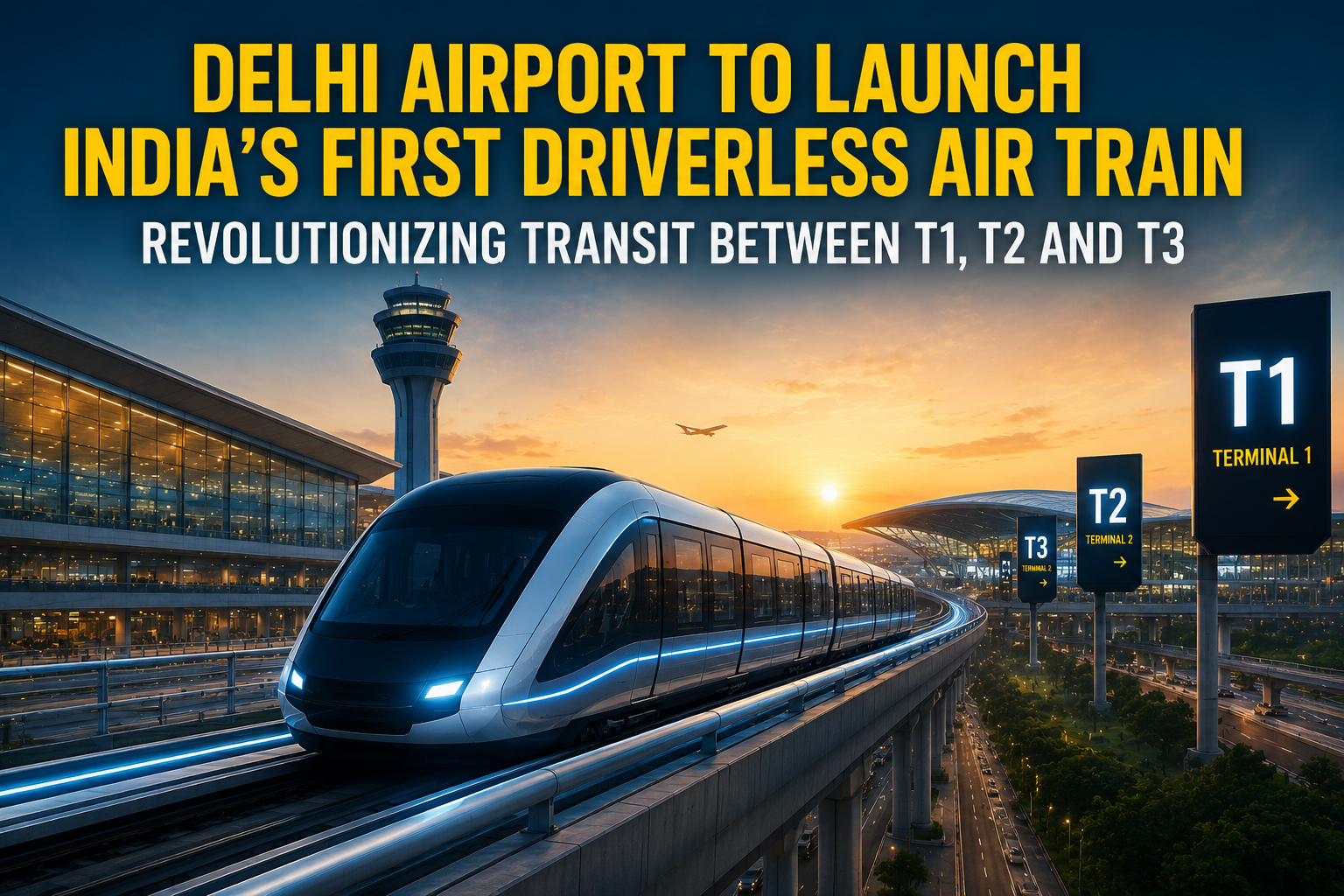
Anyone who has frequently traveled through the national capital understands that navigating the massive expanse of the Indira Gandhi International Airport can sometimes be an exhausting endeavour. For years, one of the biggest challenges for both domestic and international travelers has been moving smoothly between different terminal buildings, especially when dealing with tight connecting flights. Currently, passengers rely heavily on a fleet of shuttle buses, traditional taxis, or the metro network to get from one end of the campus to another. This reliance on road transport inevitably subjects flyers to unpredictable internal traffic bottlenecks, weather conditions, and general delays. However, the future of airport mobility in India is on the verge of a historic transformation.
Delhi Airport is officially preparing to introduce India’s first driverless air train system, officially classified as an Automated People Mover. This smart, high-tech transit loop is designed to seamlessly bridge the major terminal hubs and bustling commercial districts within the airport's massive boundary. By completely phasing out the slow and outdated shuttle bus fleet, the management aims to drastically cut down inter-terminal travel times, offering millions of passengers a truly elite, world-class transit experience. This massive transportation overhaul represents a significant construction feat for the National Capital Region and serves as a major milestone for Indian aviation infrastructure.
The sheer scale of this modernization project is nothing short of extraordinary. The management framework for the Indira Gandhi International Airport has meticulously mapped out a comprehensive dedicated transit corridor that stretches across a total distance of 7.7 kilometers. Unlike standard shuttle buses that are forced to share the road with regular airport traffic, luggage carts, and VIP convoys, the new air train will run on a dedicated rail-guided route completely separated from city vehicles.
To ensure smoother connectivity across various sections of the sprawling airport campus, the infrastructure splits into a hybrid layout. Approximately 5.7 kilometers of the automated train route will be constructed on elevated tracks, gliding gracefully above the congested roads and parking zones. The remaining 2 kilometers will operate at ground level, fully integrated into the existing terminal architecture.
Financially, this driverless airport air train is a monumental undertaking. The airport’s operating body is preparing to channel anywhere between Rs 3,000 crore and Rs 4,000 crore into this high-tech mass transit system. In a strong show of corporate commitment and financial stability, the operating authority intends to cover the entire expenditure out of its own internal reserves, recovering the costs through future airport tariffs, advertising, and commercial revenue streams without relying on external private bidders. Ground construction is projected to take about 30 months from the day they officially break ground, with the entire system slated to go live for public use between late 2027 and 2029.
The primary objective of the Delhi Airport air train project is to entirely eliminate the friction of moving across the airport ecosystem. The massive campus is currently fragmented into distinctly separate zones that serve different purposes. The automated train is strategically designed to unite these zones, serving multiple key airport stations.
The route will directly connect Terminal 1, which primarily handles a vast volume of domestic low-cost carrier flights, with Terminal 2 and Terminal 3, the massive integrated hubs for full-service domestic and international travel. Beyond just passenger terminals, the transit corridor will also feature dedicated stops at Aerocity, the thriving commercial and hospitality district, as well as Cargo City, the epicenter of the airport’s freight and logistics operations.
This level of comprehensive connectivity is a game-changer for transit passengers. Currently, a traveler landing at Terminal 1 who needs to catch an international flight from Terminal 3 has to exit the building, haul their luggage to a shuttle bus stop, wait for the bus to fill up, and endure a potentially slow ride through the airport's perimeter roads. With the new Automated People Mover, that same passenger will simply step onto an ultra-modern train platform, board a driverless carriage, and reach their departure terminal in a matter of minutes. The predictability of a rail-based system means passengers will know exactly how long their transfer will take, effectively removing the anxiety of missing connecting flights due to unforeseen road traffic.
Operating entirely without human drivers, the air train will rely on advanced automation, state-of-the-art sensors, and centralized monitoring systems to ensure absolute safety and precision. Passengers will experience a transit environment that is heavily focused on convenience and accessibility. The carriages are being designed to comfortably accommodate travelers hauling heavy luggage, with ample floor space and wide automatic doors. Furthermore, the stations and trains will feature real-time passenger information displays, enhanced accessibility for elderly travelers, and full support for individuals with mobility challenges.
In terms of sheer capacity, the Automated People Mover is being built to handle an immense volume of daily footfall. Initial projections suggest the network will comfortably manage between 40,000 to 50,000 passengers every single day during its first phase of operation. However, the system is designed with long-term scalability in mind. As passenger demand continues to grow alongside India's booming aviation sector, airport planners expect the network’s daily capacity to eventually scale up to between 80,000 and 90,000 passengers simply by increasing the frequency of the trains.
One of the most passenger-friendly aspects of the Delhi Airport driverless air train is its proposed fare structure. The transit service is expected to remain absolutely free for connecting flyers moving between terminals. Passengers will likely be able to access the station platforms quickly and securely by simply scanning their valid boarding passes at automated turnstiles. This frictionless entry process will prevent long queues and ensure a swift boarding experience.
While actual flyers will enjoy the convenience of a complimentary ride, the operating authorities have indicated that non-passengers and casual visitors using the system to travel between Aerocity and the terminals may be required to pay a nominal charge. This balanced approach ensures that the core objective of facilitating rapid passenger transfers remains unhindered while opening up a convenient, paid transit option for airport staff, corporate employees working in Aerocity, and individuals arriving to drop off or receive their loved ones.
Beyond the immediate benefits of speed and passenger convenience, the driverless air train represents a massive leap forward in sustainable aviation infrastructure. Like all major metropolitan centers, the National Capital Region grapples with severe air quality issues, and large commercial airports are historically significant contributors to localized pollution due to the heavy reliance on fuel-combusting ground vehicles.
Swapping out the current fleet of aging, diesel-powered shuttle buses for an advanced electric mass transit system will deeply cut carbon emissions across the airport campus. The electric air train will operate with a zero-emission footprint at the point of use, significantly cleaning up the local air quality and pushing the airport closer to its long-term environmental sustainability goals. Furthermore, by removing thousands of shuttle bus trips from the internal road network every single month, the project will drastically reduce ambient noise pollution and ease the general vehicular congestion that currently plagues the terminal approach roads. This pivot toward clean, automated electric transit systems aligns perfectly with the growing global emphasis on developing eco-friendly smart cities and green aviation hubs.
Large-scale infrastructure announcements of this magnitude rarely happen in a vacuum. The transformation of the Delhi Airport into a fully automated, seamlessly integrated mega-hub is already sending positive ripples through the neighboring residential and commercial property markets. Transforming the airport’s internal connectivity naturally elevates the desirability and global appeal of the surrounding locations, driving steady capital growth across South-West Delhi and the neighboring Gurugram micro-markets.
Housing sectors sitting adjacent to the airport zone are experiencing a noticeable surge in demand. Localities with robust existing metro connectivity to the airport, such as Dwarka, are emerging as primary investment choices. Homebuyers and investors are increasingly seeking residential complexes that balance easy airport proximity with comprehensive civic infrastructure. Similarly, working professionals and frequent corporate flyers are looking at premium real estate in nearby areas like Vasant Kunj and Mahipalpur to secure stable, high-yield rental returns.
Beyond the immediate residential sector, there is a visible rise in inquiries for commercial plots and retail spaces in and around Aerocity. Long-term commercial investors are actively seeking opportunities to build high-end corporate complexes, luxury hotels, and retail centers, fully anticipating a major spike in daily footfall once the automated train goes live and seamlessly connects Aerocity to the heavy passenger flow of Terminals 2 and 3. The project effectively guarantees excellent long-term asset value growth for the local real estate market, establishing a fantastic new benchmark for transit-oriented urban development across India.
For decades, the standard of airport mobility has been defined by international mega-hubs in Europe, North America, and East Asia. Automated transit systems have long been a staple at airports like Singapore Changi, London Heathrow, New York JFK, Seoul Incheon, and Zurich. By adopting this sophisticated technology, Indira Gandhi International Airport is decisively elevating its operational standards to match, and potentially exceed, those of its global peers.
As the first air train system in India, this project reflects a transformative shift in the nation's aviation infrastructure. India's civil aviation sector has experienced explosive growth over the past decade, with domestic and international air travel surging to unprecedented levels. To sustain this momentum and handle the projected 100 million annual travelers expected in the coming years, simple cosmetic upgrades are no longer sufficient. True modernization requires deep structural investments in passenger convenience, smart mobility solutions, and seamless technology integration. The driverless air train proves that Indian airport authorities are ready to implement the same caliber of world-class infrastructure found in the most advanced nations.
The impending arrival of India’s first driverless air train at Delhi Airport is much more than just a novelty; it is a critical necessity for an aviation hub striving to manage extraordinary growth. By establishing a dedicated, high-speed automated corridor between Terminal 1, Terminal 2, Terminal 3, Aerocity, and Cargo City, the airport is fundamentally rewriting the passenger experience.
When the system becomes fully operational within the next few years, the days of anxiously waiting for a delayed shuttle bus with heavy luggage in tow will be relegated to the past. Travelers can look forward to a swift, free, and highly predictable transit loop that ensures they reach their boarding gates with time to spare. As the project cuts down carbon emissions, relieves road congestion, and boosts the surrounding commercial ecosystem, it sets a powerful precedent for future airport developments across the country. Ultimately, the Automated People Mover stands as a bold declaration of India’s commitment to prioritizing efficiency, environmental sustainability, and absolute passenger satisfaction on the global stage.
