Published On:
June 29, 2026
Updated On:
June 29, 2026
When a real estate project is scrapped due to a developer’s financial distress, MahaRERA allows for deregistration only after all homebuyer claims are fully settled through refunds or cancellations. For allottees, this process serves as a protective mechanism, ensuring their investments are recovered before a project is legally removed from the regulatory registry.
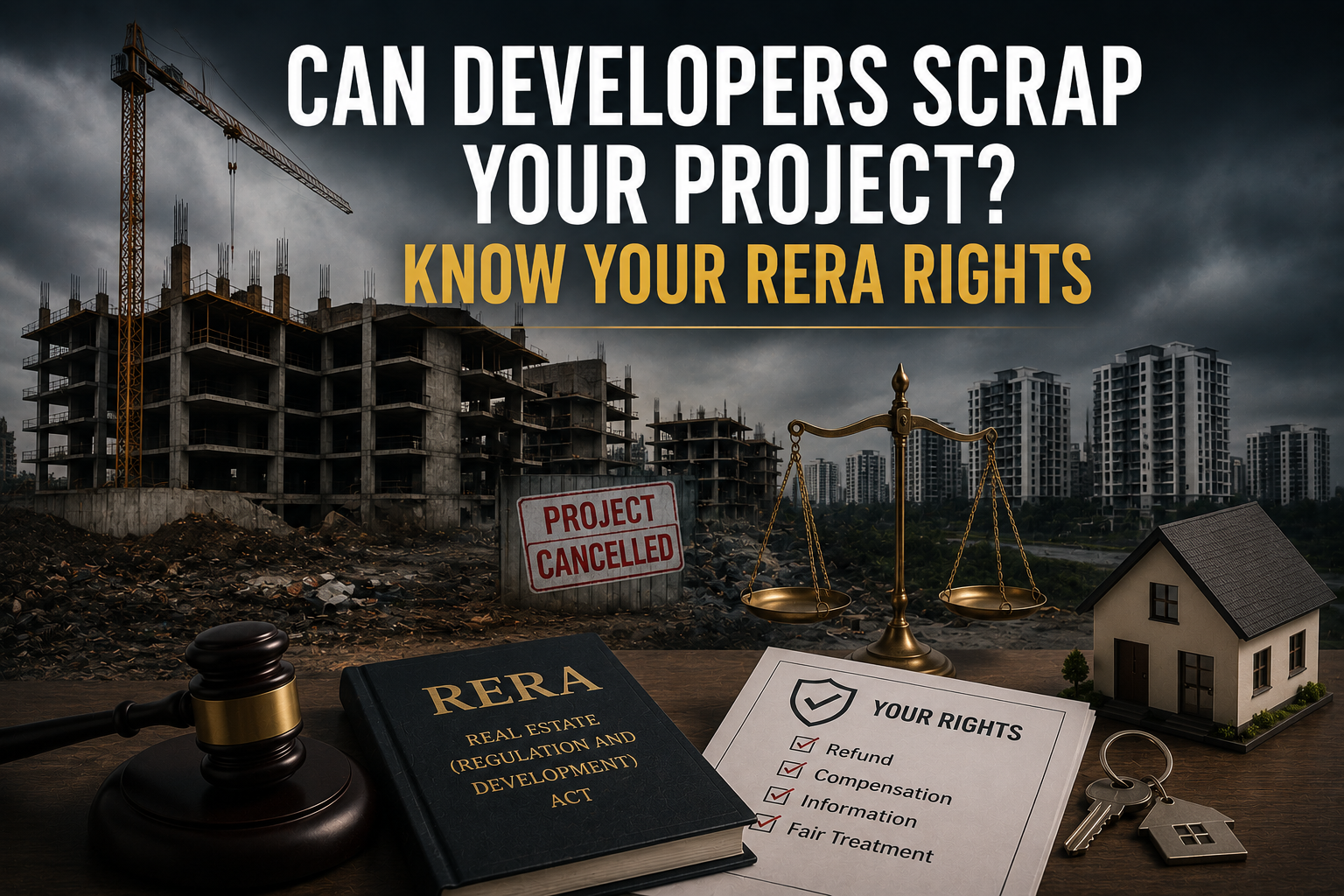
For a homebuyer, few things are as distressing as the news that the residential project they invested in is being "scrapped." For years, the real estate sector was plagued by "lapsed" projects that sat in a bureaucratic limbo, leaving investors and homebuyers with locked capital and no hope for possession. However, with the maturation of the Real Estate (Regulation and Development) Act (RERA) and specific regulatory clarifications from authorities like MahaRERA, the process of handling stalled, unviable, or abandoned projects has become significantly more structured.
The question of whether a developer can simply "scrap" a project and walk away due to financial difficulties is a complex one. The short answer is no—they cannot simply abandon it. However, they can seek deregistration under specific, rigorous conditions designed to protect the interests of those who have already invested. Understanding this process is vital for any homebuyer who suspects their project might be in financial jeopardy.
Deregistration is the formal process by which a real estate project is removed from the regulatory authority’s records. Historically, developers were often stuck with projects they couldn't complete due to litigation, loss of funding, or shifts in market viability. These projects remained on the RERA website, labeled as "lapsed," which often caused developers to be unfairly branded as "blacklisted," even when they had no intention of defrauding anyone.
MahaRERA recognized that maintaining registration numbers for projects that are effectively dead serves no purpose and actually complicates the market. Consequently, they introduced guidelines allowing for deregistration, but with one absolute, non-negotiable condition: the rights of the homebuyers must be protected first.
A developer cannot unilaterally scrap a project. If they wish to deregister, they must prove to the authority that the project has "zero allottees." This means that every single person who booked a unit must have either received a full refund or executed a registered Deed of Cancellation, effectively nullifying their claim on the property.
The power of RERA lies in its ability to transform a "builder-developer" relationship into a regulated contract. When a developer faces financial distress and seeks to deregister a project, the following safeguards are triggered to ensure homebuyers are not left empty-handed:
Before MahaRERA even considers a deregistration request, the promoter must submit proof that all financial obligations to allottees have been settled. This involves either returning the booking amount with interest or providing compensation as per the terms of the Agreement for Sale. If there are still active buyers, the developer cannot simply deregister the project.
The authority requires more than just verbal assurances. Developers must provide registered Deeds of Cancellation for all units that were sold. This legal document is critical; it proves that the contractual agreement between the buyer and the seller has been formally and legally ended, with both parties agreeing to the terms of the exit.
MahaRERA does not process deregistration requests in a vacuum. Once an application is filed, the authority often issues public notices, inviting objections from any interested parties. This is a crucial window for any homebuyer who feels that their claims have not been fully settled or that the developer is misrepresenting the situation. If even one allottee comes forward with a legitimate objection, the deregistration request can be put on hold or rejected until the matter is resolved.
Financial distress is a reality in the volatile real estate market. Projects may become unviable due to a variety of factors—cost overruns, sudden changes in local planning regulations, family disputes among promoters, or the drying up of credit lines from banks.
When a developer realizes a project cannot be completed, they have two paths. The first is to find a new developer to take over the project. This is often the preferred route for homebuyers, as it ensures the construction eventually reaches completion. The second path is deregistration, which is only an option if the developer can clear all financial liabilities toward their buyers.
If you are a buyer in a project that the developer wants to scrap, you are in a position of strength. You are not a victim of the developer’s financial failure; you are a creditor with legal standing.
If you receive notice that your developer intends to scrap a project or seek deregistration, you must act immediately to protect your investment.
Start by gathering all documents related to your purchase: the booking application, the allotment letter, the Agreement for Sale, all receipts of payment, and any email correspondence. In any dispute, the party with the most organized paperwork often holds the upper hand.
Never sign an informal "cancellation" note that doesn't explicitly state the amount to be refunded and the timeline for payment. Insist on a formal Deed of Cancellation that outlines the exact financial settlement. If you have any doubt, do not sign. You have the right to seek legal advice before finalizing your exit from a project.
The MahaRERA portal is a goldmine of information. Check the status of your project frequently. If a developer has filed for deregistration, it will often be reflected in the project status. If you see a notification, you have a right to object if your claims have not been settled.
There is strength in numbers. If a project is stalling, it is likely affecting dozens or hundreds of other buyers. Forming an association of allottees allows you to negotiate collectively with the developer. An organized group can pressure the developer to either complete the project, bring in a new partner, or ensure that refund settlements are prioritized.
Sometimes, the financial distress is so severe that the developer faces insolvency proceedings under the Insolvency and Bankruptcy Code (IBC). In such cases, the RERA framework acts as a foundation, but the National Company Law Tribunal (NCLT) becomes the primary arena.
If a developer goes bankrupt, homebuyers are treated as "financial creditors." This is a significant legal advancement. It means that you have a seat at the table in the Committee of Creditors (CoC). You can vote on resolution plans, which could include proposals for a new developer to take over the project and finish the construction. While insolvency is a long and arduous process, it is far superior to being left in the dark by a developer who has simply disappeared.
It is important to understand that MahaRERA’s primary mandate is to protect homebuyers. They are not merely an administrative body; they are an adjudicatory one. When a deregistration request is filed, the authority scrutinizes it to ensure that it is not a mechanism for the developer to "run away" from their obligations.
If a developer claims financial difficulty, MahaRERA will examine the project's bank accounts, which under RERA regulations, must be maintained in a dedicated escrow account. The authority will ensure that the funds collected for that specific project were used for that project, rather than being diverted elsewhere. If there is evidence of financial mismanagement or fraud, the developer’s deregistration request will not only be denied, but the developer may also face severe penalties, including blacklisting, freezing of personal assets, and criminal proceedings.
One of the most common mistakes homebuyers make when a project faces financial trouble is adopting a "wait and see" approach. They assume that if they don't complain, the developer will eventually find a way to finish the project.
However, in real estate, time is the enemy of value. The longer a project stays stalled, the more the structure deteriorates, the more the interest on your loans compounds, and the more likely it is that the developer will lose total control of their assets to lenders or other creditors. If you suspect your developer is in financial distress, you must be proactive. Contact the developer, demand a site update, and if the timeline continues to slip, consult with a legal professional regarding your rights to terminate the agreement and seek a refund.
The ability to deregister unviable projects is a sign of a maturing real estate market. It allows for the "cleansing" of the sector, where dead projects are removed and the land can be repurposed for viable developments. However, this process must never come at the cost of the homebuyer.
As a consumer, you have the right to a home that is delivered according to the agreed-upon specifications and timeline. If the developer cannot fulfill this, the law guarantees you the right to your money back, with interest. The regulatory framework is now robust enough to ensure that developers cannot simply walk away from their responsibilities.
The news that a developer is scrapping a project is undoubtedly a shock. It disrupts plans, investments, and peace of mind. But remember, the era where developers could abandon projects with impunity is over.
Today, whether a project is finished, taken over by a new promoter, or deregistered, the legal framework is tilted toward the protection of the homebuyer. By staying informed, keeping your documents ready, and proactively engaging with the regulatory mechanisms provided by MahaRERA, you can ensure that your financial interests are protected.
The process of deregistration, while technically an administrative cleanup, is essentially a safeguard. It ensures that if a project must end, it does so cleanly, with all accounts settled and all buyers compensated. Your investment is your hard-earned money—treat it with the diligence and care that the legal system now demands of both you and your developer. If your project is facing trouble, do not wait—engage with your rights, consult the RERA portal, and take control of your property journey.
