Published On:
February 5, 2026
Updated On:
February 5, 2026
Budget 2026-27 signals a decisive shift in India’s real estate narrative, moving the spotlight from saturated metros to emerging Tier-2 and Tier-3 "City Economic Regions." With a massive ₹12.2 lakh crore capital expenditure and dedicated funds for growth clusters, the government has effectively drawn a new roadmap for property investors looking for high-yield opportunities in the coming decade.
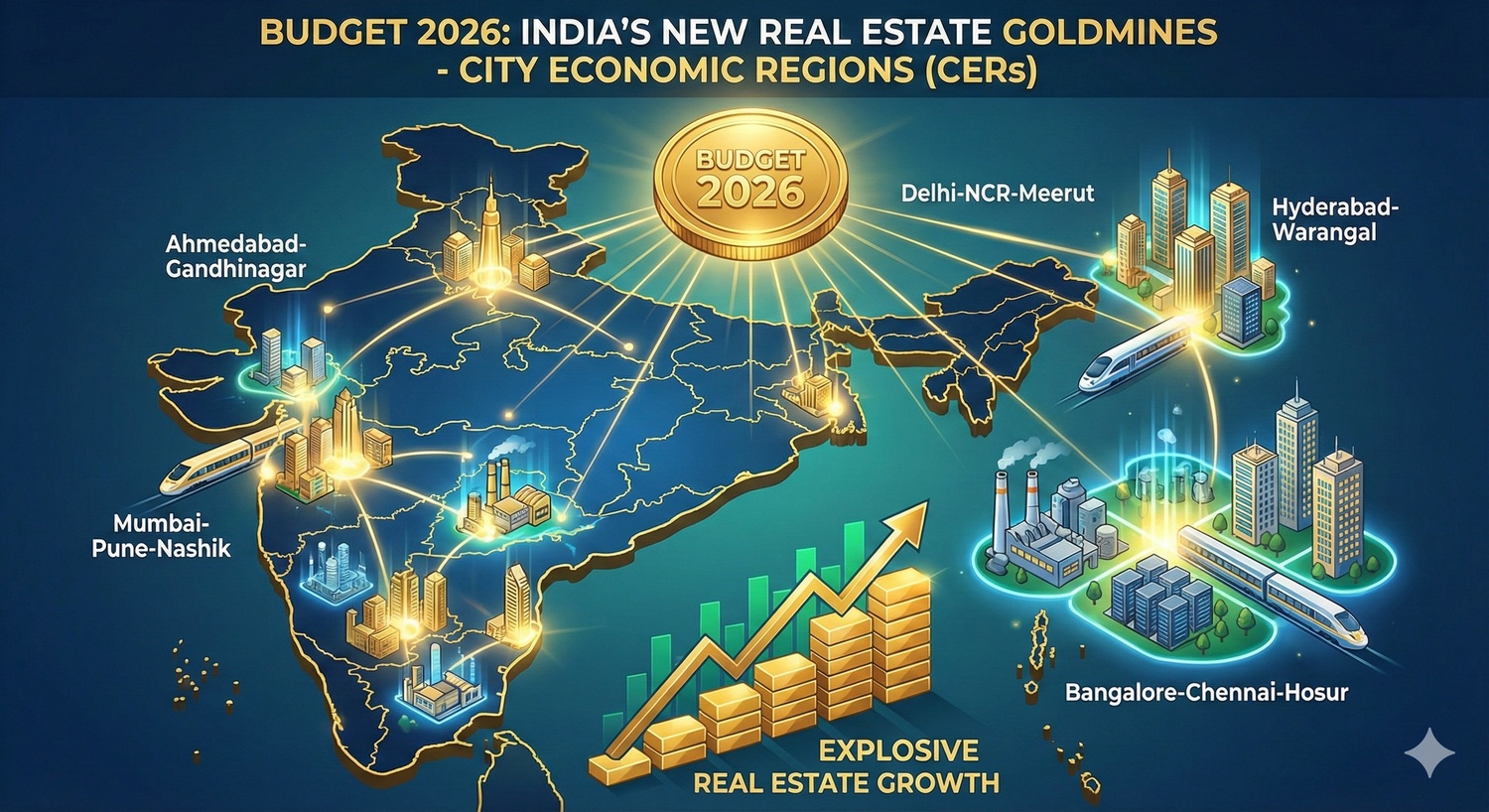
For the longest time, "real estate investment" in India was synonymous with just six or seven pin codes. If you weren’t buying in Mumbai, Delhi-NCR, or Bengaluru, you weren’t really in the game. But the Union Budget 2026-27 has just dismantled that old hierarchy. By shifting the lens from "Smart Cities" to "City Economic Regions" (CERs), the Finance Minister has acknowledged a quiet reality: our metros are saturated, and the real economic engine is shifting to the hinterland.
The announcement of a dedicated framework to develop growth clusters in Tier-2 and Tier-3 cities is not just an infrastructure promise; it is a signal to the market. With a historic capital expenditure target of ₹12.2 lakh crore, the government is putting its money where its mouth is, building the roads, rails, and logistics corridors that turn sleepy towns into booming investment hubs.
For the homebuyer and the investor, this changes the strategy. The question is no longer "Which suburb of Mumbai?" but "Which growth cluster in Odisha or Gujarat?" This blog breaks down how the new "Growth Cluster" model works and where the smart money should be heading next.
The centerpiece of this year's urban push is the concept of City Economic Regions (CERs). Unlike previous schemes that looked at cities in isolation, the CER model views them as integrated economic ecosystems—merging the core city with its peri-urban industrial belts and neighboring towns.
The Budget has identified seven initial CERs—including Surat, Visakhapatnam, and the Bhubaneswar-Puri-Cuttack tricity cluster—earmarking a substantial allocation of ₹5,000 crore per region over five years. This is "seed capital" designed to unlock local potential.
For real estate, this is transformative. When the government treats a region like Coimbatore-Erode-Tiruppur as a single textile and manufacturing entity, it creates a unified property market. We can expect a surge in demand for integrated townships and grade-A commercial spaces in these belts. The logic is simple: where the jobs go, the housing demand follows. These funds are linked to a "challenge mode," meaning cities have to compete and show results, ensuring that the infrastructure—roads, water, waste management—is actually built, raising the livability index and property values simultaneously.
Connectivity is the mother of real estate appreciation. The Budget 2026 announcement of seven new High-Speed Rail (HSR) corridors acts as the arteries for these new growth clusters.
Routes like Mumbai-Pune, Hyderabad-Bengaluru, and Delhi-Varanasi are being dubbed "Growth Connectors." The impact on real estate here will be identical to what the RRTS did for Meerut or what the Expressway did for Pune. These corridors effectively expand the "commuter zone." A professional can now realistically live in a spacious home in a Tier-2 node and commute to a metro hub in under two hours.
This creates a new asset class: Transit-Oriented Development (TOD) in smaller towns. Areas surrounding the proposed stations on these high-speed routes will likely see a sharp spike in land rates. We are already seeing early movers scouting for land parcels in places like Solapur or Tumakuru, banking on this enhanced connectivity to bridge the price gap with the metros.
One of the most specific and intriguing focuses of this budget is on Temple Towns. The government has explicitly included heritage and spiritual centers in its urban development ambit.
This is not just about tourism; it is about creating a "pilgrimage economy." Towns like Varanasi, Puri, and Ayodhya are evolving into self-sustaining economic zones. The demand here is twofold:
With improved infrastructure funding, these towns are shedding their image of "chaos and congestion" and becoming viable real estate markets with organized housing complexes and retail high streets.
While housing gets the headlines, the real workhorse of this budget is the Industrial Cluster Revival Scheme. The plan to revitalize 200 legacy industrial clusters is a direct boost to the warehousing and logistics sector.
Real estate in cities like Ludhiana, Jalandhar, or Aurangabad will benefit immensely. As these old industrial zones get a tech and infrastructure upgrade, the demand for "industrial housing"—dormitories, affordable housing for workers, and mid-segment apartments for managers—will rise. For investors, industrial land and warehousing assets in these Tier-2 hubs offer rental yields that residential properties in metros simply cannot match (often 8-9% vs 2-3%).
Historically, the biggest fear for private developers entering smaller cities was risk—funding risk, execution risk, and market depth risk. Budget 2026 addresses this head-on with the Infrastructure Risk Guarantee Fund.
By providing a credit guarantee to lenders during the construction phase, the government has effectively lowered the barrier to entry for big developers. This means we will likely see branded, national developers launching projects in cities like Indore or Nagpur, bringing "metro-class" construction quality and amenities to these markets.
Furthermore, the proposal to monetize public land through CPSE REITs (Real Estate Investment Trusts) will unlock prime land parcels in the heart of these cities. This could lead to the development of modern commercial complexes in city centers that were previously occupied by defunct PSU units, revitalizing the Central Business Districts (CBDs) of Tier-2 India.
The Budget 2026 is a clear declaration that the era of "Metro-Centricity" is ending. The saturation of land in Mumbai or Delhi, combined with skyrocketing entry prices, has made the ROI game difficult for the average investor.
In contrast, the City Economic Regions offer a ground-floor opportunity. The infrastructure is funded, the policy is clear, and the entry prices are still rational. Whether it is a plot in the logistics corridor of Visakhapatnam or a flat in the tech-belt of Coimbatore, the next decade of real estate wealth will likely be created in the "shadow cities" that this budget has just brought into the light.
