Published On:
February 3, 2026
Updated On:
February 3, 2026
Budget 2026-27 marks a decisive shift from metro-centric growth to a broader urban horizon, with ₹5,000 crore allocated per City Economic Region to unlock potential in Tier-2 and Tier-3 cities. This infrastructure-first approach, coupled with high-speed rail corridors, is set to ignite a real estate boom in India’s emerging heartlands.
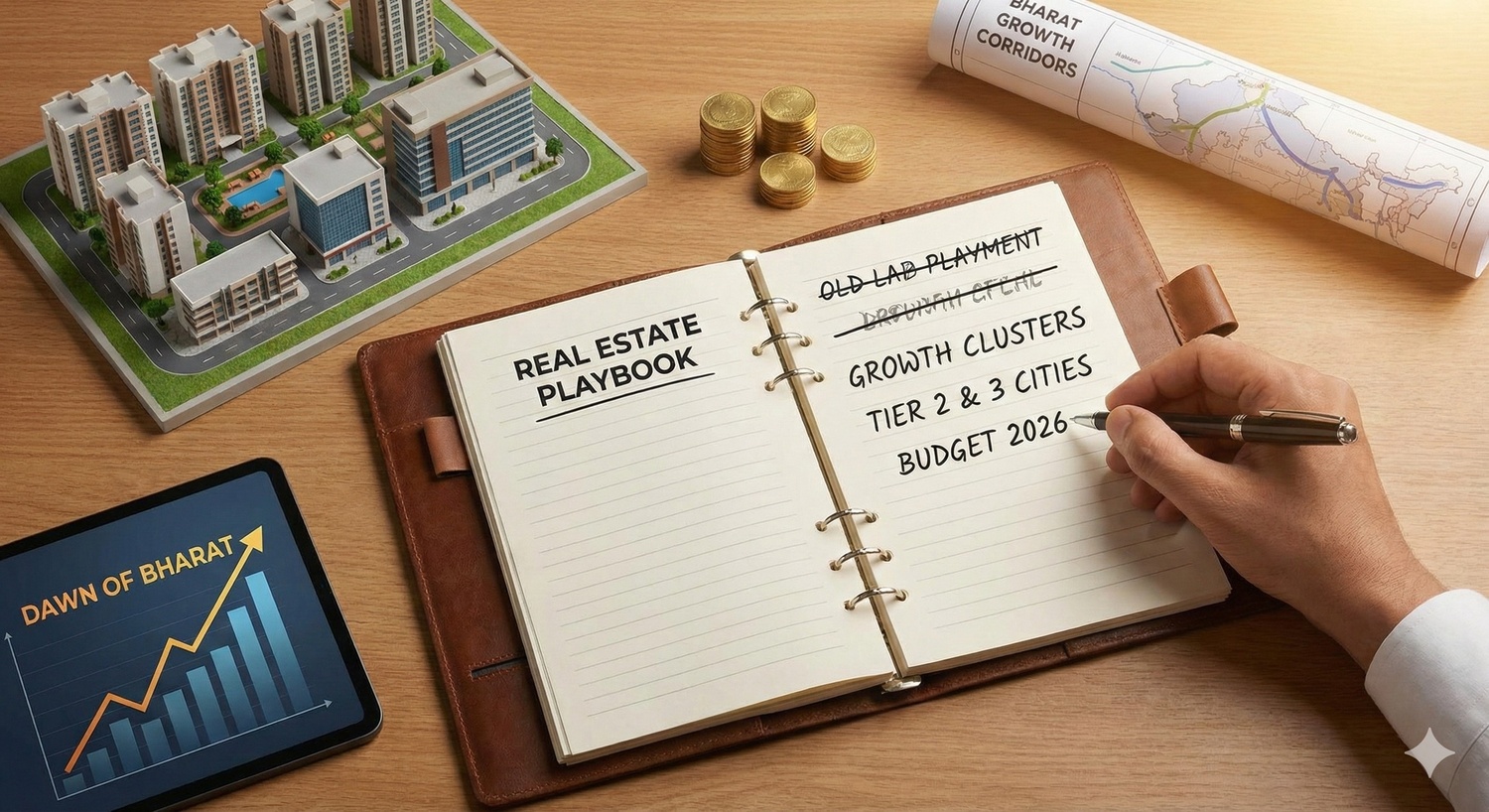
For decades, the story of Indian real estate has been a tale of eight cities. If you weren't building in Mumbai, Delhi-NCR, or Bengaluru, you were effectively on the sidelines. However, the Union Budget 2026-27 has flipped this script. By pivoting the spotlight toward City Economic Regions (CERs) and "growth clusters," the government has signaled that the next phase of urbanization will not happen in the saturated megacities, but in the aspirational districts of "Bharat."
This year's budget isn't just about fiscal allocations; it’s a structural blueprint. With a record capital expenditure of ₹12.2 lakh crore, the focus is firmly on connecting the dots—literally and economically—between India's smaller urban centers. For investors and homebuyers, this signals a massive opportunity to enter markets that are on the brink of an infrastructure-led transformation.
The centerpiece of this urban shift is the introduction of the City Economic Regions framework. Moving away from a one-size-fits-all model, the government has proposed a ₹5,000 crore allocation per CER over five years. This is not a handout; it is a "challenge mode" fund where cities must compete based on reforms and results to access capital.
Seven specific regions have been identified to kickstart this initiative, including Surat, Varanasi, Visakhapatnam, Pune, Bengaluru, and the tri-city clusters of Bhubaneswar-Puri-Cuttack and Coimbatore-Erode-Tiruppur.
By treating these cities as unified economic zones rather than isolated municipalities, the government is effectively creating new central business districts (CBDs) outside the metros.
Infrastructure is the artery of real estate, and this budget has pumped significant life into it through the announcement of seven high-speed intercity rail corridors. These "Growth Connectors" are designed to link major hubs like Mumbai-Pune, Hyderabad-Bengaluru, and Delhi-Varanasi.
This is a classic case of Transit-Oriented Development (TOD). When commute times shrink, the definition of "prime location" expands. A town that was once considered a distant outpost can now function as a viable satellite suburb.
While housing grabs the headlines, the real sleeping giant in this budget is the logistics sector. The announcement of the Dankuni-Surat Dedicated Freight Corridor and the operationalization of 20 new National Waterways is set to revolutionize how goods move across India.
Tier-2 and Tier-3 cities are often the production centers of the country, but they have historically suffered from poor connectivity. With these new freight corridors, cities like Surat (textiles/diamonds) and Coimbatore (manufacturing) will see their logistics costs plummet.
A unique facet of Budget 2026 is its explicit focus on temple towns and cultural heritage sites. The mention of developing cities like Varanasi and the Bhubaneswar-Puri belt as world-class destinations is a boon for the hospitality and retail real estate segments.
Religious tourism is one of India's most resilient economic drivers. By upgrading the civic infrastructure in these towns, the government is paving the way for branded hotels, convention centers, and organized retail to enter markets that were previously dominated by unorganized players. For real estate developers, this opens up a lucrative niche in vacation rentals, second homes, and commercial complexes catering to millions of annual pilgrims.
On the financial side, the budget has placed a strong emphasis on monetizing the assets of Central Public Sector Enterprises (CPSEs) through Real Estate Investment Trusts (REITs). This creates a mechanism to unlock the value of huge land parcels and completed assets held by PSUs in prime locations across various cities.
This move is expected to deepen the Indian REIT market, offering retail investors a chance to own a slice of high-quality commercial real estate. It also frees up capital for the government to reinvest in infrastructure, creating a virtuous cycle of development.
If there is one area where the industry felt a pang of disappointment, it was the lack of direct tax incentives for affordable housing. While PMAY-Urban 2.0 received an additional ₹3,000 crore, developers were hoping for wider tax breaks to offset rising construction costs.
However, viewing this in isolation would be a mistake. The history of real estate shows that infrastructure is the most potent driver of affordability. By opening up new lands through better connectivity and creating jobs in Tier-2 cities where land costs are lower, the budget effectively creates a sustainable environment for affordable housing to flourish naturally, rather than relying solely on subsidies.
Budget 2026-27 is a forward-looking document that bets big on the urbanization of "Bharat." It acknowledges that for India to grow, its development cannot be hoarded by a handful of metros. By empowering Tier-2 and Tier-3 cities with funds, connectivity, and a strategic vision, the government has laid the foundation for a more balanced and robust real estate market.
For the savvy investor, the message is clear: look beyond the established pincodes. The next decade of growth belongs to the growth clusters, the connector towns, and the emerging economic regions that are just waking up to their potential.
