Published On:
February 5, 2026
Updated On:
February 5, 2026
The Union Budget 2026 has unveiled seven transformative high-speed rail corridors, aiming to condense travel times between India's major economic hubs like Mumbai, Pune, Hyderabad, and Bengaluru. This infrastructure push is set to redefine the real estate landscape, turning peripheral towns into prime investment hotspots and creating new "megaregions" across the country.
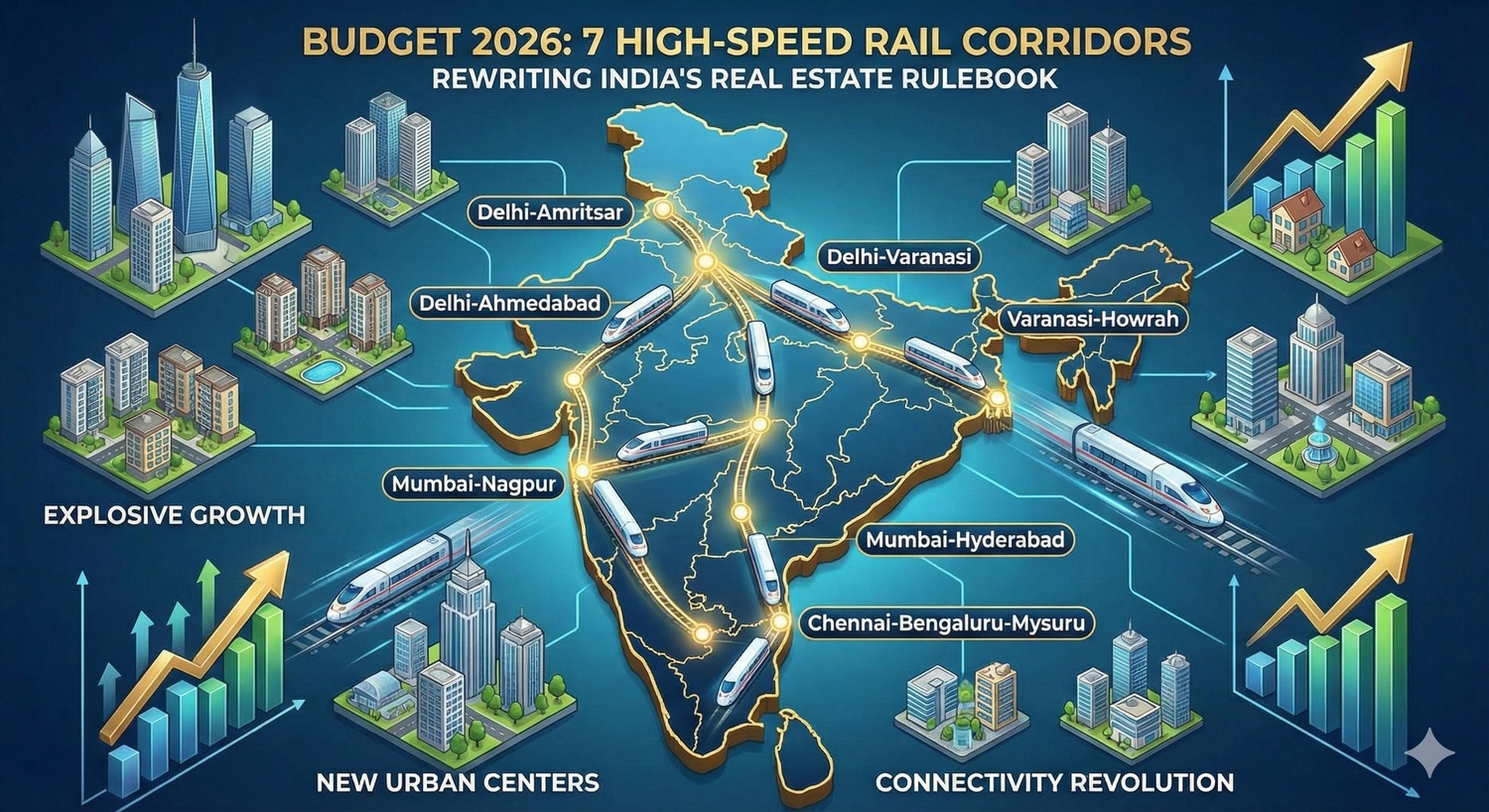
For decades, the golden rule of real estate investment has been "Location, Location, Location." However, the Union Budget 2026-27 has effectively updated this mantra to "Connectivity, Connectivity, Connectivity."
In a move that promises to be the most significant infrastructure intervention since the Golden Quadrilateral, Finance Minister Nirmala Sitharaman has announced the development of seven new High-Speed Rail (HSR) corridors. These are not just transport projects; they are economic arteries designed to compress geography. By slashing travel times between India's largest metros to under two hours, the government is effectively merging distinct property markets into unified "megaregions."
For the real estate investor, this is a signal to stop looking at city centers and start looking at the tracks. The definition of a "commutable distance" is about to expand from 20 kilometers to 200 kilometers. This blog decodes the seven announced corridors and analyzes where the next big property boom is likely to land.
The Budget has outlined seven specific routes that span approximately 4,000 kilometers with a massive investment outlay. These corridors are strategically chosen to link India’s manufacturing, tech, and cultural hubs.
Already connected by an expressway, the HSR link will reduce the travel time between these two giants to roughly 45-50 minutes.
Linking the manufacturing hub of Western India with the pharma and tech capital of the South.
Connecting India’s two primary IT capitals is a game-changer. With travel time dropping to approximately 2 hours, talent mobility will skyrocket.
This route connects a landlocked tech hub with a major port city.
Already an industrial powerhouse route, the HSR will supercharge the existing ecosystem.
This route is unique as it blends tourism with commerce, drastically cutting travel time to the heart of Uttar Pradesh.
Perhaps the most strategic route, connecting the Hindi heartland to the gateway of the Northeast via Patna.
The announcement of these corridors triggers three specific shifts in the property market behavior for 2026 and beyond.
With travel times shrinking, the concept of the "satellite town" is evolving. A professional can now live in a spacious villa in a town 150 km away and reach their office in the city center faster than someone driving from a suburb 20 km away in peak traffic. This will drive a premium for luxury township projects in Tier-2 cities along these HSR routes.
Corporates are always looking to cut costs. With HSR connectivity, we will see the "Hub and Spoke" model mature. A company can keep its HQ in Bengaluru but move its back-office operations to a cheaper location like Tumakuru or Hosur, knowing that teams can meet in person within an hour. This will lead to a commercial real estate boom in intermediate stations.
Historically, metro cities offered low rental yields (2-3%) but high capital appreciation. Tier-2 cities offered the reverse. HSR corridors will likely balance this scale. As demand shifts to these connected towns, rental yields in places like Solapur or Hosur could spike as the working population migrates there for a better quality of life.
For investors, the window of opportunity has just opened. Infrastructure projects usually see price appreciation in three phases: Announcement, Groundbreaking, and Completion. We are currently at the Announcement Phase.
While the vision is grand, investors must remain pragmatic. Land acquisition remains the biggest hurdle for linear infrastructure in India. Projects can face delays. Therefore, one should have an investment horizon of 7-10 years for these corridors. Do not invest funds you need in the short term, as infrastructure-led appreciation is a marathon, not a sprint.
The Union Budget 2026 has laid the tracks for a more decentralized and connected India. By actively linking the country's economic engines, the government is ensuring that the real estate growth story is no longer confined to a few saturated city centers.
For the homebuyer, this means more choices and better lifestyle options. For the investor, it means a brand new map of opportunities. The train has effectively left the station; the question is, are you on board?
